Paper 3 question on economic growth, investment, the multiplier, and exchange rates
IB Economics Paper 3 includes two compulsory questions. This is a sample Paper 3 question. Paper 3 allows 105 minutes, so students should spend 52.5 minutes on each question.
This Paper 3-style question covers economic growth, investment, the multiplier, and exchange rates.
India's sustainable economic growth path
One of the Indian government's key economic objectives is to promote sustainable economic growth. Part of this objective is to invest in growing markets such as artificial intelligence and renewable energy. The Indian economy faces current ‘headwinds’ because of the uncertain geopolitical environment, which adversely affects business and consumer confidence.
Renewable energy investment in India
The Bhadla Solar Park is India’s largest solar power plant and the world's 11th-largest solar plant. It covers 56 square kilometres (approximately 8,000 football pitches) of the Rajasthan desert. The solar park has a capacity of 2,245 megawatts, which would power around 2 million homes. The Bhadla Solar Park was a $2.2 billion investment funded by the Indian government, private investment and an international development fund. Chinese manufacturers supplied many of the solar panels and batteries.
Indian households
Estimates for the Indian economy say that for every $1,000 increase in household income, consumption increases by $400, savings by $100, tax by $300 and imports by $200
The Indian rupee
The Indian rupee depreciated significantly in the first 6 months of the year. High oil prices increased the volume of Indian imports, putting significant downward pressure on the rupee. The rupee has also been affected by higher interest rates in many countries, particularly the US, which has led to portfolio investment outflows from the Indian economy.
Questions
a. (i) Outline why the Bhadla Solar Park is an example of investment. [2]
(ii) Calculate the marginal propensity to consume, marginal propensity to save, marginal propensity to tax, marginal propensity to import. [2]
- MPC: $400 / $1000 = 0.4
- MPS: $100 / $1000 = 0.1
- MPT: $300 / $1000 = 0.3
- MPM: $200 / $1000 = 0.2
(iii) Explain how the Bhadla Solar Park $2.2 billion investment might lead to a multiplier effect. [4]
(iv) Calculate the value of the multiplier in India. [2]
(v) Calculate the change in Indian GDP the Bhadla Solar Park investment might lead to. [2]
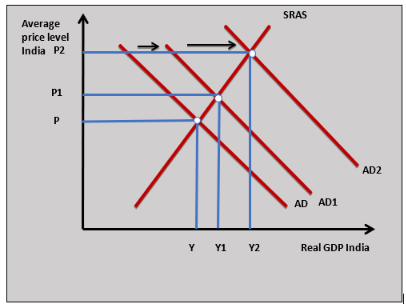
(vi) Using an aggregate demand and supply diagram, show the effect of the multiplier caused by the Bhadla Solar Park. [2]
The current exchange rate between the Indian rupee and the Chinese yuan is 14 rupees to the yuan. The cost of a solar panel imported from China 410 yuan per solar panel. Bhadla Solar Park uses 10 million panels.
(vii) Calculate the total cost of solar panels used by Bhadla Solar Park in rupees. [2]
(viii) Explain the impact of a depreciation in the Indian rupee against the Chinese yuan would have had on the cost of the Bhadla Solar Park investment project. [4]
b. Using the text/data provided and your knowledge of economics, recommend a policy the Indian government might use to achieve long term economic growth. [10]
- Monetary policy
- Fiscal policy
- Market-based supply-side policy
- Interventionist supply-side policy
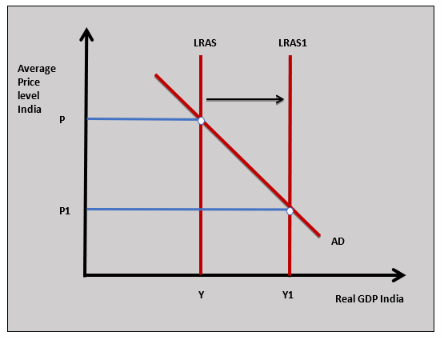
If investment increases, it could increase long-term growth because the Indian economy's capacity would increase through projects such as Bhadla Solar Park. It would also help to stimulate investment in other growing markets [growing markets such as artificial intelligence and renewable energy]. This increase in potential output is shown in the diagram where India's long-run aggregate supply curve shifts outwards from LRAS to LRAS1, increasing GDP from Y to Y1, with the price level decreasing from P to P1.
- Decreasing interest rates and increasing the money supply might stimulate economic growth, but if aggregate demand increases too fast, it could lead to inflation.
- A decrease in India's interest rate could cause a further devaluation of the Indian rupee [Indian rupee depreciated significantly in the first 6 months of the year], which would increase import costs and add to inflation.
- The impact of expansionary monetary policy on economic growth could be constrained by low business and consumer confidence [Geopolitical environment, which adversely affects business and consumer confidence].
Total [30]