Paper 2 question on trade, tariffs, PES and economic well-being
Sample paper 2 question

IB Economics Paper 2 includes two questions, and students need to choose one. This is a sample Paper 2 question. The time allowed for Paper 2 is 105 minutes, so students should spend 105 minutes on this question.
This Paper 2 style question is on tariffs, inflation, PES and economic well-being.
 Questions
 Answers
Is this the start of a trade war?
President Trump announced a blanket 25% tariff on imported steel and aluminium from all countries. The tariffs will come into effect in March 2025. The US is the world’s biggest importer of steel, with Canada, Brazil and Mexico as the leading countries that import steel and aluminium into the US. President Trump announced the policy: "This is a big deal, the beginning of making America rich again,". [Paragraph 1]
Tariffs on steel and aluminium are a key part of Trump’s economic plan to increase the country's manufacturing base. They are an essential input in the production of cars, consumer electronics, construction, and packaging. It is hoped that tariffs on steel and aluminium will give US steel producers an important cost advantage in supplying these markets. With these cost advantages, US steel and aluminium producers will be able to increase their scale of production. Businesses that supply the steel and aluminium sector are also likely to benefit from the growth it experiences because of tariffs. It is forecast that the US tariffs on steel and aluminium could raise around $70 billion in revenue, which could be used to ease the US's budgetary situation. [Paragraph 2]
Trump’s aluminium and steel tariffs have a significant political aspect. His MAGA policies are often framed to appeal to middle-class Americans who work in manufacturing and feel tariffs are protecting their jobs. [Paragraph 3]
Some commentators have argued that Trump’s use of tariffs is a political tool to give the US government leverage with the governments of other countries to do what Trump's administration wants. For example, tariffs imposed on Mexico and Canada have been used to get the governments of these countries to reduce the flow of migrants and illegal drugs into the US. [Paragraph 4]
Tariffs on aluminium and steel may significantly affect US businesses and consumers. Firms that import steel and aluminium to use in production will face higher costs, which may filter through to consumers in the form of higher prices. The tariffs could increase US inflation. There could also be an efficiency loss as US steel and aluminium producers enter the market because of the tariffs, which are not efficient enough to compete under normal market conditions. Less efficient US steel producers replace more efficient Canadian and Mexican steel producers. [Paragraph 5]
There are concerns that US tariffs on steel and aluminium could adversely affect the US economy in the long run. The tariffs could increase the cost of infrastructure projects, reducing investment in areas important for increasing the country's potential output. The US government's aggressive protectionist policies might also make the US a less attractive place for investors. [Paragraph 6]
The implications of the US steel and aluminium tariffs will not end in the US. Other countries will retaliate with their own tariffs against the US. The Chinese government has decided to impose 15% tariffs on US liquified natural gas and coal and a 10% tariff on crude oil, agriculture equipment, and cars. [Paragraph 7]
We could be heading into a world of protectionism, which runs counter to the benefits of free trade most economists believe in. It will be interesting to see what happens to different economies in the world due to Donald Trump’s introduction of trade barriers. [Paragraph 8]
Table 1
| Price of steel (US$) | US quantity demand steel (metric tonnes millions) | US quantity supplied steel (metric tonnes millions) |
| 780 | 42.4 | 17.9 |
| 760 | 45.3 | 17.3 |
| 740 | 49.3 | 16.9 |
| 720 | 52.7 | 15.6 |
| 700 | 55.7 | 14.3 |
*World price of steel $720 per metric tonne.
Questions
a. (i) Define the term tariff. [2] [Paragraph 1]
A tariff is when an indirect tax imposed by a government on imported goods.
(ii) Define the term potential output. [2] [Paragraph 6]
Potential output is the highest level of production an economy can produce with its available resources.
b. Using the data in Table 1, calculate:
(i) The price elasticity of the supply of US steel when the price of steel increases from $720 to $740 per metric tonne. [2]
[16.9 - 15.6 / 15.6 x 100] / [$740 - $720 / $720 x 100] = 8.33% / 2.78% = 3.00
(ii) The quantity of steel imported at the world price. [1]
52.7m metric tonnes - 15.6m metric tonnes = 37.1m metric tonnes
c. Explain two factors that determine the price elasticity of steel supply. [4] [Table 1]
- The time period over which a change in price causes a change in quantity supplied will affect the price elasticity of supply for steel. The longer the time period, the more price elastic the supply of steel will be because producers have more time to change output in response to a change in price.
- Suppose steel producers have a significant spare production capacity. In that case, the price-elasticity of supply is likely to be price-elastic because producers can increase output more easily if the price of steel increases.
d. Using a trade diagram, explain the impact US tariffs on steel will have on the producer surplus of US steel producers. [4] [Paragraph 1]
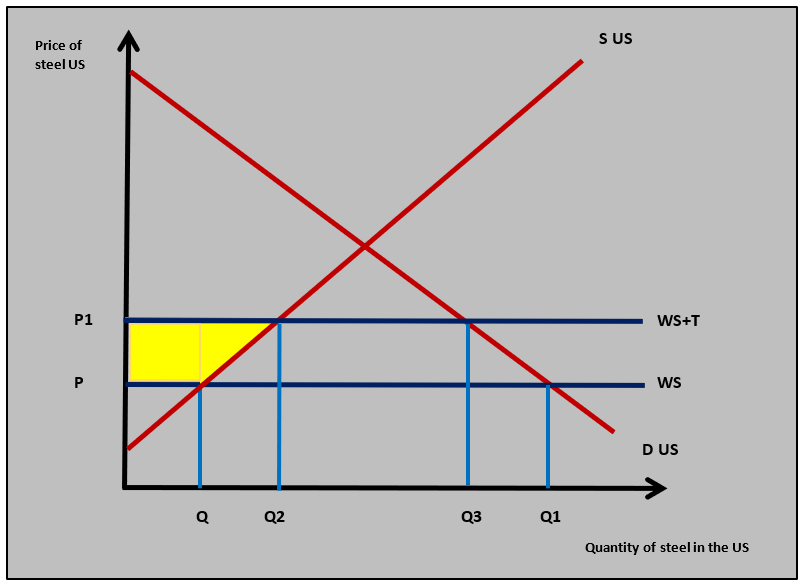
When a tariff is placed on imported steel into the US, the world price increases from P to P1 as the world supply decreases from WS to WS + tariff in the diagram. US producers experience an increase in their producer surplus, which is shown by the shaded area in the diagram.
e. Using an AD/AS diagram, illustrate the impact US tariffs on steel on a wide variety of goods will have on US inflation. [4] [Paragraph 5]
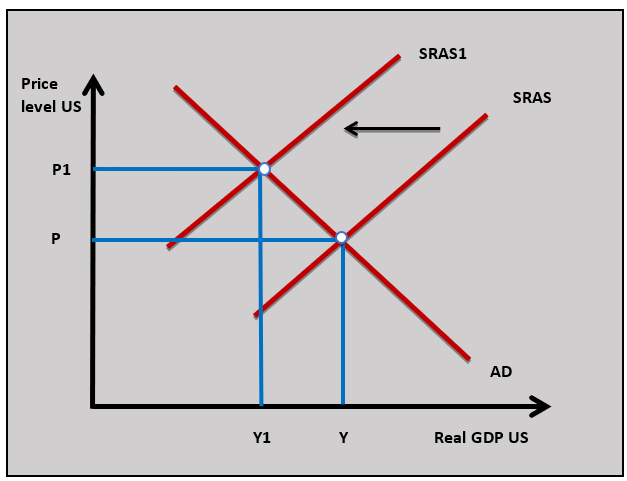
A tariff on a wide variety of US goods could lead to cost-push inflation in the US as business costs increase. Retailers may have to pay more for the imported goods they sell, and manufacturers may have to pay more for inputs. As business costs rise in the US, the short-run aggregate supply curve shifts to the left from SRAS to SRAS1 in the diagram, and this leads to a rise in the price level in the US from P to P1, causing inflation to rise in the US.
f. Sketch a demand and supply diagram that shows the effect of a rise in steel and aluminium costs on the price and output in the US car market. [2]
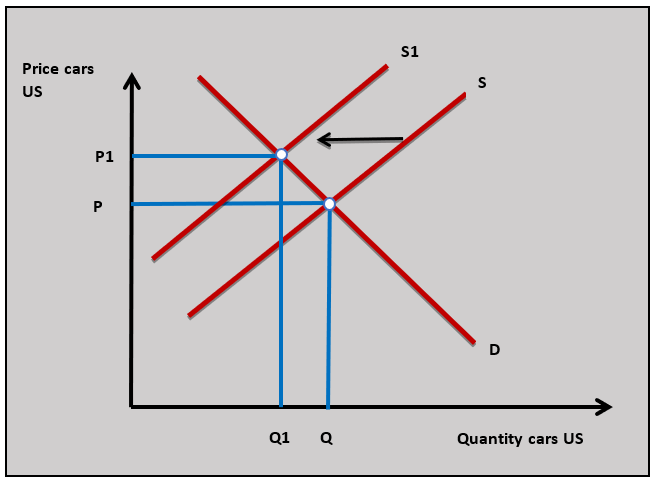
g. Using a PPC diagram, explain how decreasing rates of investment in the US might affect the country's growth in potential output. [4] [Paragraph 6]
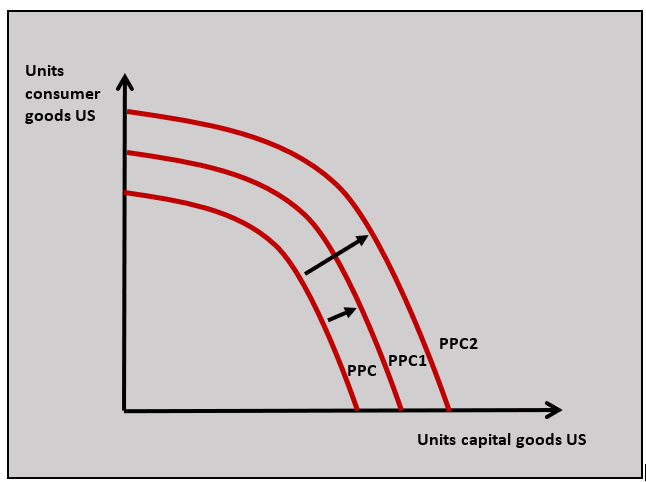
A decrease in the rate of investment in the US could reduce growth in potential output because a lower investment rate means US businesses will not experience the same productivity improvements that would occur if investment rates were increasing. This is shown in the PPC diagram: a decrease in investment rates means the US economy's potential output will increase only to PPC1, whereas an increase in US investment will allow potential output to reach PPC2.
h. Using the text and your knowledge of economics, evaluate the view that the use of trade barriers is an effective way for a government to improve economic well-being. [15]
Trade barriers are the restrictions a government puts on imported goods to reduce the quantity and value of goods imported into the country. In this case, the US government has put tariffs on imported goods into the US. ('A blanket 25% tariff on imported steel and aluminium from all countries.')
Economic well-being is the improvement in the welfare or standard of living of a country's population over time.
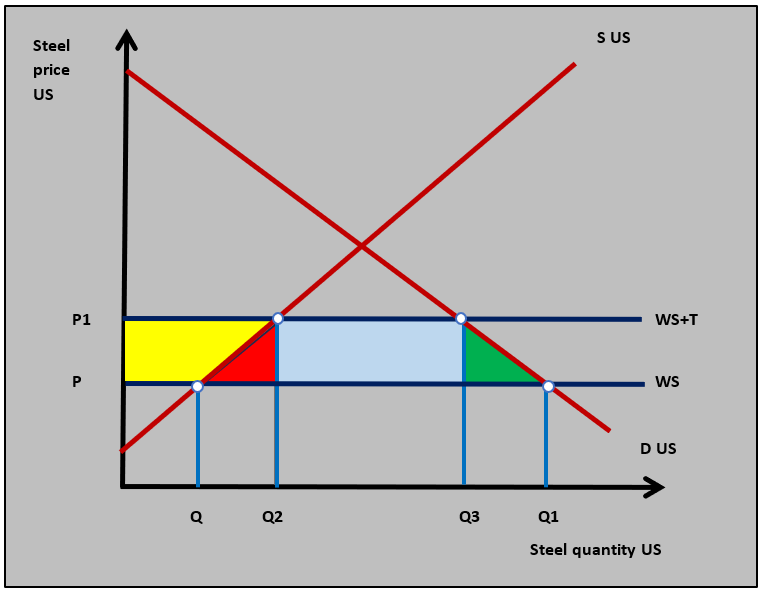
The use of trade barriers by the US would allow its domestic businesses to increase output as the quantity of steel imports is reduced. This is shown in the tariff diagram, where the quantity of steel imports is reduced from Q-Q1 to Q2-Q3. This increase in steel output by domestic US producers from Q to Q2 would increase the US producer surplus (yellow shaded area) and the incomes and employment of people who work in the US steel industry which could improve the economic well-being of the country's citizens. ('Tariffs on steel and aluminium are a key part of Trump’s economic plan to increase the country's manufacturing base.')
Trade barriers on steel and aluminium might also benefit linked industries that supply the steel and aluminium industries. This could increase income and employment in these sectors. ('Businesses that supply the steel and aluminium sector are also likely to benefit from the growth it experiences because of tariffs'.)
If trade barriers are replicated across different industries in the US economy, then this would increase incomes and employment more widely in the US economy and lead to an improvement in economic well-being in the US.
The tariffs imposed by the US on imported goods could increase tax revenue (blue shaded area in the diagram) that could be used to improve public services such as health and education. The improvement in public services could help economic well-being in the US. (It is forecast that the US tariffs on steel and aluminium could raise around $70 billion in revenue.)
Evaluation
The use of trade barriers by the US might lead to higher prices and reduced choice for US buyers. The tariffs imposed by the US on steel and aluminium could lead to a decrease in economic well-being through higher prices for industrial buyers and for consumer goods made using steel and aluminium, which reduces their consumer surplus and leads to a welfare loss (green shaded area in the diagram). ('Firms that import steel and aluminium to use in production will face higher costs, which may filter through to consumers at higher prices.')
Trade barriers could also lead to less efficient US producers entering markets (red shaded area in the diagram). Widespread tariffs, for example, could reduce economic efficiency in the US, which leads to higher costs and prices that reduce economic well-being. ('An efficiency loss as US steel and aluminium producers enter the market because of the tariffs.')
The use of trade barriers by the US could lead to retaliation from other countries, which creates reciprocal trade barriers by other countries. This might harm the income and employment prospects of people who work in those industries, which reduces their economic well-being. ('The Chinese government has decided to impose 15% tariffs on US liquified natural gas and coal and a 10% tariff on crude oil, agriculture equipment, and cars.')
Trade barriers might create a more uncertain business environment for investment. A decrease in investment in the US could reduce the US economy's long-term growth prospects. If economic growth is hindered, this could reduce US citizens' income and employment prospects and decrease economic well-being. ('The tariffs could increase the cost of infrastructure projects, reducing investment in areas important for increasing the country's potential output.')
| Marking Criteria for the 15 mark final question | Mark |
There is no answer to the question but some limited:
| 1-3 |
There is a vague answer to the question with limited:
| 4-6 |
There is an answer to the question with satisfactory:
| 7-9 |
There is a clear answer to the question with good:
| 10-12 |
There is clear answer to the question with excellent:
| 13-15 |
Total [40]