Home of real teaching & learning
  • Full support for teachers
  • Focus on critical thinking
  • Engaging classroom activities
  • Integrated student eBook
  • Assessed tasks / qBank
  • Practice exam questions

The InThinking Guarantee: Our sites are written by expert practitioners and not by AI

See our AI policy

Disclaimer: InThinking subject sites are neither endorsed by nor connected with the International Baccalaureate Organisation.

Don't miss out, find out!

FT blog: US economy beats forecasts to grow at 3.4% rate in third quarter

Financial Times article

This blog is based on the article published by the Financial Times on October 29 2026

The link to the article is: 

https://www.ft.com/content/f2de9f3c-3290-4e87-bbc2-55430025f2ab?syn-25a6b1a6=1

This article is part of the Financial Times free schools access programme. Details/registration here.

This Financial Times article reports on 3.4% economic growth in the US in the third quarter of 2026. This is a strong performance for the US economy, and the article highlights investment in artificial intelligence and strong consumer spending as key drivers of this growth. The article also considers the US's growth performance in light of inflationary pressures in the economy.

Questions

a. Describe what has happened to US economic growth in the third quarter of 2026. [2]

The US economic growth rate has increased to 3.4% in the third quarter of 2026, up from 2.5% in the first quarter and 2.1% in the second.

b. Using an aggregate demand and supply diagram, explain the impact that a 3.8% increase in US consumer spending would have on US economic growth. [4]
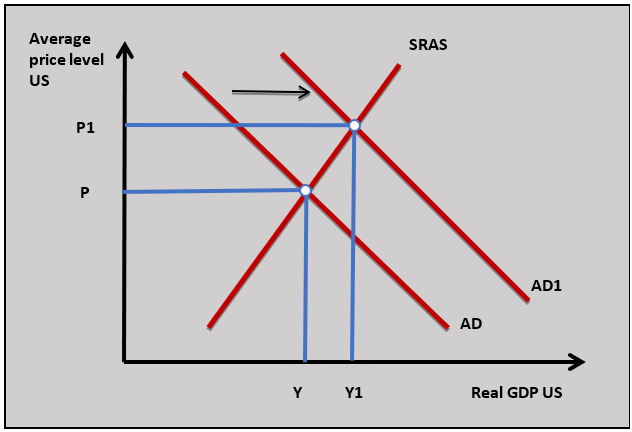
A 3.8% growth in consumer spending would increase the consumption element of aggregate demand. This would increase aggregate demand from AD to AD1, raising real GDP from Y to Y1 and the price level from P to P1, leading to economic growth in the US. 

c.  Outline how business spending on artificial intelligence might have contributed to a 9.4% increase in US investment. [2]

Investment is business spending on capital. When businesses are spending on artificial intelligence this would be capital spending and would be investment. 

d. Using a production possibility diagram, explain how an increase in business spending on AI might affect US potential output. [4]
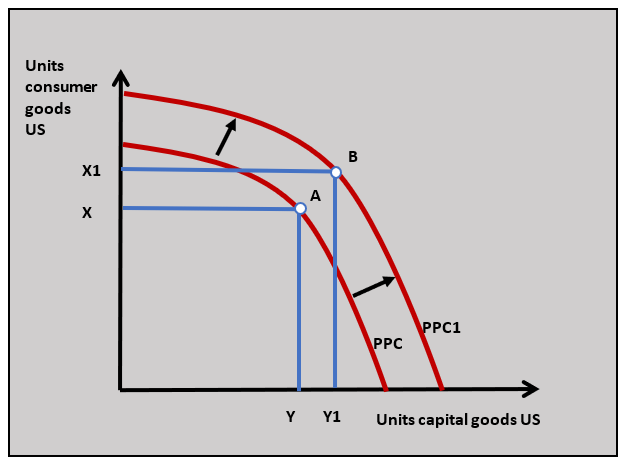
 

Business spending on artificial intelligence could make capital and labour more productive, increasing the potential output of the US economy. This is shown by the US’s production possibility curve increasing from PPC to PPC1. This would increase consumer goods output from X to X1 and capital goods production from Y to Y1. 

e. Using an aggregate demand and supply diagram, explain the impact that a rise in energy costs because of the war in Iran might have on US economic growth. [4]
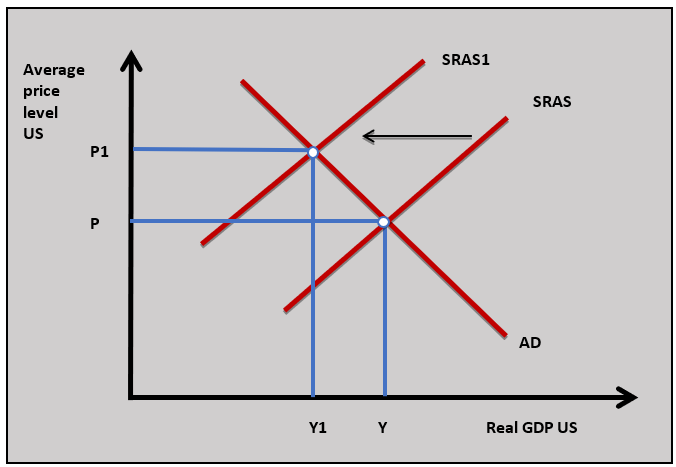
Rising energy costs due to the Iran war would shift the US SRAS curve from SRAS to SRAS1, decreasing real GDP from Y to Y1, increasing the price level from P to P1 and reducing US economic growth. 

Total [16]

All materials on this website are for the exclusive use of teachers and students at subscribing schools for the period of their subscription. Any unauthorised copying or posting of materials on other websites is an infringement of our copyright and could result in your account being blocked and legal action being taken against you.

Help