Paper 3 question on oligopoly, collusion, game theory, and non-price competition

Sample paper 3 question
IB Economics Paper 3 includes two compulsory questions. This is a sample Paper 3 question. The time allowed for Paper 3 is 105 minutes, so students should spend 52.5 minutes on each question.
This Paper 3-style question covers oligopoly, collusion, game theory, and non-price competition.
Oligopoly in the sugar market
A country's sugar market has two main producers: Firm A and Firm B. Firm A is owned by a multinational food manufacturer and manufactures its product from sugar beet. Firm B is owned by an American sugar refining company and dominates cane sugar refining. As an oligopolistic market, some in the industry worry that the two companies are exploiting consumers through pricing and choice. However, sugar prices in the country are below the average price in international markets.
Some economists and consumer groups believe effective regulation in the market is crucial in protecting both domestic consumers and firms that buy sugar as part of their production processes. It is argued that regulation could be difficult to enforce in the sugar market and could push up business costs and reduce the profits needed to fund investment. A possible alternative to regulation is using corporation tax (tax on business profits) on companies that earn profits above a certain level. There are concerns this could reduce investment by profitable businesses.
Questions
a. (i) Outline two characteristics of an oligopolistic market. [2]
- A small number of large firms account for a high proportion of total market revenue.
- Firms make interdependent decisions and react to each other's decisions.
The table shows estimated price and revenue data for an oligopolistic sugar producer.
| Price $ | Quantity ‘000’ | TR ‘000’ | MR | TC | MC | ATC |
| 6.5 | 600 | A | 3,240 | 5.4 | ||
| B | 3.39 | |||||
| 5.5 | 900 | 4,950 | 4,257 | 4.73 | ||
| 1.50 | C | |||||
| 4.5 | 1,200 | 5,400 | 4,707 | D | ||
| -0.50 | 9.81 | |||||
| 3.5 | 1,500 | 5,250 | 7,650 | 5.1 | ||
Using the data in the table, calculate the:
(i) Total revenue A. [1]
(ii) Marginal revenue B. [1]
(iii) Marginal cost C. [1]
(iv) Average cost D. [1]
| Price $ | Quantity ‘000’ | TR ‘000’ | MR | TC | MC | ATC |
| 6.5 | 600 | 3,900 | 3,240 | 5.4 | ||
| 3.50 | 3.39 | |||||
| 5.5 | 900 | 4,950 | 4,257 | 4.73 | ||
| 1.50 | 1.50 | |||||
| 4.5 | 1,200 | 5,400 | 4,707 | 3.92 | ||
| -0.50 | 9.81 | |||||
| 3.5 | 1,500 | 5,250 | 7,650 | 5.1 |
(v) State the profit-maximising output. [1]
(vi) Calculate the profit at the profit-maximising output. [1]
(v) State the type of profit being earned. [1]
(vi) Explain why the oligopolistic sugar producer might be able to maintain the profit they are earning in the long run. [2]
The matrix shows the profit and loss situations of two sugar manufacturers in a non-collusive oligopoly based on the decision to decrease price or keep prices the same.
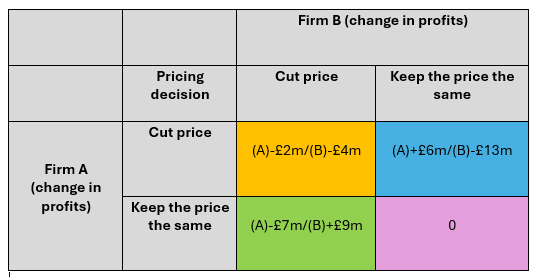
(viii) Using the information in the matrix, explain why Firm A and Firm B might both choose to cut price in this non-collusive market situation. [4]
(ix) Define the term formal collusion. [2]
(x) Based on the pricing matrix, state what would Firm A and Firm B choose to do if they could collude in the sugar market. [1]
(ix) Explain one type of non-price competition that Firm A and Firm B could use to increase their revenues. [2]
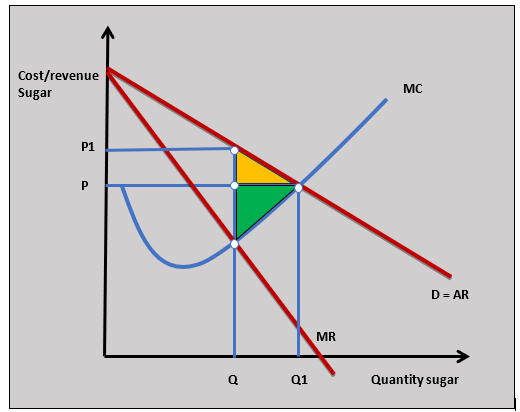
b. Evaluate a policy a government might use to control monopoly power in the sugar market. [10]
- Legislation and regulation
- State ownership and control
- Taxation
- Fines