The Death of the 'Client Interview' (and What Replaces It)
The "Client Interview" is gone. Here is what replaces it.
The "Client Interview" is officially gone. In the new 2027 syllabus, the Internal Assessment no longer requires students to find an external client. Instead, they must identify a problem of their own choosing. This sounds easier, but it removes the external accountability that kept many students on track. The new hurdle? Self-regulation. Here is how we are restructuring our Theme B units to build this skill before the IA even begins.
For years, the Client Interview was the anchor of the IA. It forced students to listen to constraints and requirements that weren't their own. Without it, students face the choice between a Trivial Project, like a simple calculator, and an Impossible Project, such as an overambitious MMORPG with AI, which ends up being too complex to complete.
The new syllabus shifts the burden of scoping entirely onto the student. They need to learn how to define their own success criteria before they start coding. Because of this, we cannot wait until the IA starts to teach project scoping. We need to embed it into Theme B (Computational Thinking and Problem-Solving).
This term, we are moving away from isolated coding exercises and towards "Mini-IAs." These are short, tried-and-tested 3-4-hour projects where students must not only write code but also manage the entire software design lifecycle at a micro-scale.
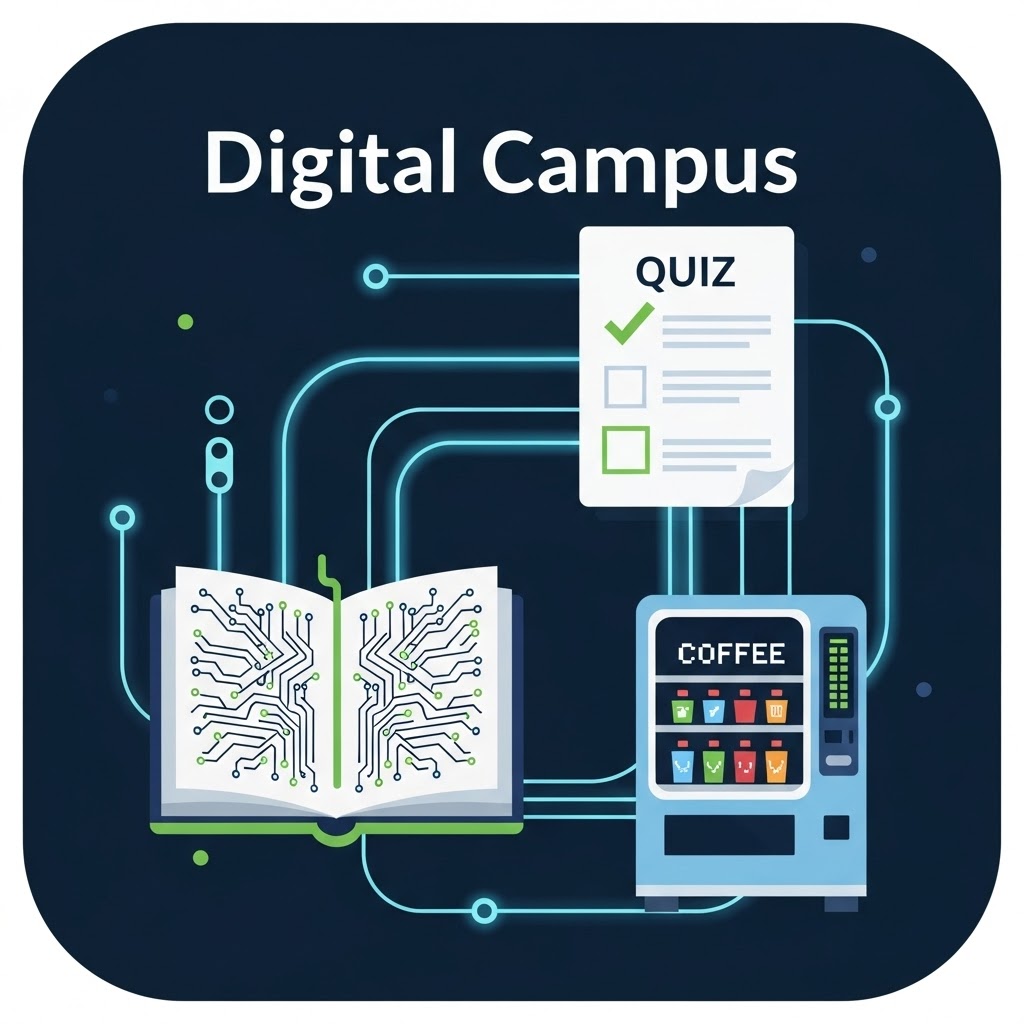
We have called this first resource suite "The Digital Campus."
What is the "Digital Campus" Suite? This suite comprises three distinct programming projects, tiered by difficulty (Mild, Medium, Spicy). Each one is designed to be completed in 3-4 hours.
They cover the core skills needed for the IA:
- B2 Algorithms: From linear search to complex logic loops.
- B2 File Processing: Ensuring data persistence (reading/writing files).
- B3 OOP: Practical application of classes, objects, and encapsulation.
- HL Extensions: Advanced tasks involving Inheritance, Polymorphism, and ADTs.
The Projects at a Glance
1. Mild: The Digital Librarian
- Context: The school library needs a system to track books.
- The Challenge: Build a system that reads book data from a file, allows users to search by title or author, and checks books out.
- Focus: List iteration, file reading, and basic class instantiation. Perfect for building confidence.
- Time Limit: 3 Hours (SL) / 4 Hours (HL).
2. Medium: The Student Quiz Engine
- Context: The school's learning platform needs a quiz tool.
- The Challenge: Create a program that reads questions from a file, randomises them for the user, validates their answers, and calculates a score.
- Focus: Randomisation, input validation, and parsing logic. This is the standard challenge for most students.
- Time Limit: 3 Hours (SL) / 4 Hours (HL).
3. Spicy: The Cafeteria Vending Machine
- Context: The cafeteria wants an automated ordering system.
- The Challenge: Manage stock levels that persist between runs (writing back to files), handle user credit/transactions, and prevent "out of stock" errors.
- Focus: State persistence, complex transaction logic, and robustness. Includes Stack ADTs for HL students.
- Time Limit: 3 Hours (SL) / 4 Hours (HL).
What is Included for Teachers? We know that managing projects is harder than managing worksheets. That is why the suite includes:
- Student Briefs: Detailed guides with scenarios, success criteria, and ready-to-use data files (
books.txt,quiz_data.txt,stock.txt). - Teacher Solutions: Complete, fully commented example code in both Python and Java.
- Assessment Rubric: A simplified 20-mark rubric to provide rapid, IA-aligned feedback on Design, Complexity, Functionality, and Evaluation.
By restricting the timeline to 3-4 hours, students learn to scope, design, build, and evaluate efficiently. They make their mistakes here, in the safety of Theme B, rather than in the high-stakes environment of the Internal Assessment.
Subscribers can get access to the project here:
Topics B2/B3 Projects
Designed as "Mini-IAs," these three-tiered projects (Mild, Medium, Spicy) guide students through the full software design lifecycle in just 3-4 hours. Perfect for differentiating instruction and building...
Topic B Project 1: The Digital Librarian (Mild Difficulty)
Context: The "Digital Campus" Library.Time Limit: 3 Hours (SL) / 4 Hours (HL).
Topic B Project 2: The Student Quiz Engine (Medium Difficulty)
Context: The "Digital Campus" Learning Platform.Time Limit: 3 Hours (SL) / 4 Hours (HL).
Topic B Project 3: The Cafeteria Vending Machine (Spicy Difficulty)
Context: The "Digital Campus" Cafeteria.Time Limit: 3 Hours (SL) / 4 Hours (HL).