Teaching Databases for the First Time? Here is How to Check Your Students are With You

For many of us, this term marks a first: teaching Topic A3 (Databases) as a core unit of the new 2027 IB Computer Science guide. But databases are a "house of cards" topic; if a student misses Primary Keys in Week 1, they will be lost by Week 3. The solution isn't more lessons; it's better diagnostics. Here is how we use "Lesson Starters" to catch silent gaps in knowledge before they become disasters.
For many of us, this term represents a first. Under the previous syllabus, databases were often an optional module or minor topic. However, in the new 2027 curriculum, Topic A3 (Databases) is now a core requirement for everyone. This means that many of us will be teaching relational theory, normalisation, and SQL in depth for the first time in years. To be honest, this is a unit where students can easily become lost.
The concepts in A3 build upon one another like a house of cards. If a student misses the logic behind "Primary Keys" in Week 1, understanding "Referential Integrity" in Week 3 will be nearly impossible.
The risk is that you may not realise that a student is struggling until the end-of-unit test.
The Diagnostic Starter
To support our teaching of this new unit, we have developed a "Do Now" routine. Every lesson begins with a 5-minute task designed to assess one specific learning statement from the previous class. This routine serves as our safety net.
Example: The "Keys and Relationships" Check
Before moving to 3NF (Topic A3.2), we need to know whether our students have grasped the key concepts in A3.1 Database Fundamentals
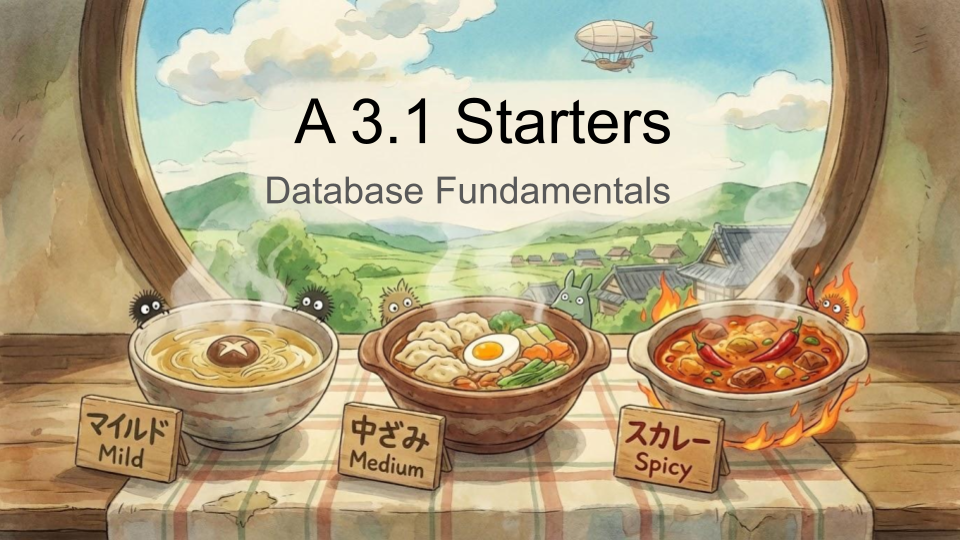
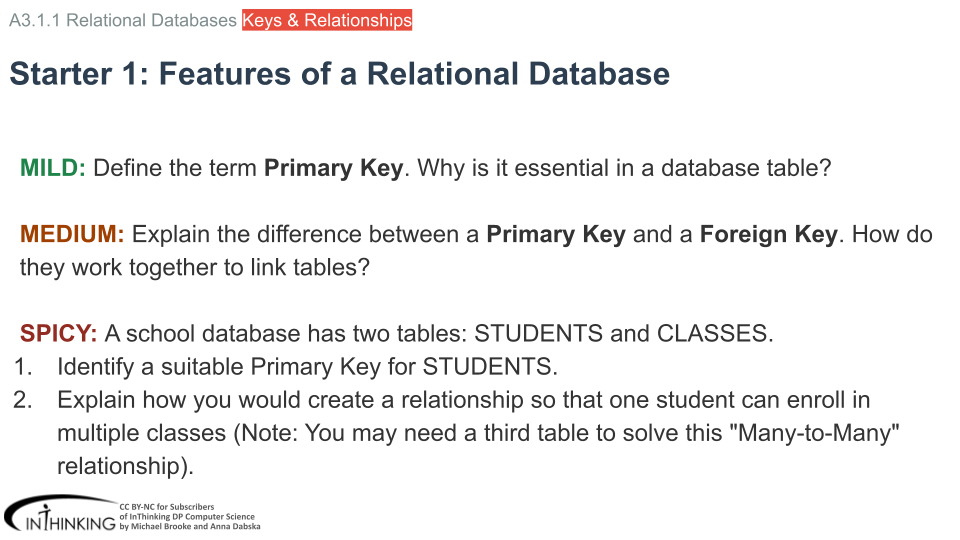
The Strategy:
- Targeted: Each starter directly aligns with a syllabus point (e.g., A3.1.1 Relational Databases).
- Quick: Each task lasts no more than 5 minutes.
- Diagnostic: It informs us about what to teach next.
We have created a comprehensive deck of these starters, including presentations for each starter, answer keys for teachers, guidance on how to use starters effectively, and a markbook to track student progress. The starters cover the entire A3 unit to help us, and you navigate this new course requirement with confidence. Subscribers can see these on the main sub-topic pages.
A 3.1 Database fundamentals
Subtopic A3.1 introduces database fundamentals, driven by guiding questions: purpose, problem-solving, and real-world representation. Databases are structured for efficient data handling, solve complex...
A 3.2 Database design
Subtopic A3.2 covers database design: schemas (conceptual, logical, physical), ERDs, data types, table creation (keys), normalisation (1NF-3NF with related concepts), and denormalisation.
A 3.3 Database programming
Subtopic A3.3 covers database interaction via SQL, building on fundamentals and design. It focuses on DDL (structure) and DML (data manipulation: insert, update, delete). Students learn to query tables...
A 3.4 Alternative databases (HL Only)
HL Subtopic A3.4 explores alternative databases (NoSQL, cloud, spatial, in-memory) and data warehouses. It covers their applications (e-commerce, GIS, analytics, etc.) and data warehouse characteristics...