Referencing Traditional and Indigenous knowledge
When students use sources that are Traditional knowledge, Indigenous knowledge(s), oral traditions, traditional stories, or oral histories, they should show respect for such sources, not least with regard to their use and referencing of these sources of information. On this page, we look at factors that could be relevant when DP students use traditional knowledge sources of information.
This page is specifically about referencing sources of Traditional an Indigenous knowledge. For other aspects of Traditional and Indigenous knowledge (and libraries) see the page Traditional Knowledge
Traditional knowledge and referencing styles
Specific referencing styles may provide guidance as to how traditional knowledge (TK) should be referenced. For instance, in APA, the basic premise is that traditional knowledge needs to be treated with respect and students should use their critical thinking skills to frame several questions, such as:
- Evaluating sources. Sources may exist for specific TK and evaluating sources is relevant. For instance, is bias apparent in older sources?
- Permission from owners of knowledge. Does the student have permission from Indigenous Peoples to share their knowledge?
- Summarise oral information in the text. Where there are no recorded sources (so not verifiable by readers of a text, such as examiners), can the student provide as much relevant information as possible in a concise manner?
- Personal communication and experiences. If the student spoke with an Indigenous person, the student should treat the information as a personal communication and cite as appropriate to the style they are following. If the student is an Indigenous person, then again follow the appropriate referencing style they are using, but if the written content is about the student's own experiences, then that becomes personal information.
(American Psychological Association, 2020, pp. 260-261)
Note on geographic coverage. We have aimed to be as holistic as possible covering different areas of the world. However, we found that certain geographic areas had more literature than other places. Indeed, Barry et al (2026) indicated that Australia had developed more procedures than other places. Therefore, if you feel our coverage cites more references from a couple of geographic areas, it is because that is where we found the content.
Indigenous Referencing Guidance for Indigenous Knowledges
This was an initiative developed by an organisation which acknowledged the politics of citation, and so developed the Indigenous Knowledge Attribution Toolkit (IKAT). Though it was developed for a geographical area (Victoria, Australia), it was considered that the toolkit could be used more widely. The document includes a discussion and provides criteria for evaluating materials that provide Ingidenous knowledge. The relevant and appropriateness of materials were discussed, including materials authored by Indigenous peoples, non-Indigenous peoples, including legacy publications. (Indigenous Archives Collective et al, 2023)
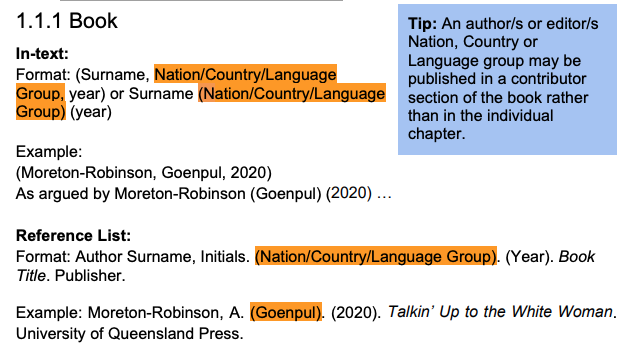
Drawing on the APA referencing system, IKAT is aimed at undergraduates and provides examples of referencing resources in a way that respects Indigenous knowledge, not least through recognition of an indigenous person's country and language group. Here are some examples in the three categories of resources IKAT identified:
Indigenous authored publications that include Country/Language group affiliation
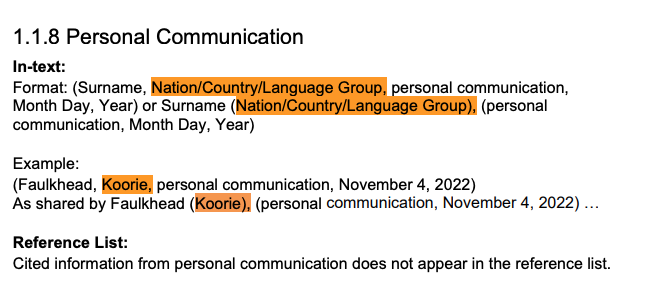
Indigenous knowledges cited in Indigenous authored publications
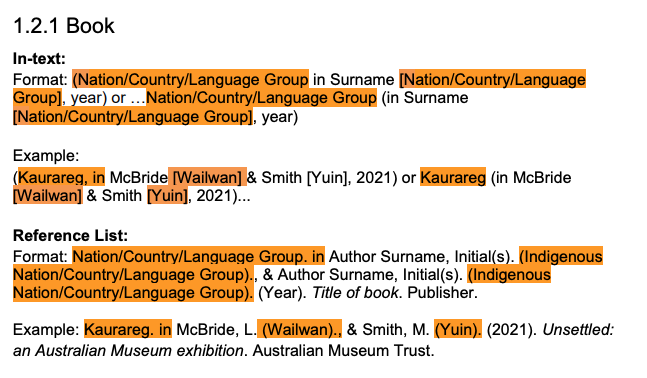
Indigenous knowledges cited in non-Indigenous authored publications
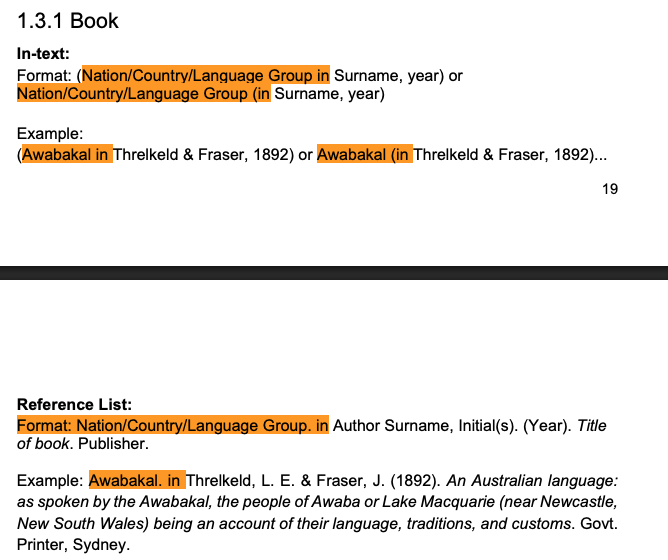
Images from Indigenous Archives Collective et al, 2023. Highlighted text made by authors of the publication.
Yarning and talking circles
Barlo et al (2020) explained that these terms represent traditional ways of imparting and discussing Indigenous knowledge by Australian Aboriginal Elders (yarning) and North American First Nations Peoples (talking circles). In terms of referencing, they can be considered as alternative terms for personal communication, according to an Australian higher education institution, Bond University (2026) as part of its Harvard Style guide.
Dynamic citation
Traditional knowledge (TK) can be a dynamic, ongoing process. As Barry et al (2026) identified, Western knowledge can be cited in a static way, whereas a more creative approach to citation may be more appropriate for TK.
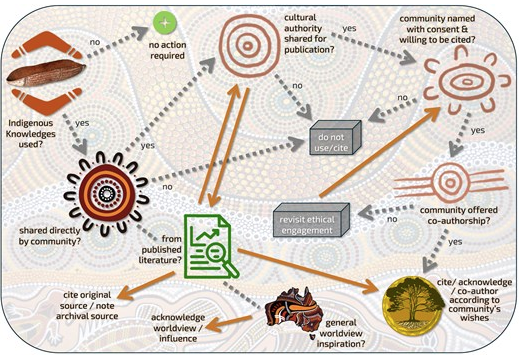
Barry et al (2026) suggested a “decision tree”, as imaged above, which researchers and First Nation knowledge holders could use to agree a way of citing TK. Barry et al. acknowledged the work of the IKAT project (mentioned above) and how that could be utilised, so that “the outcome of following the decision tree would be a Harvard or APA style in-text citation, reference, and a DOI link to a repository connected to the reference that displays a partially or fully completed table of information on which non-Indigenous researchers and First Nations group(s) agree.”
Dynamic citation is a proposal and the group concerned welcomes comments and views from stakeholders.
Capitalisation
Nakata et al (2005) identified the care students need to take in using, respecting and citing and referencing Indigenous Knowledge and other sources since then have also highlighted this need. One way of showing respect for Traditional and Indigenous knowledge is to capitalise most terms related to Indigenous Peoples, e.g. names of specific groups and words associated with Indigenous culture (American Psychological Association, 2020, p.261 - and most other sources).
Personal communication
Given that personal communication has been mentioned as a way of citing and referencing traditional or indigenous knowledge, this video explains what personal communication is in referencing terms - in this case using the Harvard style, as adopted by the specific institution (Western Sydney University, Australia).
Reference style examples
APA
In APA, for personal communication, there is no listing in a reference list, but for the parenthetical in-text citation, APA format is:
(A.A. Smith, Indigenous group, location, additional details, personal communication, March 31. 2020)
Chicago
For Chicago, the footnote format is:
First Name Last Name of Elder, Nation, Topic/subject of communication, Personal communication, Territorial acknowledgment of where the information was shared, Month Date, Year.
Harvard
This style is dependent on the institution that has adopted the style, so it will depend on which version of Harvard the school library is following.
MLA
For MLA, the works cited list format is:
Last name, First name., Nation/Community. Treaty Territory if applicable. City/Community they live in if applicable. Topic/subject of communication if applicable. Date Month Year.
(University of British Columbia Library, 2025)
Reference styles and citing Traditional and Indigenous Knowledge
Most of the major referencing styles have guidance on referencing and citing Traditional and Indigenous Knowledge. If a style doesn't, it still may have guidance about using inclusive language.
Individual institutions - not least in higher education - may also have advice based on expertise developed by staff with specific responsibility, and also connect, where relevant, to universal requirements, such as the UN Declaration on the Rights of Indigenous Peoples. One example is Kwantlen Polytechnic University library (Australia), which produced short videos explaining how to reference in three main referencing styles: APA, MLA and Chicago. The videos make clear that the practices advocated have been developed independently of the named referencing styles, and are specific to that institution.
This is the video for the APA referencing style, showing how it can be adapted to show respect for and accurately cite Indigenous knowledge:
This is the video focused on the MLA reference style, showing how it can be adapted to show respect for and accurately cite Indigenous knowledge:
This is the video for the Chicago referencing style, showing how it can be adapted to show respect for and accurately cite Indigenous knowledge:
Another example is James Cook University (Australia),specifically about the APA style: https://libguides.jcu.edu.au/apa/First-Nations
IBDP connections
Purpose of writing
The purpose for the written assignment is relevant. For the DP, it may be mostly about assessed elements, such as internal assessments (IAs). Many assessed requirements are research based and require appropriate citation and referencing. There are some assessed requirements that are different, such as the TOK assessment: essay and exhibition, but depending on the context, may still require citation.
Oral sources of information
Oral sources: several IB documents (including Effective Citing and Referencing) cover what and how to cite when giving an oral presentation (by the student), but not necessarily about students using oral sources of information.
What can we do?
- Be aware that specific advice in relation to citing and referencing sources of Traditional and Indigenous Knowledge may be separate from main referencing styles.
- Adopting detailed advice from a preferred institution in your jurisdiction may be a way of showing respect for Traditional Indigenous knowledge holders in your jurisdiction.
- If students in your institution are advised to show respect for Traditional and Indigenous Knowledge holders through citing and referencing appropriately, it might be helpful for students to note that they are doing so in their assessed work, perhaps on the bibliography, works cited or references section of their work. This not only makes it clear to an examiner (who may be elsewhere in the world) that the student has done so, but also demonstrated international-mindedness by the student. It would probably be advisable to consult with the DP coordinator about this, too.
References
See also Traditional Knowledge
American Psychological Association. (2020). Publication manual of the American Psychological Association: The official guide to APA style. 7th ed. APA.
Anand, S., Sonar, R. M., & Jain, K. (2025). Traditional knowledge research in India: A bibliometric-based review and thematic analysis. Indian Journal of Traditional Knowledge (IJTK), 24(3), 275-287.
Barlo, S., Boyd, W. B. E., Pelizzon, A., & Wilson, S. (2020). Yarning as protected space: Principles and protocols. AlterNative: An International Journal of Indigenous Peoples, 16(2), 90-98.
Barry, C. et al. (2026, June). Crediting and citing Indigenous Knowledges within research. BioScience, 76(6), 501–512. https://doi.org/10.1093/biosci/biag009
Bond University. (2026, October 08). First Nations Knowledge. https://bond.libguides.com/harvard-referencing/first-nations-knowledge
First Nations – Traditional Knowledges and referencing. (2025). Biotext. [Available as a 3 page pdf. document at https://biotext.com.au/content-guides/]
Indigenous Archives Collective; Faulkhead, S; Thorpe, K; Sentance, N; Booker, L; & R Barrowcliffe. (2023) Indigenous Referencing Guidance for Indigenous Knowledges. Indigenous Archives Collective and the UTS Jumbunna Institute of Indigenous Education and Research.
Nakata, M., Byrne, A., Nakata, V. & Gardiner, G. (2005). Indigenous Knowledge, the library and information service sector, and protocols. Australian Academic & Research Libraries, 36(2), 7-21. https://www.tandfonline.com/doi/pdf/10.1080/00048623.2005.10721244
Photo: introduction box photo by Museum of New Zealand Te Papa Tongarewa on Unsplash
Red River College Polytechnic Library. (2026, September 21). Citing Indigenous Elders and Knowledge Keepers. Academic Writing and Citation. https://library.rrc.ca/academic_writing/indigenous-style
University of British Columbia Library. (2025, December 11). Indigenous Citation Guide. https://guides.library.ubc.ca/IndigenousCitationGuide/MLA