International-mindedness

International-mindedness is regarded and often referred to as a key attribute of the International Baccalaureate.
In this section we explore this central IB concept and how the library/ian can support international-mindedness in a DP school.
What IB documents say
"The International Baccalaureate aims to develop inquiring, knowledgeable and caring young people who help to create a better and more peaceful world through intercultural understanding and respect."
IB mission statement
"The aim of all IB programmes is to develop internationally minded people who recognize their common humanity and shared guardianship of the planet. Central to this aim is international-mindedness."
What is an IB education? IB, 2019, p. 2
"Librarians can also play a key role in promoting reading for pleasure, which ... [will further] language acquisition and intercultural understanding. Librarians should ensure that the books in the library reflect the inclusive nature of the school and the languages of the students."
Diploma Programme: from principles into practice. IB, 2015, p. 42 *
What is international-mindedness?
This is the explanation by the IB of the term international mindedness
International-mindedness is a multifaceted concept that captures a way of thinking, being and acting characterized by an openness to the world and a recognition of our deep interconnectedness to others.
To be open to the world, we need to understand it. IB programmes therefore provide students with opportunities for sustained inquiry into a range of local and global issues and ideas. This willingness to see beyond immediate situations and boundaries is essential as globalization and emerging technologies continue to blur traditional distinctions between the local, national and international.
What is an IB education? IB, 2019, p. 2
The name international-mindedness
"The term, international-mindedness, is the IB’s own, in preference to terms such as inter-culturalism or multiculturalism, though there will be overlap ... How a school develops and reflects international-mindedness will be dependent on context and situation. It can include celebrating cultures and different national characteristics and achievements. It can include support for mother tongue and community languages. It can also include looking at various issues and challenges in a global context, on the understanding that we all inhabit a ‘global village’ (Roberts, 2009). Whatever the approach or approaches taken by a school, it is a cornerstone of IB thinking."
(Tilke, 2015, p. 399)
Similar and related terms used interchangeably with international-mindedness
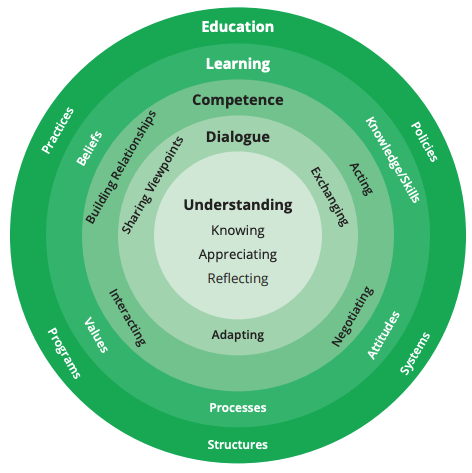
Different terms exist in this area and whilst there may be overlap when defining terms, each term may be distinct. Recent recent in the field of intercultural understanding notes strong connections with international mindedness and global citizenship and suggests these terms are often used interchangeably with intercultural understanding (Brandt, 2024). This image helpfully shows the various aspects associated with the concept intercultural understanding:
Key terms
Some key terms are already emerging
- Openness
- Using inquiry to understand global issues
- Globalization
- Inter-cultural understanding
- Inter-related - or interconnectedness - distinction between local, national (or regional) and international contexts
Further key aspects for students:
- ability to reflect on their own (and others) perspectives, identifies and cultures
- focusing on diverse beliefs and values
- think and collaborate
- develop a peaceful and sustainable world
- multilingualism aids intercultural understanding
- environmentalism on global and local levels - including through service and action.
How can international-mindedness be developed in an IB school?
Guidance issued by the IB for schools who are in the process of beginning to offer IB programmes suggests the various discussion prompts, including the following, as an activity for a "full DP faculty, including core teachers and the librarian" (p.15):
- What are we already doing in school that promotes international-mindedness?
- How can internationally minded perspectives be developed in teaching and learning?
- What resources do we need to support the development of international-mindedness?
Programme development guidance for Diploma Programme candidate schools. IB,2024, p.15
What does international-mindedness look like in a school library?
Here are two research-focused views that can illustrate how international-mindedness looks in a school library. The first column is a non-library sector piece of research whilst the other was a paper for a professional conference of school librarians. Both columns have crossover but also bring out different aspects, so complement each other.
Study about evidence of international-mindedness in an IB school. Those relating to the school library were:
- Researcher audit of the school - and specifically referenced the school library - for visual evidence of international-mindedness
- Using LIS library infrastructure to disseminate student-created materials as a result of an inter-cultural project
- Living library project
- Answer to a survey question about how international-mindedness was being implemented in a particular school, one response was “our library is filled with books that encourage international mindedness” (p.162)
- International-mindedness was considered widely, for instance the report identified that “the library contained much literature about human rights, political freedom etc.” (p.209)
- The concept of openness in one DP school was framed as one of space, ethos and environment: “this openness was reflected in the school buildings with a large open central area including cafes, library, amphitheatre and social areas” (p.218)
(Barratt Hacking et al, 2017)
Typical roles for a school library in support of international-mindedness in IB programmes
- Resource provision reflecting international-mindedness – world literature, mother tongue, countries and culture – a ‘window on the world’
- Environment to practice, value and celebrate students’ involvement with the IB Learner Profile, which itself reflects international-mindedness
- Affective domain – a place to think, to reflect, to be calm, to be balanced – a mindful environment
- The library can be a physical statement of IB values and philosophy (e.g. international-mindedness)
- A place to engender a love of story, creative narratives and reading, often reflecting a multi-cultural and multi-lingual environment.
(Tilke, 2015)
What can we do?
- Consider and promote the idea that school libraries are natural places where international-mindedness can be expressed, seen and practiced.
- Library/ian involvement can range from more passive evidence (such as noticeboards) to the more active (such as library collections).
- Librarian involvement with international-mindedness can involve large and small actions, and both specific activity and ongoing actions.
References
Barratt Hacking, E., Blackmore, C., Bullock, K., Bunnell, T., Donnelly, M., & Martin, S. (2017). The international mindedness journey: school practices for developing and assessing international mindedness across the IB Continuum. [Previously hosted on the website of the International Baccalaureate Organisation.] https://researchportal.bath.ac.uk/en/publications/the-international-mindedness-journey-school-practices-for-develop
Brandt, C.W. (2024, August). A review of the literature on intercultural understanding. Center for Assessment. https://ibo.org/globalassets/new-structure/research/pdfs/2024-intercultural-understanding-report-eng.pdf
Photo of a Japanese ceramic bowl by an author of this website
Programme development guidance for Diploma Programme candidate schools. International Baccalaureate Organization, 2024.
Tilke, A. (2015, July). IB school libraries as international-minded learning spaces and environments. IASL conference proceedings, Maastricht, The Netherlands. https://journals.library.ualberta.ca/slw/index.php/iasl/article/view/7524
What is an IB education? (2019). International Baccalaureate Organization. [Available on the PRC.]
* We've kept the quote in the IB blue box above, even though the document has been superseded. The quote comes from Diploma Programme: From principles into practice (2015). However, in September 2026, this document was replaced by Diploma Programme and Career-related Programme. From principles into practice: In practice. The new document is different in that it focuses on both DP and CP and relates strongly to the IB Programme Standards and Practices. The previous document was more of an overview of the DP and contained some useful references to the library/ian. This is not the case with the new document and, whilst the refocus of the new document is understandable, we've retained quotes (in this website) to the role of the library/ian from the 2015 document, as they remain helpful and relevant - and more detailed.