Teaching & learning

In this section, we focus on a librarian's contribution to teaching and learning in the IB Diploma Programme. Teaching and learning is where the school librarian can make a direct contribution to the programme.
We identify the librarian's role in IB documentation, link to good practice and suggest ideas and strategies for development of a librarian's role in the DP.
What IB documents say
When defining a teacher, the IB Programme Standards and Practices document states that a teacher is "anyone directly responsible for learning and teaching in the school community. For some practices, schools will need to define who they consider teachers, including those outside of the classroom. Examples might include librarians, technology integration specialists, and learning support specialists."
(Programme Standards and Practices, International Baccalaureate Organization, 2018, p.27)
"Librarians can be a valuable resource in planning, but also in team or shared teaching. Collaborative teaching with the librarian need not be restricted to the library, but can take place in any learning spaces within the school."
(Diploma Programme: From principles into practice, IB, 2015, p.42)
"The librarian takes an active role in designing and coordinating student activities, providing appropriate spaces and resources, and directly teaching areas of the curriculum such as ATL development, service learning, or social and emotional learning."
(Ideal Libraries: a guide for schools, IB, 2018, p.17)
What IB librarians say
These are the words of an IB librarian in Brazil, who reported a meeting of IB librarians in São Paulo:
Our conversations highlighted the important role librarians play in IB education: fostering a love of reading, supporting critical thinking, information and media literacy, and developing research skills, while encouraging curiosity and the ethical use of information. (Tostes, 2026)
We explore elements identified by IB librarians (in the quote above) in this website, not least in this teaching and learning section.
Core ideas of the IB Diploma
This short video gives perspectives from students, teachers and school administrators.
Comment and reflection
- IB documentation makes clear that librarians have teaching roles in the IBDP, starting with the very important Programme Standards and Practices, the key document of criteria used to evaluate schools who offer IB programmes.
Teaching by librarians will look different, depending on circumstances, but common models often include:
- Stand-alone teaching of specialised content to a group or class
- Co-teaching a group or class
- Supporting individual students with specific content and skills
- Providing support and/or training educators to provide specialised content
- Co-planning a unit or learning experience.
It may be interesting to reflect on ourselves and our teaching role in terms of the key phrase used in a study which "positions school librarians as ‘professional resources’ when they perform teaching [and] provide support for teaching" (Centerwall, 2024).
Pages or tabs in this Teaching and Learning section provide information, content and strategies to support a librarian engaged in teaching in the IB Diploma Programme.
From this page/screen, you can see the contents of this section (on the left hand side of the screen) and selected pages are also highlighted towards the bottom of this page.
Nothing new
The librarian as a teacher, whilst still a surprise to a small number of people, is in fact nothing new as this article from 1907 attests. In other words: the IB librarian is an educator.
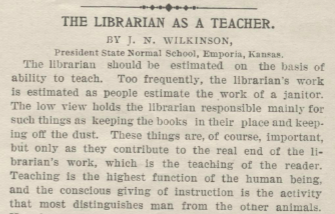
The above image is the beginning of an article by J.N. Wilkinson, from Emporia, Kansas, USA, in 1907, called ‘The librarian as teacher’ which appeared in The Journal of Education. http://www.jstor.org/stable/42816458
What might teaching and learning and the school library/ian look like?
In this section, we take the term teaching and learning quite broadly - after all, arguably, everything the school library/ian does supports teaching and learning in a school.
Here are some examples:
| Direct teaching and learning support by the librarian | Indirect teaching and learning support by the librarian |
Class teaching Co-teaching Guest presentation ‘Quick visit to a classroom’ to explain … Student group activity One-to-one support Virtual learning | Being a role model Displays Developing online knowledge products Speaking at meetings, assemblies, etc. Spontaneous hallway, corridor, water cooler interactions Creating and managing the school library space that promotes and enables teaching and learning |
References
Centerwall, U. (2024). In plain sight: School librarian practices within infrastructures for learning. Journal of Librarianship and Information Science, 56(1), 211-222. https://doi.org/10.1177/09610006221140881
Photo: introduction box photo by Marcus Winkler on UnSplash
Tostes, B. (2026, October 31). Post. LinkedIn.
Wilkinson, J. N. (1907). The librarian as teacher. The Journal of Education, 66(5 (1640)), 121–122. http://www.jstor.org/stable/42816458
Bold type in the quotes above are by the authors of this website
Selected Pages
-

Teaching & learning
Artificial Intelligence (AI) literacy Free
Whilst, at first, it may have been perceived by the wider educational and/or IB community that a librarian's focus in student
-

Teaching & learning
Hallucinations
Hallucination is a term used in medical sciences and, having a long history, is sometimes associated with belief, such as
-

Teaching & learning
Prompt design or engineering
Prompt, whether prompt engineering or prompt design, are terms that we now use daily, perhaps in individual support for
-

Teaching & learning
Well and pastoral roles for the IBDP library/ian
Supporting DP students - including wellbeing - is an important aspect of a school's approach to offering the IB Diploma
-

Teaching & learning
Reading
In this section, we look at reading from a teaching and learning perspective, sometimes called readers' advisory. The focus
-

Teaching & learning
TOK knowledge framework and the library
A concept in the TOK guide/course that may be of interest to librarians in particular is the knowledge framework. Here,