Hallucinations

Hallucination is a term used in medical sciences and, having a long history, is sometimes associated with belief, such as apparitions - as in the photo of this body-less costume.
However, it has a new meaning in AI. We look at this newer use of the word and what it can mean for DP students.
What does IB documentation say?
“Given the capacity of AI to ‘hallucinate’, it is wise to use more conventional search engines for the investigative stage of your research because these search for and list human-produced content.”
Extended essay guide, first assessment 2027. International Baccalaureate Organization, 2025, pp. 94-95
What are hallucinations?
Hallucination is a term developed from a latin word and used in the Middle Ages, but now used in the field of psychiatry, where for an “individual who experiences these phenomena, they are indistinguishable from normal perceptions. Something is perceived yet, objectively, there is nothing to perceive.” (Ohayon, 2000, p.154)
What are hallucinations in AI
Now, the word has been used in a particular context. Here's what it means in relation to artificial intelligence:
Concerns about hallucinations in AI
In relation to AI, the writer Naomi Klein identified that the term was used by developers of generative AI to “characterise responses served up by chatbots that are wholly manufactured, or flat-out wrong. Like, for instance, when you ask a bot for a definition of something that doesn’t exist and it, rather convincingly, gives you one, complete with made-up footnotes.”
Klein wonders why use the term, given it had a meaning, credibility and application already, was used -
“Why not algorithmic junk? Or glitches? … By appropriating a word commonly used in psychology, psychedelics and various forms of mysticism, AI’s boosters, while acknowledging the fallibility of their machines, are simultaneously feeding the sector’s most cherished mythology: that by building these large language models, and training them on everything that we humans have written, said and represented visually, they are in the process of birthing an animate intelligence on the cusp of sparking an evolutionary leap for our species.”
(Klein, 2023)
Ethical considerations
One school librarian identified their work with students about using AI. “I would primarily caution them about hallucinations, copyright, and bias.” This is because “AI engines are designed to give you the answer that you want. To do so, they may hallucinate and answer that may not have basis in reality - either in whole or in part. AI can make up articles, authors, quotes, and events in an effort to generate what the user is requesting. As such, AI products should be thoroughly fact checked - which builds amazing research skills.”
(Craddock and Wilson, 2024)
Hallucinations in context
LIS educator Amanda Harrison makes a connection with previous concerns about another information source silo:
AI-generated content can be rife with errors, often called “hallucinations,” although they might more clearly be considered glitches. Identifying the “hallucinations” in AI-generated content can spark curiosity and encourage users to engage with AI and critically evaluate the information it produces. Since AI-generated content is based on statistical likelihood rather than verified accuracy, several writers and leaders in educational technology have suggested that AI is the new Wikipedia: a helpful starting point for learning, but one that requires deeper, more rigorous research to follow.
(Harrison, 2025, page 4)
Hallucinations - some can be minor but others serious
Hallucinations in AI can be thought of as bluffing, which sounds innocuous, but isn't and is something that could be rectified in the technology (by saying: I don't know) though this doesn't fit with AI-developer business model (Zhou, 2025). Researchers at Cornell and Washington universities identified that when AI tools are used in everyday life, some hallucinations “may be minor – when a chatbot gives the wrong answer to a simple question, the user may end up ill-informed. But in other cases, the stakes are much higher. From courtrooms where AI software is used to make sentencing decisions to health insurance companies that use algorithms to determine a patient's eligibility for coverage, AI hallucinations can have life-altering consequences. They can even be life-threatening. Autonomous vehicles use AI to detect obstacles, other vehicles and pedestrians.” (Choi and Mei, 2025)
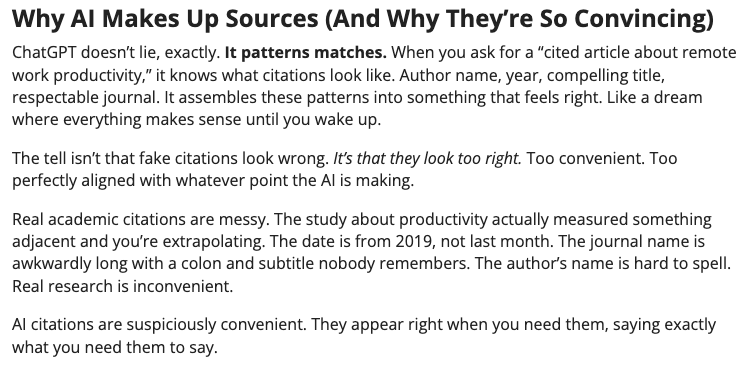
Hallucinations might make citations too perfect
Here is an interesting and helpful explanation about AI generated sources.
Issues for librarians
No answer is better than a false answer
Reporting in a popular science magazine, rather than a library science publication, in a short but punchy piece with a very specific title Librarians can’t keep up with bad AI: From false sources to hallucinations, it’s become a major problem, the piece set the scene:
Generative artificial intelligence continues to have a problem with hallucinations. Although many responses to user queries are largely accurate, programs like ChatGPT, Google Gemini, and Microsoft Copilot are still prone to offering made-up information and facts. As bad as that is on its own, the issue is further complicated by a tendency for these AI programs to produce seemingly reputable, yet wholly imaginary, sources. But as annoying as that is for millions of users, it’s becoming a major issue for the people trusted to provide reliable, real information: librarians.
"For our staff, it is much harder to prove that a unique record doesn’t exist," Sarah Falls, a research engagement librarian at the Library of Virginia, told Scientific American.
15% of reference inquiries at the particular university library resulted from AI generated false sources. The library strategy was to point students to go to the source - and prompted students to think about their critical thinking skills - and the report identified that there may be a future need to limit support to students given that it is a recurring issue. (Paul, 2025)
Inaccuracies and lack of trust
One study looked specifically at the ability of ChatGPT to provide reliable references for research proposals. It analysed 178 references and found that over a third of the references did not have a DOI (Digital Object Identifier) and 28 references could not be traced online. Other references were not research articles, but secondary sources. The study concluded that “the 28 articles that neither turned up on an extensive internet search nor had a functional DOI are undoubtedly the product of AI hallucination” and “AI hallucination usually occurs due to adversarial examples such as varied input data that confound the AI systems into misclassifying and misinterpreting them resulting in inappropriate and hallucinating output. AI hallucination is a problem because it hampers a user’s trust in the AI system”. (Athaluri et al, 2023)
Another study that looked purely at ChatGPT considered that, whilst there were positive uses of the AI tool, a balance should be maintained for accuracy and ethical issues and (again) there was a need for library/ian education to students in the areas of critical thinking, fact checking and verification skills. (Oladokun et al, 2025).
Verification skills are sophisticated
Older secondary school students find verifying information from AI sources because there are nuances and subtleties and skills and knowledge that comes from experience, plus lack of experience in independently evaluating sources and a perhaps latent trust in seemingly well-written sources (Reyes, 2026). The verifying process can be complex - a lot of advice is aimed at students in HE and new professionals, where there is an assumption of context and previous knowledge.
How to support students
Given LIS based concerns and advice from the IB (at the top of this page), clearly students should be aware of and able to identify hallucinations. Here are some strategies to use with students:
Critical thinking
Virtually all the sources we consulted for this page referenced critical thinking as a key skill for students to develop in order to identify and beware of hallucinations in AI tools. However, one international school educator (Wemyss, 2026) identified that students do this internally (as a thought process) and that there was a value in giving
students a shared phrase they use before accepting any AI output. Aviation uses “Cross-check” and “Verified.” Your version might be as simple as "Checked or accepted?" spoken aloud or written at the top of the work. The point is not the specific words. The point is that the moment of acceptance becomes visible rather than invisible. Right now, students accept AI output silently. The callout makes the decision conscious. (Wemyss, 2026)
Fact-checking or verifying information sources
Here is an idea to help students evaluate the veracity of information and claims from an AI-generated source of information.
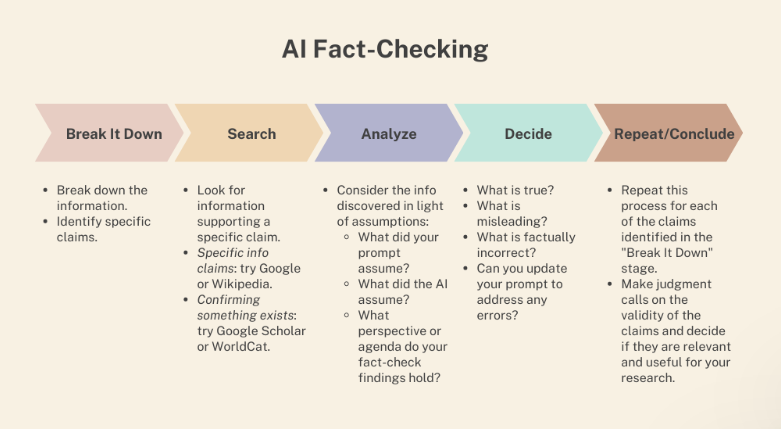
This is wonderfully comprehensive, but as it is aimed at university-level students, perhaps we could reduce it to one thought per column which can be more manageable for 16-18 year old students. So, what about:
| Break it down | Search | Analyse | Decide | Repeat/conclude |
| Don't be overwhelmed by claims in a single source. Break it down into manageable chunks. | Check that the source exists and what it says using Google Scholar | Given the AI source information, what did the prompt (or you) assume? | If you find errors, how can you change your prompt to avoid such errors? | As you build up your expertise, you can better judge whether claims from AI sources are valid or not. |
Instruction about hallucinations
There are several commercially-produced learning packs of lesson plans and structured activities to use with students that will help explain hallucinations and for students to understand how to respond to them. These can be useful, though for DP student, it might be helpful to consider whether, in the DP years, curriculum time would be available. Perhaps the pedagogical tools could be used in previous school years though.
Source evaluation skills
Teach or reinforce source evaluation skills, such as: primary and secondary sources; peer-reviewed research and opinion pieces; author credentials and institutional affiliations; publication date. (Eaton, 2025)
Encourage students to engage with source material directly (and not AI-generated summaries).
Visual tools
Create or use a short video or poster to explain the concept.
Retrieval-based tools
Some generative AI tools are “built with Retrieval-Augmented Generation (RAG) architectures. This means they’ll retrieve relevant information from trusted sources … before generating output” (MIT Management). Some niche tools seem to include RAG (Codingscape, 2025) and perhaps RAG's time is still to come in terms of tools that students use?
Examples
Sometimes, examples can provide specific detail to add to general advice to students to beware of hallucinations. (We provide a select list of helpful examples in the references box at the bottom of this page.)
Using vocabulary
Use the specific term ‘hallucination’ with students, especially as it is mentioned in an IBDP document. Although the term might not be the most accurate or description on that could be used, it is trending and therefore memorable. It might be worth pointing out to students, as identified in the Popular Science article, that university libraries may limit help with these issues (as students can help themselves) so worth students getting into the habit or developing skills so they can cope with hallucinations in AI sources.
School context
Be aware how the term is used in the school generally. Are other educators using it and, of so, what are their strategies and/or advice? It is best for students if there is a common approach and response.
See also Critical thinking: evaluating authority and bias in sources
What does IB documentation say?
Let's revisit the IB quote from the top of the page
Here is the quote in full. We can see that this fits in with the general tone of IB that sees AI tools as helpful provided that learning - specifically critical thinking - occurs and that the student uses AI as a help but not instead of learning (i.e. cognitive offloading).
Using artificial intelligence (AI) to write an essay that is then presented as your own is dishonest and demonstrates a lack of integrity. Instead, think about how you might use AI software as a tool to help you in your research in a permissible, positive way. For example, material generated by AI can be considered as one of your resources, alongside resources gathered in more conventional ways (e.g. websites, academic articles, books), always acknowledged and cited appropriately. However, it is important to check and validate information generated by AI, perhaps by corroborating it with information gathered from other sources. Given the capacity of AI to “hallucinate”, it is wise to use more conventional search engines for the investigative stage of your research because these search for and list human-produced content. AI may also be used to help you compare and evaluate other resource materials.
Extended essay guide, first assessment 2027. IB, 2025, pp. 94-95
References and further information
See also Critical thinking: evaluating authority and bias in sources
We've tried to limit references to those published in the last couple of years, unless really compelling and helpful (detail and tools might change, but strategies last longer). Most of the sources are from the LIS and tech professional areas, and there are a few studies, too.
Athaluri, S. A., Manthena, S. V., Kesapragada, V. S. R. K. M., Yarlagadda, V., Dave, T., & Duddumpudi, R. T. S. (2023). Exploring the Boundaries of Reality: Investigating the Phenomenon of Artificial Intelligence Hallucination in Scientific Writing Through ChatGPT References. Cureus, 15(4), e37432. https://doi.org/10.7759/cureus.37432
Choi, A. and Mei, K.X. (2025, March 21). What are AI hallucinations? Why AIs sometimes make things up. The Conversation. https://doi.org/10.64628/AAI.etwucf49j
Codingscape. (2025, October). Best AI tools for retrieval augmented generation (RAG). Codingscape Blog. https://codingscape.com/blog/best-ai-tools-for-retrieval-augmented-generation-rag
Craddock, I. and Wilson, K. (2024, May 23). An AI toolbox for librarians. School Library Journal. https://www.slj.com/story/an-ai-toolboxlfor-librarians-artificial-intelligence
Eaton, S.E. (2025, April 23). Teaching fact-checking through deliberate errors: An essential AI literacy skill. https://drsaraheaton.com/2025/04/23/teaching-fact-checking-through-deliberate-errors-an-essential-ai-literacy-skill/
Goldin, H.L. (2025, December 30). How to Spot AI Hallucinations Like a Reference Librarian. LLRX. https://www.llrx.com/2025/12/how-to-spot-ai-hallucinations-like-a-reference-librarian/
Harrison, A. (2025). Inquiry, AI, and pedagogy in the library classroom. Virginia Libraries 69(1), 1-8. DOI: 10.21061/valib.v69i1.691
International Baccalaureate Organization. (2023). Artificial intelligence (AI) tools – common questions and concerns. https://www.ibo.org/globalassets/new-structure/programmes/shared-resources/pdfs/artificial-intelligence-questions-and-concerns-en.pdf
Klein, N. (2023, May 08). AI machines aren’t ‘hallucinating’. But their makers are. The Guardian. https://www.theguardian.com/commentisfree/2023/may/08/ai-machines-hallucinating-naomi-klein
MIT Management. (n.d.) When AI gets it wrong: Addressing AI hallucinations and bias. Blog. https://mitsloanedtech.mit.edu/ai/basics/addressing-ai-hallucinations-and-bias/
Ohayon, M.M. (2000). Prevalence of hallucinations and their pathological associations in the general population.
Psychiatry Research, 97, 2, 153-164. https://doi.org/10.1016/S0165-1781(00)00227-4
Oladokun, B., Emmanuel, V., Osagie, O. & Alabi, A. (2025). ChatGPT and library users: AI risks of hallucinations and misinformation. Cybrarians Journal, 25-37. DOI: 10.70000/cj.2025.76.642
Paul, A. (2025, December). Librarians can’t keep up with bad AI: From false sources to hallucinations, it’s become a major problem. Popular Science. https://www.popsci.com/technology/librarians-bad-ai/
Photo: introduction box photo ('A white dress floating on water') by Pict4life on Unsplash
Reyes, I. (2026, April 15). How to teach students to detect AI hallucinations. hypothes.is. https://web.hypothes.is/blog/how-to-teach-students-to-detect-ai-hallucinations/
University of Maryland Libraries. (2026, January 16). Artificial intelligence (AI) and information literacy. [Libguide.] https://lib.guides.umd.edu/AI
Wemyss, M. (2026, March 06). AI hallucinations in schools: how to teach students to verify AI output. IN&ED. https://www.inanded.com/insights/ai-hallucinations-schools-verify-output
Zhou, C. (2025, October 28). AI hallucinates because it’s trained to fake answers it doesn’t know. Science. https://www.science.org/content/article/ai-hallucinates-because-it-s-trained-fake-answers-it-doesn-t-know
Bold type in quotes above applied by authors of this website
Examples of hallucinations
Sometimes, examples can provide specific detail to add to general advice to students to beware of hallucinations. Here are some interesting examples to use with students (sources dated 2025):
- https://www.techtimes.com/articles/313610/20251225/why-chatbots-resort-ai-hallucinations-here-are-5-real-life-examples.htm
- 8 AI hallucination examples https://www.evidentlyai.com/blog/ai-hallucinations-examples
- Guide with examples https://www.datacamp.com/blog/ai-hallucination
- and, for 2026 https://tech.co/news/list-ai-failures-mistakes-errors
This could be an interesting example as it is an academic paper which includes summaries of affects of hallucinations in different sectors and disciplines:
Al Jannadi, K. (2023). AI Hallucinations: Types, causes, impacts, and strategies for detection and prevention. https://doi.org/10.13140/RG.2.2.19451.37925 [Preprint; available on ResearchGate.]