Annual report

Librarians look for ways of highlighting the contribution of the library/ian to school life. One strategy is to provide an annual report, which has been used successfully by various school librarians.
Here, we look at the value of an annual report, plus what is involved and DP-related ideas to develop one.
Benefit of producing an annual report for the library
- “Annual reports illuminate how the library budget has been used and clarify whether the amount of money spent on the library program and its resources has been enough to cover its tasks and attain the policy targets. Annual reports should include evidence of the quality of school library services and programs and their impact on teaching and learning in the school.” (International Federation of Library Associations and Institutions, 2015, page 24)
- “Your annual report is an advocacy and accountability tool that can help to build a positive picture in the minds of your school community. Think of your report as a way of telling your library’s story. Use it to celebrate successes, acknowledge support and share your plans for the coming year.” (National Library of New Zealand)
What an annual report can do
- Present statistical information
- Celebrate successes of the school library
- Thank those who were involved in the school library services, performance and events during the year
- Garner support from management for the future
- Help with fundraising (from non-school budget sources), e.g. PTA.
(Gaddy, 2023)
An annual report can be a political tool
- For school librarians who engage in advocacy about their school library, the annual report can be a helpful tool to use with decision-makers and influencers in the school.
- In such cases, the annual report needs to not only provide statistical information about performance, but indicate how the library has helped and benefited the school community through its program or services.
- So, the annual report is not a benign document but one with values. Where there is dialogue with readers of the report, the librarian needs to be able to back up what has been stated in the the report.
- Align the report to the school's own strategic goals - show how the library/ian supports these goals.
- Acknowledge the support of senior management for extra resources or opportunities for the school library during the year.
(Chrastka, 2024; National Library of New Zealand; School library reporting in a digital age, 2021)
Telling the story of the school library
“Reporting numbers isn’t enough; I need to tell my library’s story. Storytelling can incorporate those same statistics but also needs to include the voices of my patrons, images of library programs, and reflection on the library’s impact on learning.” (School library reporting in a digital age, 2021)
Producing an annual report
What to include
- Accomplishments and performance
- Impact. Perhaps the most important aspect: what impact does library activity and/or services have on teaching and learning in the school? Similarly, reader development and literacy.
- Funding and resources. If the library was allocated or won extra funding or resources, what was the difference that these extra resources provided or what was the benefit.
- Statistics. Should be easily understood, but also be meaningful.
- Feedback and testimonials; stories of users
- Challenges and goals
- Improvements - perhaps of space, furniture and equipment
- Significant events during the year
- Reflection on the year
(Chrastka, 2024; Dearnaley, 2022; School library reporting, 2021)
Reflection prompts
- Is the focus on the contribution of the library to the school or on the needs of the library?
- Is there a clear connection to teaching and learning and the Diploma Programme in particular?
- Does the annual report provide just statistics or stories too?
- How visual is the report - does it include photos?
- Are the photos used of students or just the library space or furniture?
- Does the annual report focus on library events only or perhaps also community/school events (in which the library/ian participated)?
- Does the report start with statistics, or are they used to support the library story? (Alternatively, in a school environment where managers are more persuaded by statistics, perhaps best to start with stats!)
- Is there a balance between physical/print resource use and digital resource use?
Expectation
Sometimes, producing an annual report is not an initiative of the librarian, but a school requirement or expectation. For example, this was identified in the school library's policy document:
“Annual reports on the library will be produced by the librarian (Learning Resource Manager), and relevant data will be tracked to show impact.” (King's Langley School, 2026, p. 8)
If a school requirement, it may be that annual reports are required from other departments or sections of the school (so there may be a required template to use) or it might be individual to the school library. If the latter, it could be that there is more scope to provide a report that is interesting … and might be read!
- A different expectation is where the school itself produces an annual report and requires or invites different sections of the school to provide content. Here, there may be specific or occasional mentions of the library, rather than a balanced view of what the library does.
Statistics
Preparation for an annual report may include collecting data and evidence through the year.
Using statistics meaningfully and to aid understanding
Most practitioners agree that statistics should be included in an annual report, as Madison Dearnaley says “loan statistics of physical resources are easy to pull down, but can be arranged in a variety of ways. This year I decided to display them alongside the stats from the previous year, to highlight the change. I also decided to break the stats up into collections, as we saw great changes for a few collections, and term by term, as some of our terms were significantly impacted by our move into a temporary location. I also included statistics of new resource additions, digital collections, page views on our website and catalogue and social media account statistics. Next year, I’ll be able to include bookings of the library space … [and] I included numbers of research guides created.”
(Dearnaley, 2022)
Presenting an annual report
How to present the annual report
There are various ways or formats to present a report, including:
- infographic
- website (including blog)
- printed document
- visual, e.g. carousel or presentation
- scrapbook
(Maliszewski, 2025)
An effective and professional-looking report
- is concise and clear, short and brief
- uses standard language and avoids library jargon
- incorporates visual aids, such as tables or charts to show data
- includes photographs showing library use
- highlights quotes and anecdotes from users
- references relevant research which links the library's performance to trends
(National Library of New Zealand)
Creating an infographic
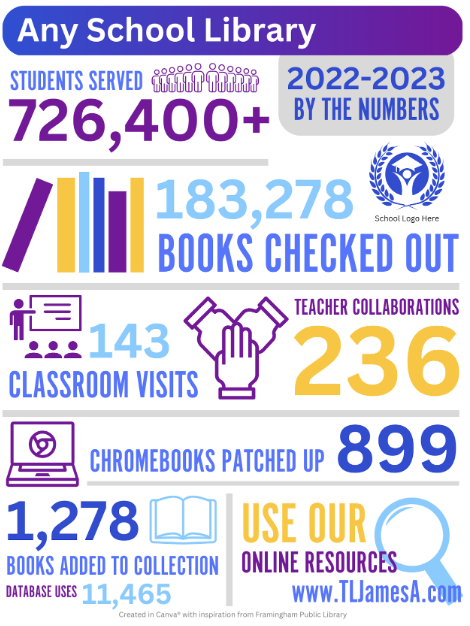
An infographic format, being typically brief and easy to scan, is a popular way of presenting an annual report.
Example
This is one example of a school library's annual report in infographic format. It is brief (two sides of an A4 sheet of paper) and contains information about resource inputs and maintenance (i.e. withdrawn items) and use made of the catalog.
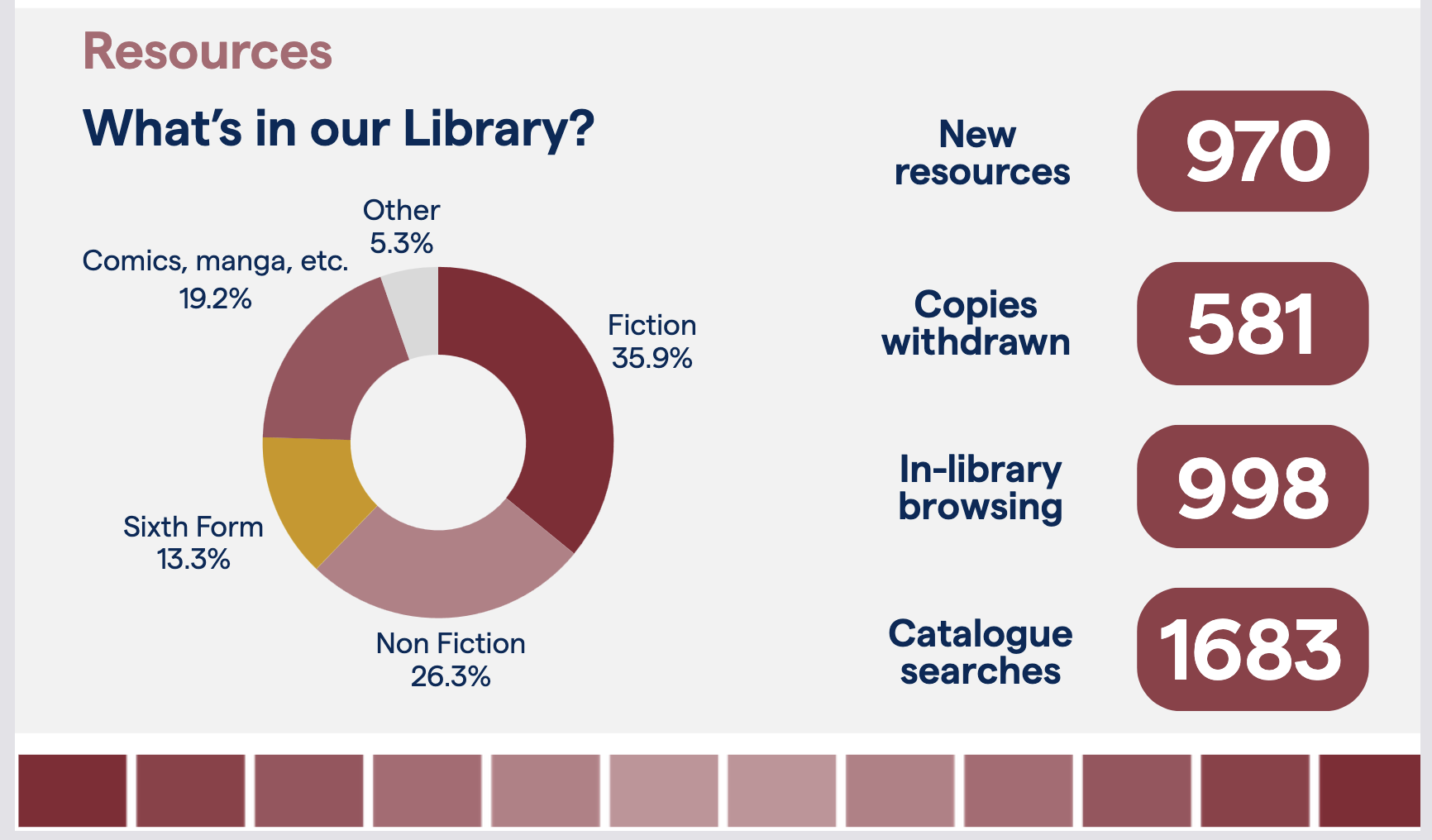
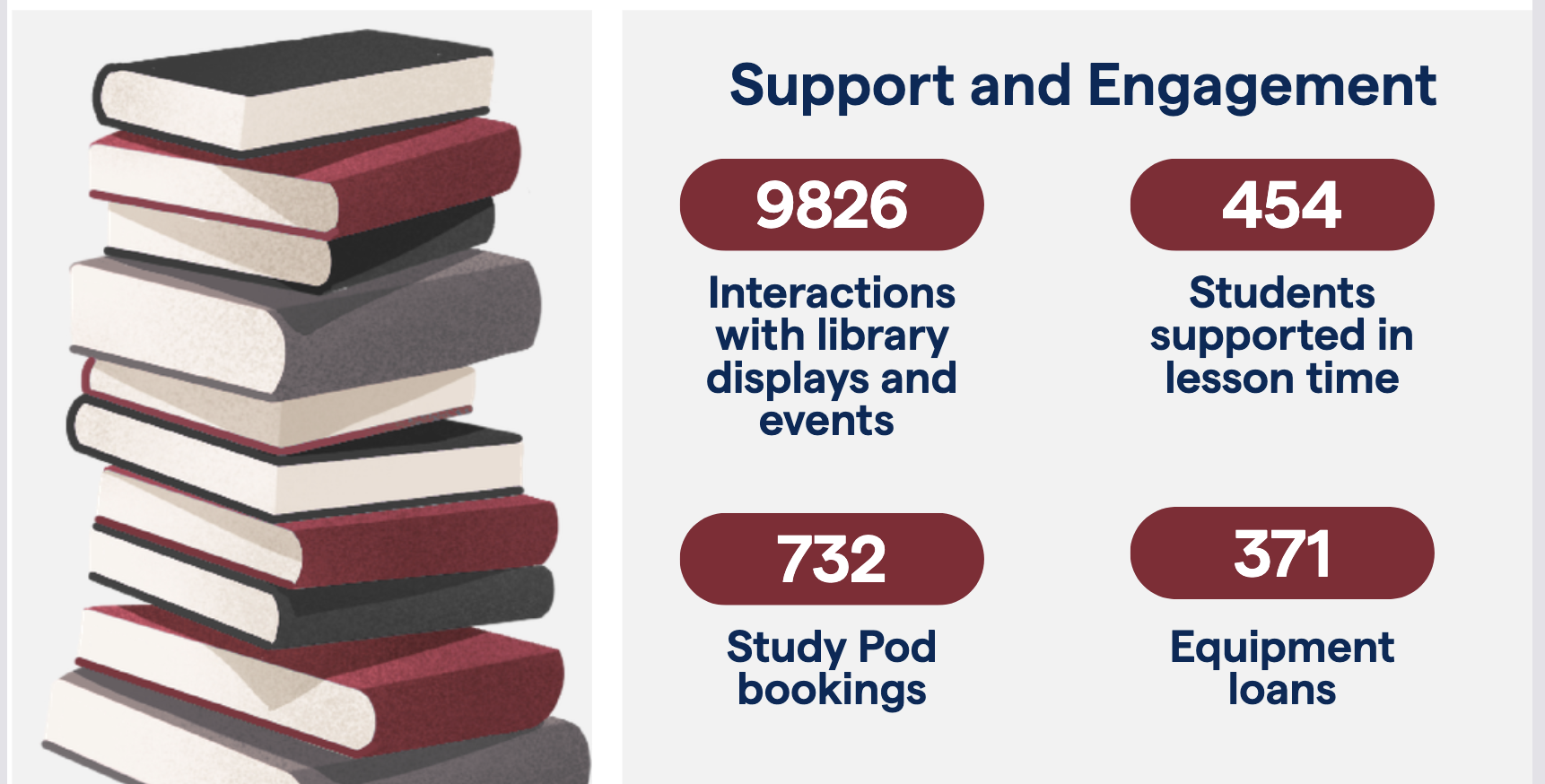
The infographic also uses interesting headings, such as this section called “support and engagement”. Other sections include an analysis of loans (such as a table showing borrowing by student year group - and staff), projects and events, and most popular items.
Using library-focused technology
Another option is to use technology used for library purposes, such as a library blog or part of the library management system used by the library. Equally, there could be use of a library section of the learning management system used by the school. An alternative is a product used through a subscription from the library budget, such as Libguides.
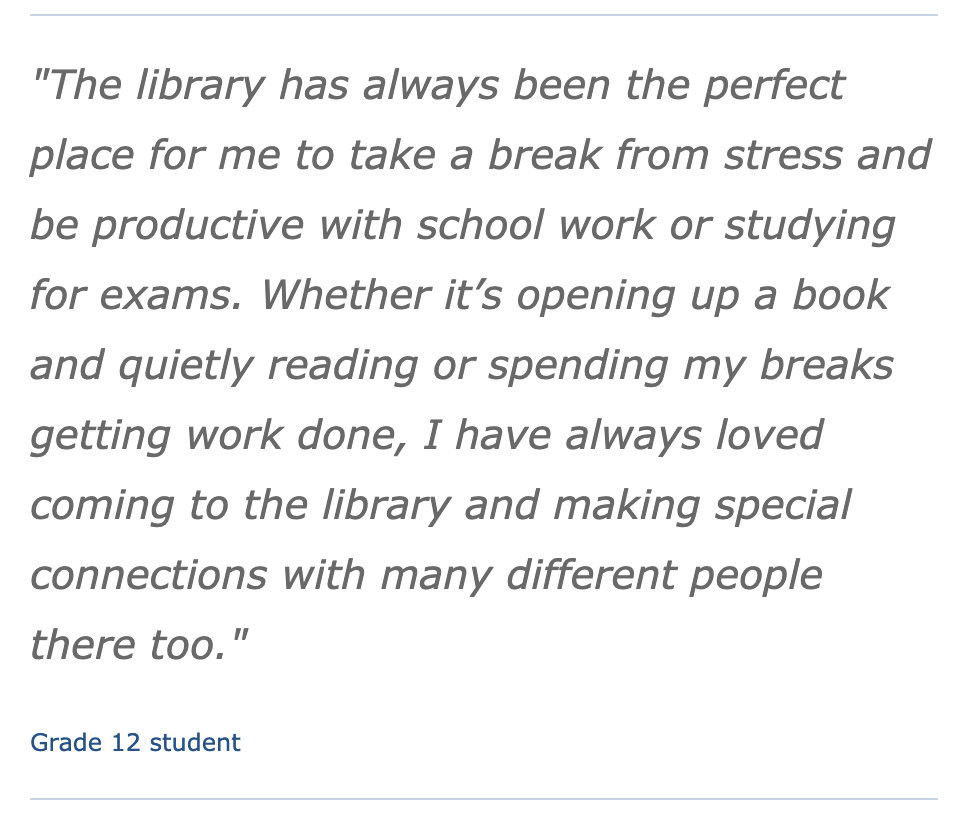
Advantages are that, generally speaking, library staff have control over the appearance and content of the annual report reproduced in this way. Sometimes, this can include making the annual report available to a wider audience than the school through hosting on a platform available on the internet. One example is that of the American School of Dubai library - here we can see that the annual reports for the school library are available, together with the three themes or columns - reading, research, community - that provide focus and a way of organizing content.

Within each column, small pieces of information are offered. In this example, the library story is shown through a quote from an older student showing the value of the library to that person. The quote stands alone and clear, and doesn't need any further explanation.
Positive thinking and approach when producing an annual report
Because of its annual nature, it may be difficult to generate motivation for an annual report year on year, in spite of perhaps an initial enthusiasm. However, it is helpful to maintain motivation in the long term.
Motivation
Nadine Bailey, an IB librarian, writes: “The most arduous task at the end of the year … is creating the annual report. I can see why people stop doing this. With declining borrowing / reading it can be quite a depressing exercise. It's also remarkably difficult to get good data our of our systems. She was also aware of difficulties of getting reliable data from a library management system, etc., and had become aware of the concept of vanity metrics 'basically just putting together data that makes you look good. With that at the back of my mind, putting the report together became this exercise in trying to show both that the situation with reading is not great while trying to show that as librarians and teachers we're doing our darnest to turn the tide and hopefully all is not lost.” (Bailey, 2025)
Helpful reflections
Another librarian uses reflection to help work out what to include in an annual report: “I've been working on my annual report and gathering circulation data, number of student requests, counting library lessons we delivered and events and programs … [and] reflecting on how we in school libraries make reading a visible, valued and enjoyable part of everyday school life. … it's all the little things we do throughout the year that really make a difference. The conversations about books, the welcoming spaces, the freedom to choose what to read, the opportunities to discover something new, and the relationships we build with our readers. And sometimes, those little things can be just as powerful as our biggest celebrations.” (Dearnaley, 2026)
Whilst one reflective school librarian (Maliszewski, 2025) identified that it wasn't possible to make a causal link between an annual report and increased resourcing for a school library, the process of making an annual report was nevertheless helpful as:
- Collecting data and evidence and compiling annual reports was helpful personally for the school librarian
- Celebrating is good, and a school library annual report is one way of doing this
- Sharing and communicating is helpful, especially in a caring and wellness environment.
DP-ising the annual report
Highlighting library/ian contributions to the school's Diploma Programme and support for DP students can be a useful strategy.
Possibilities include:
- DP classes supported
- DP classroom collections
- Core element support, not least Extended Essay
- Work with individual DP students
- Help with CAS
- Numbers of students using the library outside lesson times - for DP students, this may include ‘free lessons’ or their non-timetabled times.
- Connecting to IB ‘big’ ideas, such as academic integrity and international-mindedness.
Depending on the size of the cohort of the DP students in the school and the number of subject options available, information/data might not seem significant if just using statistics, so a better focus might be a qualitative approach or explanation. Let's take an example of library/ian support for DP classes. One way would be to identify how many classes were supported, e.g.
The library provided five classroom collections during the year and 15 visits from DP classes
Alternatively, why not briefly describe what was provided, e.g.
The library curated focused collections to DP classes, including Lang&Lit, History, TOK, …
The librarian worked with DP subject teachers to host focused DP class visits to the library, including Theatre, Visual Arts, Economics, History …
As the DP may be a distinct way of working for the school librarian and DP students use it in an individual way say from how they might have used the library when younger, so this different focus of the school library/ian may well be reflected differently in the annual report.
What can we do?
- Highlight DP connections in the annual report especially if you consider that the DP is a significant aspect of the work of the library.
- Use any identified DP connections as supporting evidence in the five-yearly IBDP evaluation process.
- Think about how statistics are included and/or presented in an annual report. Do they support the library's story or narrative?
- Think whether an infographic format will work for your library. It may initially involve some work to get it right, but can be relatively straightforward in future years. It also combines the advantages of a digital approach, plus can be reproduced in printed form and enlarged as a poster.
- When reviewing the annual report copy, reflect if the overriding impression is one that is celebratory?
- Seek an opportunity to present - in-person - the report to senior management.
- An annual report is a great opportunity and a good strategy, but it doesn't work for every situation. If you know an annual report for your school library wouldn't be read or looked at, then - even if the school library community encourage you do develop one - think carefully if it is a good use of your time … Perhaps another approach would work better for you. See Advocacy, impact and evidence and Partners and influencers
References and further information
See also Advocacy, impact and evidence
Bailey, N. (2025, June 28). Year end 2025. Informative Flights - musings of a teacher librarian [blog]. https://intlnadine.org/2025/06/28/school-year-end-2025/
Chrastka, J. (2024, February 28). The annual report as an advocacy technique. School Library Journal/SLJ blog. https://politicsinpractice.slj.com/2024/02/28/the-annual-report-as-an-advocacy-technique/
Dearnaley, M. (2022, December 17). School library annual report. Madison's Library [blog]. https://madisonslibrary.com/2022/12/17/ramblings-school-library-annual-reports/
Dearnaley, M. (2026, November). A reading culture is more than Book Week. Madison's Library [newsletter]. https://madisonslibrary.com/
Gaddy, L. (2023, December 05). Recipe for compelling annual reports. EBSCO NoveList blog. https://about.ebsco.com/blogs/novelist/recipe-compelling-annual-reports
International Federation of Library Associations and Institutions. (2015). IFLA School Library Guidelines. 2nd ed. https://www.ifla.org/publications/node/9512
King's Langley School. (2026). Library policy. Formerly available online at the school's website.
Library infographics and reports. Kentucky School Library Media Resources. [James Allen]. https://sites.google.com/education.ky.gov/kylmr/resources/library-reports
Maliszewski, D. (2025). Decades of Data: Accountability and Impact with Annual Reports. Canadian School Libraries Journal, 9(2), 1.
National Library of New Zealand. (n.d.). Annual report. Services to Schools. https://natlib.govt.nz/schools/school-libraries/leading-and-managing/managing-your-school-library/annual-report
Photo: introduction box photo by Firmbee.com on Unsplash
School library reporting in a digital age. (2021, July 02). Infobase blog. https://infobase.com/blog/public-libraries/school-library-annual-reporting-in-a-digital-age/ [Author: Linda Hoiseth]
Bold type in quotes above by authors of this website