Peacemaking: Negotiation, Mediation, and Treaties

Introduction to Peacemaking
This topic focuses on peacemaking, which the United Nations describes as measures "to address conflicts in progress" that usually involve "diplomatic action to bring hostile parties to a negotiated agreement" (United Nations, n.d.). We will examine how conflicts end, how negotiation works and when parties are ready to negotiate. We will also explore barriers to achieving peace, how third parties mediate, and what peace agreements include.
| Prescribed Topic | Prescribed Content |
| Interactions of political stakeholders and actors | Third parties, including mediation processes, negotiation processes and interventions |
| Nature, practice and study of peace and conflict | Peacemaking, including negotiations and treaties |
This is the first of three pages on peacemaking. This page covers how conflicts end, negotiation, mediation, and peace agreements. The second page, Diplomacy, Sanctions, and Embargoes, covers coercive diplomacy, the tracks of diplomacy, and the use of sanctions and embargoes by third parties. The third page, Humanitarian Intervention and the Responsibility to Protect, covers genocide, R2P, and the debate over military intervention.
In 2025, the Uppsala Conflict Data Program (UCDP) recorded 65 armed conflicts involving states, the highest number since its records began in 1946. Thirteen of these were wars (conflicts with at least 1,000 battle-related deaths in a year) (Uppsala University, 2026). It is important to understand how these conflicts end, because not every end to the fighting leads to a lasting peace. Some conflicts end when one side wins, while others end when the parties agree to stop fighting. Many simply die down and start again years later. Studying peacemaking will help you explain why some agreements last while others collapse, and assess the efforts being made to end current wars, such as those in Ukraine and Sudan.
Allow me to tell you, from my own experience, that it is much harder to make peace than to wage war.
- Santos, 2016
Juan Manuel Santos made this statement in Oslo in December 2016, when he received the Nobel Peace Prize. As Colombia's president, he had just reached an agreement with the Revolutionary Armed Forces of Colombia (FARC), a left-wing guerrilla group that had fought the government for more than 50 years. More than 200,000 people were killed in the conflict. The two sides began peace talks in Havana, Cuba, in 2012 and signed an agreement four years later. However, in October 2016, Colombian voters narrowly rejected the agreement in a referendum. The government and the FARC renegotiated parts of it, and Colombia's Congress approved the revised agreement at the end of November.
Questions to Consider
- Why might it be harder to make peace than to wage war?
- Why might people who have suffered during a war vote against a peace agreement?
In this simulation, you will act as a negotiator for one of the two sides in a civil war, or as a mediator between them. You do not need to know anything about negotiation before you begin. Your teacher will give you a briefing for your role.
This simulation takes about 20 minutes, including a short debrief. If time is short, assign the debrief questions as homework or discuss them at the start of the next lesson. Students negotiate in groups of three. The debrief introduces several of the ideas in the lesson content, including positions and interests, the zone of possible agreement, ripeness, mediation, and barriers to peacemaking. The scenario is fictional, but it draws on issues that arise in many civil wars, including disarmament, autonomy for a region, the sharing of natural resources, and the fear of prosecution.
Setup
- Put students in groups of three. One student represents the government of Kestria, one represents the Northern Front, and the third is the mediator.
- Read the background briefing aloud to the whole class.
- Give each negotiator their own confidential briefing. Students should not see the other side's briefing.
- Give the mediators their briefing and ask them to wait at the side of the room during the first round.
Background Briefing (All Students)
For six years, the government of Kestria has fought the Northern Front, an armed group from the Varo region in the north of the country. Most people in Varo speak a different language from the rest of Kestria. Many feel that the government has ignored them. Varo also has the country's largest copper mines, but most of the profits go to the capital. The fighting has killed thousands of people and forced many more from their homes. Neither side has been able to win. Both have now agreed to send negotiators to talks.
Confidential Briefing: Government of Kestria
- Your government's public position is that the Northern Front must give up its weapons and surrender before any other issue can be discussed.
- You cannot accept independence for Varo, because it would divide the country and you would lose the copper mines.
- Copper exports pay for a large part of the national budget. The war has closed several mines.
- An election is due next year. Voters are tired of the war. However, your government cannot be seen to reward violence.
- If the fighting ends, you could accept more control for Varo over its own affairs and a larger share of the mine profits for the region.
- Some of your senior army officers oppose any deal with the Northern Front.
Confidential Briefing: Northern Front
- Your public position is that Varo must become an independent state.
- What your supporters want most is for the Varo language to be officially recognized and for the region to run its own schools and local government.
- You also want Varo to receive a fair share of the profits from the copper mines.
- Your fighters will not give up their weapons unless they are safe from arrest and have a way to earn a living afterwards.
- Your leaders fear they will be put on trial if they surrender.
- You are running short of weapons and money, but some of your commanders want to keep fighting whatever happens.
Mediator Briefing
- You represent a regional organization that Kestria belongs to.
- You do not take sides. You cannot force either side to agree.
- Your task is to help each side explain what it needs, as well as what it is demanding.
- You may speak to each side privately.
- Do not suggest a solution until both sides have explained their needs.
Rules for Students
- Stay in role throughout the simulation.
- You may tell the other side as much or as little about your briefing as you choose, but you may not show it to them.
- An agreement is only reached if both negotiators accept it.
- Write down any agreement and have both negotiators sign it.
The Simulation
- Round 1 (5 minutes). The two sides negotiate directly, without the mediator.
- Update (read aloud). "A drought has caused food shortages across Kestria. Aid agencies are warning of famine in Varo. Kestria's largest trading partner has announced that it will stop buying Kestrian copper until the fighting ends."
- Round 2 (8 minutes). The mediator joins the negotiation.
Debrief
- Identify your side's position and the needs behind it.
- Explain why it was difficult to reach an agreement in the first round.
- Explain how the update and the mediator changed the negotiation.
- Outline the agreement your group reached, if any. How likely is it to last?
Instructions
To open a section of the lesson content, click the "+" sign beside its title. Click the "-" sign to close it.
As you read the following lesson content, take notes in your own words. For each section, record the following.
- Key concepts, with a definition in your own words
- Theorists and practitioners, and their main arguments
- Examples you could use as evidence in Paper 1 and Paper 2 responses
- Different perspectives and criticisms
- Links to the core topics and the key concepts (power, sovereignty, legitimacy, and interdependence)
When you have finished, review your notes, then put them away and complete the content quiz without looking back at the reading or your notes.
William Zartman, a leading scholar of negotiation, explained negotiation as a process in which parties combine their conflicting positions into a joint agreement (Zartman, 1977). Each side can veto any proposal, so neither side can force the other to agree. This distinguishes negotiation from a military victory or an imposed settlement.
Ripeness
Why do parties that have been fighting for years suddenly agree to talk? Zartman argued that the timing has to be right, or "ripe."
The concept of a ripe moment centers on the parties’ perception of a mutually hurting stalemate (MHS)...
- Zartman, 2000, p. 228
In other words, neither side believes it can win. Continuing the conflict is also costly for both. Zartman described the stalemate as a plateau. He described the point at which things are about to get much worse, such as an approaching military defeat, as a precipice. Furthermore, the parties need to believe that a negotiated solution is possible and that the other side believes this too. Zartman called this a "way out."
Ripeness depends on perception. In other words, the leaders on both sides must believe they are in a stalemate, whether or not one exists in reality. Zartman also noted that ripeness is "a necessary but not sufficient condition" for negotiations to begin (Zartman, 2000, p. 227). Even when a conflict is ripe, the parties still have to recognize the moment and act on it.
The Stages of Negotiation
Zartman and Berman (1982) explained that negotiation takes place in three stages.
| Stage | Explanation |
|---|---|
| Diagnosis | The parties identify their real interests, not just their stated positions. They also look at how similar conflicts have been resolved. |
| Formula | The parties agree on a shared definition of the problem and a general framework for solving it. A formula can be minimal, ending the violence without dealing with its causes, or it can try to resolve the causes of the conflict. |
| Details | The parties work out the specific terms of the agreement. |
The diagnosis stage links to the positions, interests, and needs (PIN) model that you may have used to analyze conflict dynamics. Parties often begin with fixed positions, but an agreement is more likely when they focus on the interests and needs behind those positions.
Zartman also explained that parties can move toward an agreement in three ways.
- Concession: when each side gives up part of what it wants and moves toward the middle
- Compensation: when one side is offered something else in return for giving way, such as aid, trade, or territory
- Construction: when the parties reframe the problem so that a solution benefits both sides
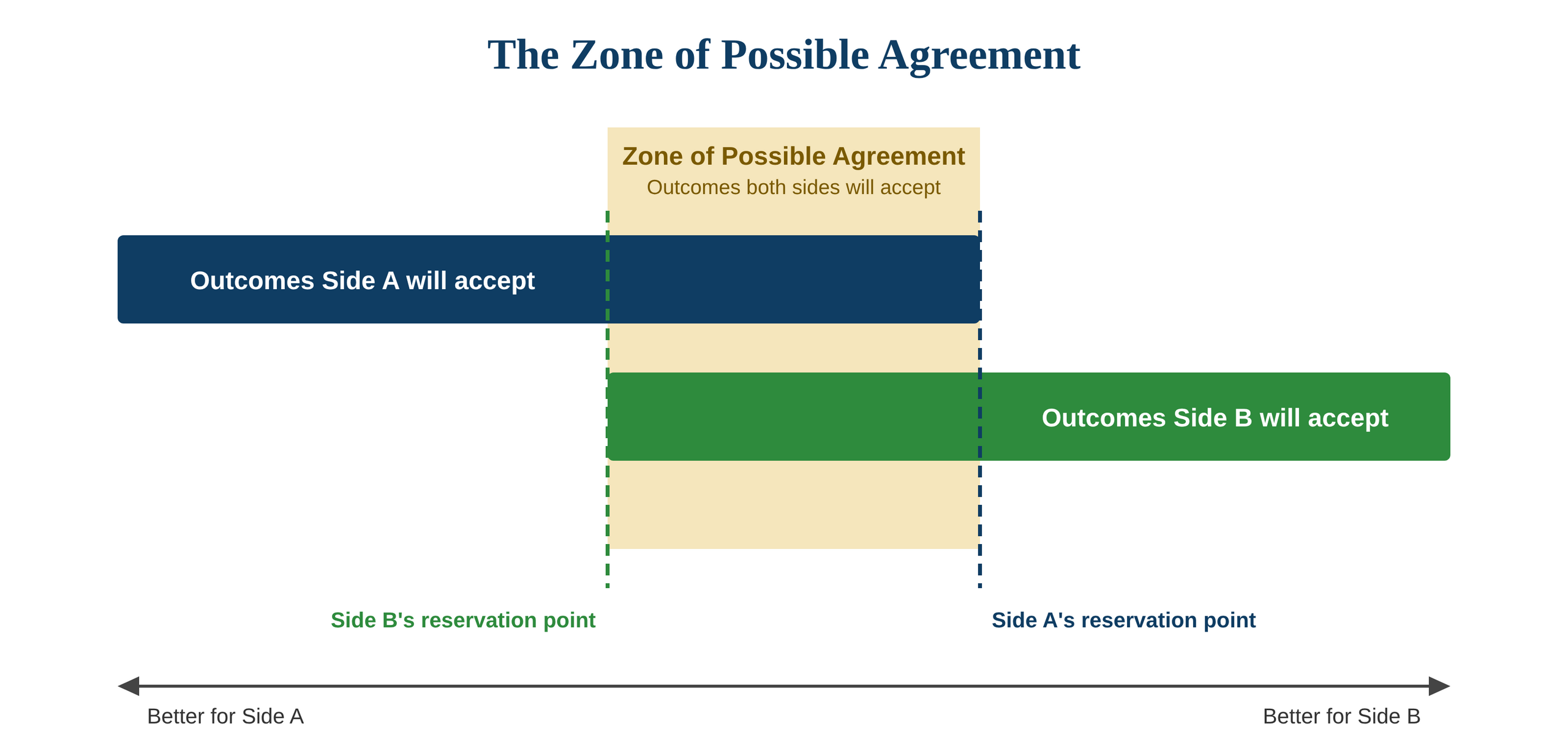
Lax and Sebenius (1986) described the overlap between what each side is willing to accept as the zone of possible agreement. Each party's limit is called its reservation point (the point beyond which it will walk away from the table). If there is no overlap, no agreement is possible unless one side changes its position or a mediator finds a way to create one. Construction and compensation are both ways of creating an overlap where none existed.
Negotiation becomes much harder when the parties see the conflict as zero-sum. In a zero-sum conflict, any gain for one side is seen as a loss for the other, so neither side is willing to give way.
Choose one of the following peacemaking processes and conduct some research to respond to the guiding questions below.
- The Colombian peace agreement (2016)
- The Doha Agreement between the United States and the Taliban (2020)
- The truce in Yemen (2022)
- The Pretoria agreement in Ethiopia (2022)
- The Black Sea Grain Initiative (2022 to 2023)
- The Jeddah talks between Sudan's army and the Rapid Support Forces (2023)
Guiding Questions
- Identify the parties to the conflict and any third parties involved in the peace process.
- Explain whether the conflict was ripe for negotiation when talks began. Consider whether the parties faced a mutually hurting stalemate and whether they saw a way out.
- Outline what the agreement contained and identify any spoilers inside or outside the process.
- To what extent has the agreement brought peace? Consider both negative and positive peace.
Paper 1, Question 3
Source A Extract from “Ripeness: The Hurting Stalemate and Beyond” by I. William Zartman, published in International Conflict Resolution After the Cold War (2000).
Ripeness theory is intended to explain why, and therefore when, parties to a conflict are susceptible¹ to their own or others’ efforts to turn the conflict toward resolution through negotiation. The concept of a ripe moment centers on the parties’ perception of a mutually hurting stalemate (MHS), optimally associated with an impending, past, or recently avoided catastrophe (Zartman and Berman, 1982; Zartman, 1983, 1985/ 1989; Touval and Zartman, 1985). The idea behind the concept is that, when the parties find themselves locked in a conflict from which they cannot escalate² to victory and this deadlock is painful to both of them (although not necessarily in equal degrees or for the same reasons), they seek a way out. The catastrophe provides a deadline or a lesson indicating that pain can be sharply increased if something is not done about it now; catastrophe is a useful extension of the notion of an MHS but is not necessary to either its definition or its existence. In different images the stalemate has been termed the plateau, a flat and unending terrain without relief, and the catastrophe the precipice, the point where things suddenly and predictably get worse.
¹ susceptible: likely to be influenced or affected by something
² escalate: to increase the intensity of a conflict, for example by using greater force
Source B Extract from United Nations Guidance for Effective Mediation, published by the United Nations (2012).
A range of issues can affect whether conflict parties consent to mediation. The integrity of the mediation process, security, and confidentiality are important elements in cultivating the , along with the acceptability of the mediator and the mediating entity. However, the dynamics of the conflict are a determining factor, and whether parties consent to mediation may be shaped by an interest to achieve political goals through military means, by political, ideological or psychological considerations, or by the actions of external players. In some instances, parties may also reject mediation initiatives because they do not understand mediation and perceive it as a threat to sovereignty or outside interference. In a multi-actor conflict³, some, but not all, conflict parties may agree to the mediation, leaving a mediator with the difficult situation of partial consent to commence a mediation process. Moreover, even where consent is given, it may not always translate into full commitment to the mediation process.
³ multi-actor conflict: a conflict that involves more than two parties
Compare and contrast the views of Source A and Source B on what makes peace talks successful. [6]
Paper 2, Section A
To what extent is the timing of negotiations more important than the role of third parties in ending conflicts? [15]
Paper 3, Question 2
(a) With explicit reference to a political issue in one of your researched case studies, analyse two barriers to reaching a peace agreement between the parties involved. [4]
(b) Based on the political issue identified in 2(a), recommend how a third party could help the parties overcome one of these barriers. [6]
Engagement Project and Extended Essay
Engagement Project. You could explore a local dispute in which mediation is being used, such as a disagreement between residents and a developer over the use of land, or a dispute between a union and an employer. Bercovitch's conditions for successful mediation could be used as a lens. Interviews with a mediator and with people on each side might reveal how motivated the parties are, whether they feel the dispute is ripe for settlement, and how they judge the fairness of the process.
Extended Essay. You could draw on Zartman's theory of ripeness to ask, "To what extent does the concept of a mutually hurting stalemate explain the timing of the Pretoria agreement between the Ethiopian government and the TPLF in November 2022?" The research could explore the military situation in Tigray in the months before the talks, the costs of the war for both sides, and the role of the African Union's mediators.
Key Terms
| Term | Definition |
|---|---|
| Peacemaking | Action to address a conflict in progress, usually through diplomacy, to bring the parties to a negotiated agreement |
| Negotiation | A process in which parties combine their conflicting positions into a joint agreement |
| Mediation | A process in which a third party helps the parties reach their own agreement, without force or the authority of law |
| Arbitration | A process in which a third party decides a dispute and the decision is binding |
| Ceasefire | An agreement to stop fighting, which may be temporary or permanent |
| Truce | A pause in the fighting, usually for a set period of time |
| Mutually hurting stalemate | A situation in which neither side believes it can win and continuing the conflict is costly for both |
| Zone of possible agreement | The overlap between what each party is willing to accept |
| Reservation point | The point beyond which a party will walk away from a negotiation instead of accepting an agreement |
| Spoiler | A leader or group that uses violence to undermine a peace process it sees as a threat |
| Ratification | The formal approval of an agreement, usually by a parliament |
Key Theorists and Practitioners
| Theorist | Key idea |
|---|---|
| William Zartman | Conflicts become ripe for negotiation when the parties perceive a mutually hurting stalemate and a way out |
| Jacob Bercovitch | Mediation is more likely to succeed when the parties are motivated, the conflict is ripe, and the mediator is suitable |
| Stephen Stedman | Spoilers inside and outside a peace process can undermine it. They also differ in how much they want |
| Joakim Kreutz | Most armed conflicts end without a victory or a peace agreement. Civil wars are less likely to recur after a government victory |
| Juan Manuel Santos | As Colombia's president, he negotiated the 2016 peace agreement with the FARC and argued that making peace is harder than waging war |
Key Ideas
- Conflicts can end through military victory, imposed settlements, ceasefires, truces, arbitration, mediation, or peace agreements, but many simply die down.
- Parties are most likely to negotiate when they perceive a mutually hurting stalemate and believe a negotiated solution is possible.
- Third parties, including the UN, regional organizations, states, and NGOs, can help the parties reach an agreement, but they cannot impose one through mediation.
- War economies, fear of prosecution, hardliners, and spoilers can prevent or undermine peace agreements.
- An agreement that ends the fighting brings negative peace, but putting it into practice and dealing with the causes of the conflict is often more difficult.
Connections to the Core Topics
- Power in Global Politics: Ripeness depends on the balance of power between the parties. Powerful mediators can use rewards and pressure to move the parties toward an agreement.
- Legitimacy: Referendums and ratification by parliament give peace agreements greater legitimacy. Mediators such as the UN and the African Union draw on their legitimacy to bring parties together.
- Sovereignty: States often see conflicts within their borders as internal matters and resist outside mediation.
- Framing Global Politics: Peacemaking involves many of the actors listed in the core topics, including states, IGOs, NGOs, and armed non-state actors.
Connections to Case Studies and the HL Extension
| Case Study | HL Topic Areas | Links to the Topic |
|---|---|---|
| The Colombian peace agreement (2016) | Security, Poverty, Identity | A mutually hurting stalemate led to four years of talks. The agreement was rejected in a referendum and then revised and approved by Congress. |
| The Pretoria agreement in Ethiopia (2022) | Security, Health, Identity | African Union mediators ended the war in Tigray. Eritrea was not a party to the agreement. |
| The Black Sea Grain Initiative (2022 to 2023) | Security, Poverty, Environment | The UN and Turkey brokered an agreement on a single issue during the war in Ukraine. It collapsed when Russia withdrew in July 2023. |