Nonviolent Conflict: Social Movements
Introduction to Social Movements
A single protest rarely changes very much. Lasting change usually comes when people organize, keep the pressure on over months or years, and build support well beyond those who first took to the streets. On the previous pages, we looked at what nonviolence means and at the debate over the legitimacy of nonviolent and violent protest. This page examines social movements, which are among the most important non-state actors in nonviolent conflict. It looks at what social movements are and how they differ from other non-state actors, why they form, the stages they tend to go through, how social media has changed them, and what they achieve.
| Prescribed Topic | Prescribed Content |
| Interactions of political stakeholders and actors | Violent and non-violent state and non-state actors |
This is the third of three pages in the Nonviolent Conflict section. This page covers what social movements are, why they form, and how they develop. The first page, Nonviolence and Pacifism, covers the meaning of nonviolence and pacifism. The second page, The Legitimacy of Nonviolent and Violent Protest, covers forms of nonviolent action and the debate over whether nonviolent or violent protest is more effective. Social movements are also listed as non-state actors in the core topic Framing Global Politics, so you can use this page when teaching the core as well.
But I've learned you are never too small to make a difference.
- Thunberg, 2018
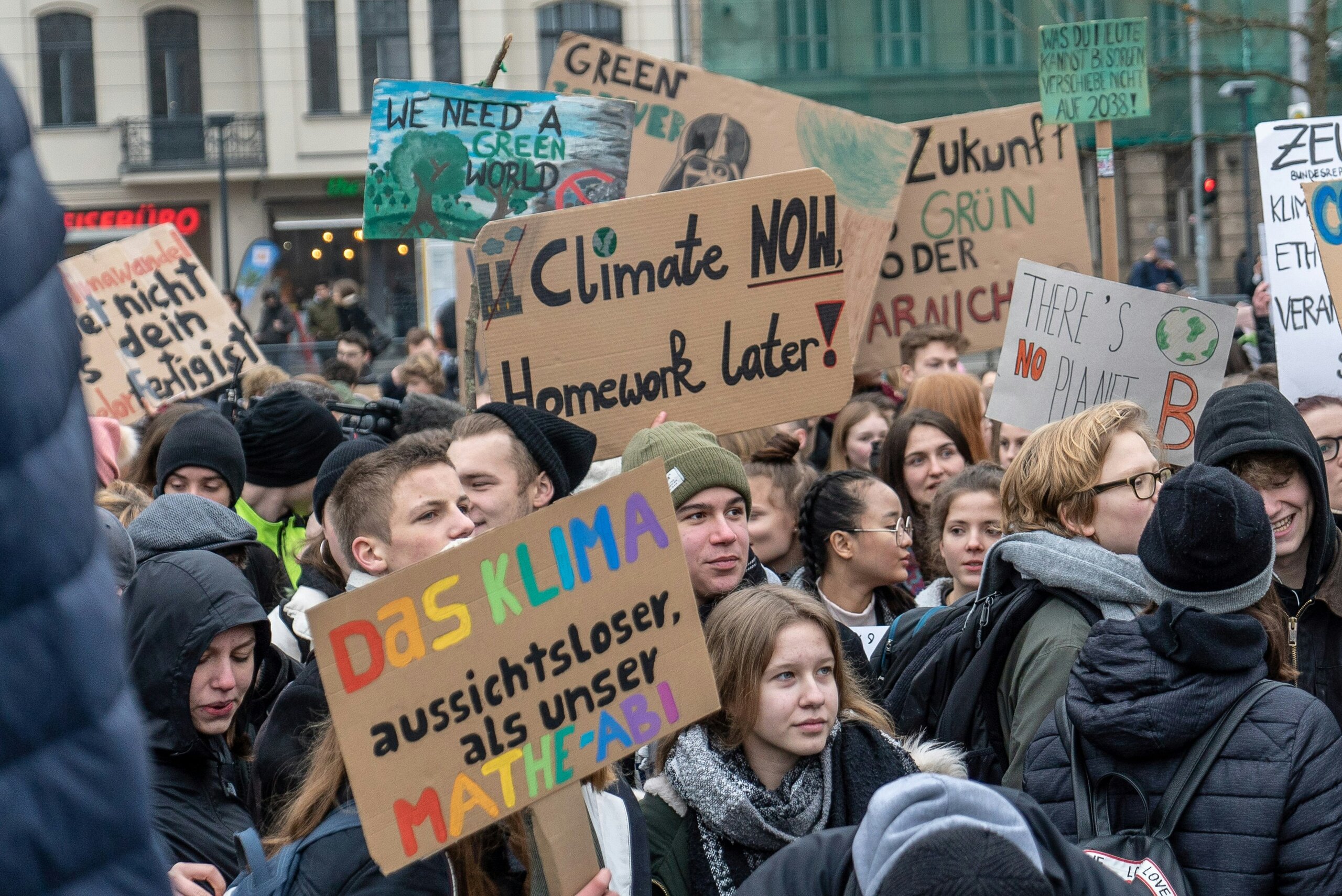
In August 2018, Greta Thunberg, then 15 years old, sat alone outside the Swedish parliament with a sign that read "School strike for climate." Other students began to join her, first in Sweden and then in other countries, under the name Fridays for Future. Thunberg spoke the words above at the United Nations climate conference in Poland that December. On 20 September 2019, just over a year after her first strike, organizers reported that more than 4 million people in 150 countries took part in a single day of climate strikes. However, global carbon emissions have continued to rise since then.
Questions to Consider
- Why do some protests grow into movements while others fade away?
- How should we judge whether a social movement has succeeded?
Social movements are one type of non-state actor. Others include NGOs, political parties, interest groups, and resistance movements. It is not always easy to tell them apart, because they often work on the same issues and use similar methods. For example, a social movement and an NGO might both campaign for action on climate change.
The table below describes eight non-state actors from the last 20 years. You are not expected to know the definition of a social movement yet. Use what you already know to decide which of them are social movements.
| Actor | Description |
|---|---|
| Fridays for Future | Students in many countries who have gone on strike from school since 2018 to demand action on climate change |
| Amnesty International | An organization with paid staff, members, and offices around the world that researches and campaigns against human rights abuses |
| Black Lives Matter | A campaign against racism and police violence that began with a hashtag in the United States in 2013 and has no single leader |
| A one-day march against a rise in bus fares | Residents of a city who march to the mayor's office on a single afternoon |
| The People's Defence Forces in Myanmar | Armed groups formed in 2021 to fight the military government that seized power in a coup |
| A political party | An organization that puts forward candidates in elections in order to form a government |
| #MeToo | Women around the world who have shared their experiences of sexual harassment and assault online since 2017 and called for change |
| A national association of oil companies | An organization that meets with government ministers to influence energy policy on behalf of its members |
Reviewing the Activity
Once you have discussed the prompts with your partner, open this box and compare your responses with the possible responses below. Your responses may differ, because some of these actors are difficult to place.
Identify the actors you consider to be social movements.
- Fridays for Future, Black Lives Matter, and #MeToo are usually considered social movements.
- Amnesty International is a non-governmental organization (NGO), although it often works alongside social movements.
- The People's Defence Forces are an armed resistance movement.
- The association of oil companies is an interest group.
- The one-day march is a protest. It could become part of a social movement if it continued and grew.
Outline the features that these social movements have in common.
- They involve large numbers of ordinary people acting together.
- They continue over months or years.
- They share a cause and a sense of belonging to the movement.
- They work mainly outside formal political institutions, using protest to put pressure on those in power.
- They are often loosely organized, without a single leader or formal membership.
Distinguish between a social movement and one other type of actor in the table.
- A social movement has no formal membership or paid staff, while an NGO such as Amnesty International is a formal organization.
- A social movement tries to influence those in power, while a political party tries to win power through elections.
- A social movement relies mainly on nonviolent protest, while an armed resistance movement uses force against a government or occupying power.
- A social movement seeks support from the wider public, while an interest group mainly represents the interests of its own members.
This activity works well with actors printed on cards so pairs can sort them at their desks. Allow about 15 minutes, including the discussion. Students do not need a definition of a social movement before they begin. Ask them to explain how they sorted the actors before they open the Reviewing the Activity box, which gives possible responses to the prompts. Students can return to their groups after the first section of the lesson content.
Instructions
To open a section of the lesson content, click the "+" sign beside its title. Click the "-" sign to close it.
As you read the following lesson content, take notes in your own words. For each section, record the following.
- Key concepts, with a definition in your own words
- Theorists and practitioners, and their main arguments
- Examples you could use as evidence in Paper 1 and Paper 2 responses
- Different perspectives and criticisms
- Links to the core topics and the key concepts (power, sovereignty, legitimacy, and interdependence)
When you have finished, review your notes, then put them away and complete the content quiz without looking back at the reading or your notes.
Choose one of the following social movements. Research it and answer the questions below.
- Fridays for Future (2018 onward)
- Black Lives Matter (2013 onward)
- Ni Una Menos in Argentina and Latin America (2015 onward)
- #MeToo (2017 onward)
- The farmers' protests in India (2020 to 2021)
- The #EndSARS protests against police violence in Nigeria (2020)
- The Gen Z protests in Nepal (2025)
Guiding Questions
- Explain why the movement formed, using at least one of the explanations from the reading. Consider the grievances, resources, and political opportunities involved.
- Outline the goals of the movement and how it framed its cause. Who did it hold responsible, and what solution did it propose?
- Identify the stage the movement has reached, and explain your choice. If the movement has declined, why?
- To what extent has the movement achieved its goals? Consider policy, political, and cultural change.
Paper 1, Question 1
Source A
Social movements do not last forever. Some decline because they succeed, as their demands are met and supporters see no further need to protest. Others fail when internal divisions or weak organization cause them to collapse. A movement may also be weakened by co-optation, when its leaders accept jobs or money from those they once opposed. Governments may repress a movement through laws, arrests, or force. Finally, a movement can fade because its goals become so widely accepted that it is no longer needed.
- Adapted from Christiansen, 2009
According to Source A, outline three ways in which social movements decline. [3]
Paper 2, Section A
Examine the view that social movements rarely achieve lasting political change. [15]
Paper 3, Question 1
Using two examples, distinguish between social movements and non-governmental organizations (NGOs). [3]
Paper 3, Question 3
With reference to one of your researched case studies and two of the HL topic areas, examine how social movements help in addressing global political challenges. [15]
Engagement Project and Extended Essay
Engagement Project. You could explore a youth-led campaign in your community, such as a local climate strike group or a student campaign to change a school or city policy, and use resource mobilization theory as a lens. Interviews with organizers might reveal which resources the campaign depends on and whicdh of the four stages it has reached.
Extended Essay. You could draw on political opportunity theory to ask, "To what extent does political opportunity explain the success of the Gen Z protests in removing Nepal's government in September 2025?" The research could explore the role of long-standing grievances about corruption and unemployment, the government's ban on social media, and the way protesters organized online.
Key Terms
| Term | Definition |
|---|---|
| Social movement | A large group of people who share a cause and keep challenging those in power over a long period of time |
| Repertoire | The set of actions a movement uses, such as marches, strikes, and boycotts |
| WUNC displays | Public displays of worthiness, unity, numbers, and commitment |
| Relative deprivation | The gap between what people have and what they believe they are entitled to |
| Resource mobilization | Gathering the money, time, skills, and organizations a movement needs |
| Political opportunity | A change in the political situation that makes it easier for a movement to form or succeed |
| Framing | Presenting an issue in a way that persuades people to act |
| Co-optation | When a movement's leaders are drawn to the side of its opponents |
Key Theorists and Practitioners
| Theorist | Key idea |
|---|---|
| Sidney Tarrow | Social movements are sustained collective challenges to those in power, and they respond to political opportunities |
| Charles Tilly | Social movements combine campaigns, a repertoire of actions, and WUNC displays |
| Ted Gurr | People mobilize when they experience relative deprivation |
| John McCarthy and Mayer Zald | Movements form when people can gather resources, often through social movement organizations |
| Robert Benford and David Snow | Movements rely on diagnostic, prognostic, and motivational framing |
| Zeynep Tufekci | Social media helps movements grow quickly but can leave them without the organization they need to last |
Key Ideas
- Social movements are sustained over time and loosely organized. This distinguishes them from single protests and from NGOs, political parties, and interest groups.
- Grievances, resources, political opportunities, and framing together help to explain why movements form.
- Movements often pass through emergence, coalescence, bureaucratization, and decline, although not always in order.
- Decline does not necessarily mean failure, and success can be judged by policy, political, or cultural change.
Connections to the Core Topics
- Power in Global Politics: Social movements rely on power with, by acting together in large numbers. Framing is a form of soft power because it draws people into supporting a cause.
- Framing Global Politics: Social movements are among the non-state actors listed in the core topics. They often work alongside NGOs and political parties, and they can become formal organizations themselves.
- Interdependence: Movements such as Fridays for Future and Ni Una Menos have spread quickly across borders, with protesters in one state adopting the methods and slogans of those in another.
Connections to Case Studies and the HL Extension
| Case Study | HL Topic Areas | Links to the Topic |
|---|---|---|
| Fridays for Future (2018 onward) | Environment, Technology | School strikes spread to 150 countries in just over a year. However, global carbon emissions have continued to rise. |
| Ni Una Menos in Argentina (2015 onward) | Equality, Health, Identity | The movement framed the killing of women as a failure of the state. It contributed to a national Registry of Femicides and to the legalization of abortion in 2020. |
| The Gen Z protests in Nepal (2025) | Technology, Poverty | Protests over corruption, unemployment, and a ban on social media led the prime minister to resign. Protesters then used Discord to choose an interim leader. |