The Lines of Inquiry and the GPCs
The Lines of Inquiry and the GPCs
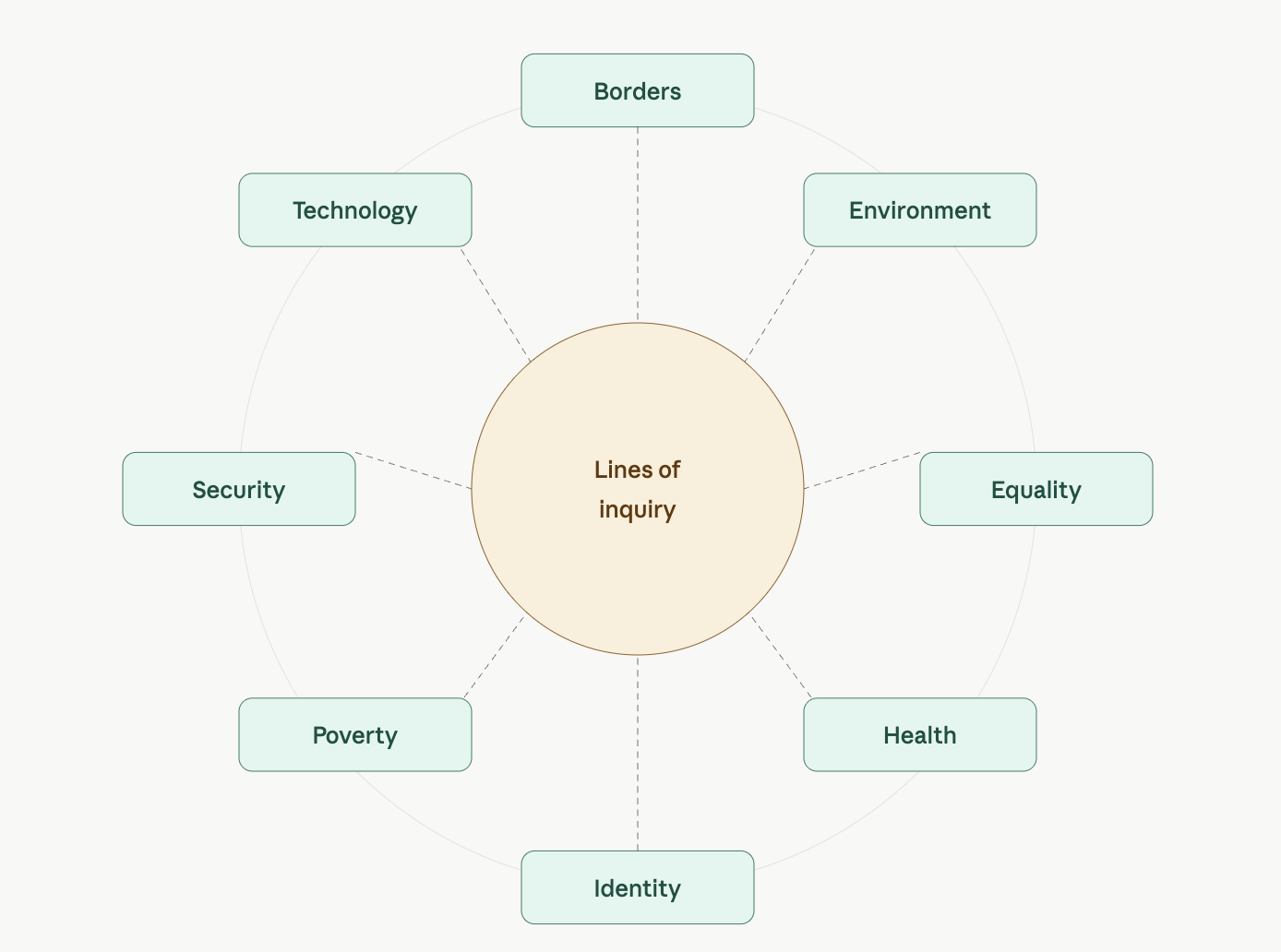
Thinking About the Lines of Inquiry
Question 3 is the most challenging component of Paper 3 and, as noted in this section of the site, Question 3 will be based on one of the lines of inquiry.
This section is dedicated to better understanding each of the six lines of inquiry and their relationship to the Global Political Challenges (GPCs)/Topic Areas. To do this, we will also offer possible explanations/definitions of the GPCs.
Question 3 is out of 15 marks and uses the same markbands as Paper 2. For copyright reasons, please see your Global Politics guide for the specific wording of the full set of markbands.
This question requires synthesizing and evaluating researched case studies and global political challenges. It will be based on one of the six guiding lines of inquiry (LOIs) for the HL extension. This does not mean question 3 will be asked using the same wording or be as general as the six LOIs.
The Six Lines of Inquiry (GP Guide, p. 52)
- What connections can be established between the global political challenge(s) and the core topics?
- What connections can be established between the global political challenge(s) and the thematic studies?
- To what extent are the global political challenges interconnected? What are some of the links in how they are studied and/or addressed?
- How are the global political challenges perceived and addressed in different contexts?
- What are some of the frameworks, systems, organizations and mechanisms put in place for addressing global political challenges?
- How can looking at specific cases from different topic areas change the way global political challenges are perceived or addressed?
Because this question requires synthesizing research from case studies and the Global Political Challenges (also called “Topic Areas”), it is important to understand what each GPC means. Below are suggested explanations of the eight GPCs, political challenges that may arise from each and two possible examples.
Use the “+” to open the explanation and the “-” to close it.
Explanation
Borders are boundaries that separate territories or communities. They may be physical lines between states or non-territorial divisions based on categories like language, religion, wealth, or gender.
Political Challenges
Political challenges can arise from borders when they restrict access or participation. They can also arise when borders fail to regulate what crosses them, such as digital information, criminal networks, or environmental harms.
Examples
A physical border between states (the United States and Mexico)
This is a physical boundary that controls who can cross and under what terms. Migration enforcement, asylum policy, and cooperation on trafficking and labour flows all generate political challenges that are in constant flux. States want to assert sovereignty over their territory while meeting humanitarian and treaty obligations and ensuring that restrictions don't negatively impact their economies.
A non-territorial border based on gender (Afghanistan under the Taliban)
Since 2021, the Taliban have imposed restrictions that function as a border between men and women inside the same territory. Women have been banned from secondary and university education, most paid employment, public parks, and travel without a male guardian. The political challenge is that this border restricts access and participation for half the population. The border cuts women off from public life, economic independence, and having a political voice, while men have full movement through the same spaces.
Explanation
Identity refers to the ways people understand themselves and are recognized by others as belonging to particular groups. It can be shaped by culture, language, religion, gender or shared history, and people often hold multiple identities at the same time.
Political Challenges
Political challenges can arise when identity determines access, status, or participation in society. They can also arise when identities are contested or used to mobilize exclusion or violence against particular groups.
Examples
Identity determines access and status (caste in India)
Caste is a system of social ranking tied to birth that continues to shape life in India despite being formally outlawed in the constitution. Dalits, those at the bottom of the hierarchy, still face discrimination in employment, marriage, and access to public spaces, particularly in rural areas. The political challenge is that caste identity sorts people into different levels of opportunity and protection from the moment they are born.
Identity used to mobilize exclusion (the Rohingya in Myanmar)
The Rohingya are a Muslim minority in a majority-Buddhist country whose identity has been used by the state to justify their exclusion. Myanmar's 1982 citizenship law denies most Rohingya citizenship by refusing to recognize them as one of the country's official ethnic groups. They are stateless as a result. The political challenge is that identity has been turned into a tool of exclusion, stripping a population of legal recognition in the country where they were born.
Explanation
Health refers to the physical, mental and social well-being of individuals and communities. It is influenced by access to healthcare, clean water, food security, and safe living conditions, as well as by social, economic and political factors.
Political Challenges
Political challenges can arise when access to health services is unequal within or between states, whether due to resource constraints or political choices. They can also arise when conflict destroys the systems that protect public health.
Examples
Unequal access to health services (maternal mortality in Nigeria)
A woman's chance of surviving pregnancy and childbirth depends heavily on where she lives. Nigeria's maternal mortality ratio is 1,047 deaths per 100,000 live births, compared with fewer than 10 in most high-income countries (WHO, 2023). The country accounts for roughly 28 percent of all maternal deaths worldwide. Most of these deaths are preventable with skilled medical care during childbirth. The disparity reflects political choices, including how much of a country's budget goes to health. Nigeria spends about 5 percent of its budget on health, well below the 15 percent target African Union states agreed to at the 2001 Abuja Declaration.
Health crises driven by conflict and displacement (cholera in Yemen)
Cholera spreads through contaminated water. It surges in conflict zones and refugee camps where sanitation systems have broken down. Outbreaks in Yemen have infected more than two million people since 2016 and spread into neighbouring countries through displaced populations. The political challenge is that cholera is preventable and treatable, but war and forced displacement destroy the water, sanitation, and health systems that normally keep it in check. People die from a disease that medicine has known how to handle for over a century.
Explanation
Poverty refers to limited access to income and essential services, such as healthcare, education, and clean water, that restrict people's ability to meet basic needs and participate fully in society. It is shaped by economic systems, social structures and political choices that determine how wealth and opportunity are distributed.
Political Challenges
Political challenges can arise when debt or instability weakens a state's capacity to address poverty. They can also arise when anti-poverty policies are poorly designed or fail to reach the people they are meant to help.
Examples
Debt and instability weakening state capacity (Sri Lanka)
In May 2022, Sri Lanka defaulted on its foreign debt for the first time in its history. The economy collapsed, fuel and medicine ran out, and inflation pushed millions of people into poverty within months. The political challenge is that the government had little room to respond. Most of its revenue was already going toward debt repayment, and the IMF bailout that followed imposed conditions requiring further cuts to public spending. When most of the budget goes to debt repayment, there is little left for public services.
Poorly designed anti-poverty policies (the two-child benefit cap in the United Kingdom)
In April 2017, the UK government limited Universal Credit payments to a family's first two children. By 2025, the policy was affecting around 1.6 million children, one in nine in the country, and the government's own analysis estimated that 300,000 of them were in poverty as a direct result. The political challenge is that a system designed to support families with children deliberately excluded some of them based on birth order. The cap was scrapped in November 2025.
Explanation
Environment refers to the natural systems and resources that sustain life. Human activity shapes these systems, and political decisions determine how they are used and protected.
Political Challenges
Political challenges can arise from the tension between protecting the environment and pursuing economic growth. They can also arise when the harms of environmental damage fall most heavily on those who contributed least to causing them.
Examples
The protection-vs-growth tension (Australia and coal exports)
Australia has committed to reaching net zero emissions by 2050. It is also one of the world's largest coal exporters, and the government approved seven new coal mine projects between 2023 and 2024. The political challenge is that Australia wants the revenue from coal exports and the credibility of climate leadership.
Unequal distribution of environmental harms (Tuvalu and rising seas)
Tuvalu is a Pacific island nation of around 11,000 people. Its emissions are negligible, yet sea level rise could make the country uninhabitable by the end of the century. The political challenge is that Tuvalu has done almost nothing to cause climate change but bears some of its worst consequences.
Explanation
Security refers to the protection of individuals, communities and states from threats that undermine their safety and well-being. It includes military threats as well as threats to economic stability, cultural identity, and the basic conditions for a decent life.
Political Challenges
Political challenges can arise when actors disagree over what counts as a threat and whose security should be prioritized. They can also arise when actions taken in the name of security undermine the rights or wellbeing of the people they are supposed to protect.
Examples
Contested security claims (Russia's invasion of Ukraine)
Since 2022, Russia has justified its invasion of Ukraine by framing NATO expansion as a security threat to Russia. Most other states reject this framing and see the invasion itself as the security threat, both to Ukraine and to the wider international order. The political challenge is that one state's claim about what counts as a threat has been used to justify invading another state. The disagreement is not just over facts of the invasion but also over who defines security and what actions that definition might justify.
Security measures that harm those they claim to protect (El Salvador's gang crackdown)
In March 2022, El Salvador declared a state of exception, suspending constitutional rights to crack down on gang violence. Since then, the government has arrested more than 80,000 people, often without trial. Homicide rates have fallen sharply, and the policy is popular with Salvadorans who lived through years of gang control. The political challenge is that public safety has improved for many, while basic legal protections have been removed for everyone. Security has been delivered by methods that leave anyone vulnerable to arrest without trial.
Explanation
Equality is the principle that individuals and groups should have the same rights, opportunities, and protections within a society. In global politics, equality raises questions about how power and access to services are distributed, and whether political and economic systems reinforce advantages for some groups over others.
Political Challenges
Political challenges can occur when economic resources are unevenly distributed between countries. They can also arise when some groups have less political power than others, even in some cases where formal equality supposedly exists.
Examples
Economic equality issues (global income gaps between states)
Income varies enormously between states. The average person in a high-income country like Switzerland earns more than 50 times as much as the average person in a low-income country like Burundi. The political challenge is that the country a person is born into may largely determine their economic life chances.
Political equality (women in parliaments)
Women make up roughly half the world's population. As of 2026, they hold 27.5 percent of national parliamentary seats worldwide (IPU, 2026). Only seven countries have parliaments where women hold half or more of the seats. The political challenge here is that women have the right to vote and run for office in almost every country, yet men still hold most seats in parliaments.
Explanation
Technology refers to the digital systems that shape how people communicate and access information. Technological change can transform political participation and economic activity. It can also widen gaps between those who can benefit from it and those who cannot.
Political Challenges
Political challenges can arise when states use technology to monitor or control their populations. They can also arise when digital systems operate across borders faster than any single state can regulate them.
Examples
States using technology to control populations (China's surveillance system)
China has built one of the most extensive surveillance systems in the world, using facial recognition cameras and internet monitoring to track its citizens. The system has been used to restrict the movement of people the state considers a problem. The political challenge is that technology gives states tools to shape citizens' behaviour at a scale that earlier governments could never have managed.
Digital systems operating beyond state regulation (generative AI)
Generative AI tools are now used worldwide, but governments have struggled to agree on how to regulate them. The political challenge is that the technology is being deployed faster than states can write rules for it.
*Explanations based on the Global Politics guide
The following is an explanation of how to interpret the six guiding lines of inquiry for question 3 on Paper 3
Use the “+” to open the explanation and the “-” to close it.
What connections can be established between the global political challenge(s) and the core topics?
This line of inquiry asks students to take a global political challenge and trace its connections to the four core topics of the course. The core topics are: power, sovereignty, legitimacy, and interdependence.
In the example below, we will look at the GPC of borders, explain how it connects to each of the core topics, and then offer an example of that connection.
While students should look for connections between selected GPCs and all four core topics as part of their inquiries, they should be sure to read Paper 3, Question 3 carefully, in case they are only required to reference a select number of core topics or one in particular.
Borders and Power
Actors use power to enforce, contest, or reshape borders, and states use military and economic power to decide where their territory begins and ends. Other states may use sanctions or diplomatic pressure.
For example, Russia's invasion of Ukraine in February 2022 was an attempt to redraw a border by force. Russia used military power to seize territory, and Ukraine used military power to defend their borders. Western allies of Ukraine have attempted to use economic power to force Russia to settle. There is a clear connection in this example between the GPC of borders and the core topic of power
Borders and Sovereignty
Borders define the limits of territorial sovereignty. A state's authority is supposed to stop at its borders, and what happens on the other side is, in principle at least, another state's responsibility. Sovereignty isn't only about lines on a map; it is also about whether a state can control what occurs inside its own territory and who can move in and out of its territory.
Ukraine's sovereignty has been directly challenged since 2014, when Russia annexed Crimea, and again in 2022, when Russia claimed to annex four more Ukrainian regions it didn't fully control. Most of the international community, including the UN General Assembly, rejected those annexations. This is a good example of how the GPC of borders and sovereignty are connected.
Borders and Legitimacy
Border changes gain or lose legitimacy based on whether they're seen as fair and lawful. A state can claim territory and still fail to convince anyone else that the claim is legitimate.
In September 2022, Russia held referendums in the occupied parts of Donetsk, Luhansk, Zaporizhzhia, and Kherson and tried to use the results to justify their annexation. The votes took place under military occupation, with no independent monitoring, and were rejected by 143 countries at the UN General Assembly. Russia had the power to hold the vote, but it couldn't demonstrate legitimacy for the outcome.
Borders and Interdependence
The notion of interdependence is reflected in the many goods, people, and ideas that move across borders every day. We also see borders and interdependence connected in the way that countries rely on each other for trade, energy, food, and security. This extensive interdependence can become a weapon when cross-border relationships break down.
Before 2022, Russia supplied around 40% of the European Union's natural gas, and Ukraine was one of the world's largest exporters of wheat and sunflower oil. The war disrupted both. Europe tried to replace Russian gas, global food prices spiked, and countries in North Africa and the Middle East that depended on Ukrainian grain felt the shock immediately. The border between Russia and Ukraine was relatively local, but the dispute significantly affected other states due to global interdependence.
All four examples attempt to demonstrate the link between one GPC and each core topic.
What connections can be established between the global political challenge(s) and the thematic studies?
This line of inquiry is essentially the same as LOI #1, which is explained above. Students need to take a global political challenge and identify connections between it and one of the thematic studies (Rights and Justice, Development and Sustainability and Peace and Conflict).
In the example below, we will examine the GPC of identity, explain how it connects to the thematic study of peace and conflict, and provide a real-world example of that connection.
While students might want to explore connections between a GPC and more than one thematic study as part of their inquiries, they should read Paper 3, Question 3 carefully, in case they are only required to reference one thematic study.
Identity and Peace and Conflict
Identity shapes how people understand themselves and how others recognize them. It can be built around culture, language, religion, gender, or shared history, and people usually hold several identities at once. Identity becomes a political challenge when it determines who gets access to power, wealth, or protection, and who doesn't. When one community is consistently excluded, and another benefits from that exclusion, the conditions for conflict are already in place. The GPC of identity doesn't cause war on its own, but it can give armed groups a way to recruit, a story to tell, and a target to point to. This is how identity connects to the thematic study of peace and conflict.
The current war in Sudan demonstrates a connection between the GPC of identity and the thematic study of peace and conflict. Fighting between the Sudanese Armed Forces and the Rapid Support Forces (RSF) broke out in April 2023, but the identity dimensions of the conflict go back much further. The RSF grew directly out of the Janjaweed, the Arab militias the Sudanese government used to carry out the Darfur genocide against the Fur, Masalit, and Zaghawa communities from 2003 until about 2006. The same identity-based targeting has returned in the current war. The RSF has been accused of targeting non-Arab communities again, including mass killings of Masalit civilians in El Geneina. In January 2025, the US government formally determined that the RSF and allied militias had committed genocide in Sudan. Genocide is, by definition, an identity-based crime. Under international law, it means acts committed with the intent to destroy a national, ethnic, racial, or religious group.
In this example, we see a clear connection between the GPC of identity and the identity-based type of conflict that is part of the peace and conflict thematic study.
To what extent are the global political challenges interconnected?
What are some of the links in how they are studied and/or addressed?
This line of inquiry encourages students to explore the extent to which global political challenges are linked to one another. It is not necessary to demonstrate how one GPC is connected to all the others. Instead, choose a case and explain how, when you look closely at one challenge, you usually find that one (or more) GPCs shape it. To demonstrate this, we have taken two GPCs, explained how they are connected and then provided a real-world example.
Poverty and Security
When poverty deepens, and the state can't deliver basic services, security tends to break down. People who can't feed their families or trust the police look for protection somewhere else, and armed groups are sometimes the ones offering that protection. Poverty and security pull on each other. Each one makes the other worse, and when the cycle starts, it's hard to break.
How poverty impacts security
Poverty and security are interconnected: when people can't meet basic needs due to impoverishment and the state can't deliver services, security breaks down. Police go unpaid or get bought off. Young people with no work and no prospects become easy recruits for gangs and armed groups.
We can also see links in terms of how these GPCs could be addressed. If issues of poverty are addressed, perhaps young people won't be attracted to groups that create insecurity.
How security impacts poverty.
When armed violence occurs, the economy contracts. Businesses close or relocate, and farmers can't get crops to market. Schools and clinics shut down, so the next generation falls further behind. Aid groups might pull staff out, and foreign investment dries up. Insecurity can make poverty even worse.
Similar to the explanation above, if the security issue is addressed, then poverty issues are likely to improve. Businesses will return, farmers will be able to get crops to markets and aid groups will send people back to support those grappling with poverty.
Haiti, 2021 to 2025.
The interconnection between security and poverty is evident in both directions when examining the case of Haiti. Poverty caused insecurity after years of economic decline, fuel shortages, and an illegitimate, powerless state. These conditions allowed for gang coalitions to take over most of the capital, Port-au-Prince, by 2024.
Once this happened, we began to see how insecurity was worsening poverty. When the gangs controlled the ports, the main roads, and the fuel terminals, they taxed everything. Food prices climbed, hospitals ran out of supplies, and more than half the population faced acute hunger. The interconnection between the two GPCs also demonstrates that neither challenge can be addressed without the other being addressed as well.
Borders and Technology
When cross-border movement spikes, states haven't simply added more border guards; they have added increased technology.
The US response to Haitian migration shows the link between borders and technology well. US Customs and Border Protection Air and Marine Operations runs regular aerial and radar surveillance over the Caribbean to detect vessels leaving Haiti before they reach US waters. Between 2023 and early 2025, the CBP One app was the only way Haitians could request an asylum appointment at a port of entry, which tied access to a legal process to a smartphone and a working internet connection. The US border didn't just get tighter; it also expanded its use of technology.
How are the global political challenges perceived and addressed in different contexts?
This line of inquiry asks students to examine a global political challenge and consider how it is perceived and addressed in different contexts. The goal isn't to determine which perspective is more accurate; instead, the intent is to better understand that the same challenge can look quite different depending on where you sit, that is, your context. Context biases how we see a GPC, so understanding how contexts colour the lens through which we view the world is central to this line of inquiry.
Before we look at a couple of examples, we need to make sure we have a clear understanding of what we mean by “context”. We did some work on this at the start of the course, but the following is a summary aimed at this LOI in particular.
Defining Context
Understanding context is very important when exploring Line of Inquiry #4. In Global Politics, a context is the specific setting that shapes how an actor or stakeholder perceives and/or responds to a challenge. It includes factors such as their physical environment, economic position, political power, institutional role, legal status, and history. Identity can also be part of a stakeholder or actor's context, but context is broader. It refers to the whole situation an actor or stakeholder is operating in, not just who they are or how they identify.
As it relates to this LOI, we might say that context shapes three things:
- It shapes what an actor treats as a priority
- What an actor believes they can realistically do about it
- What an actor sees as the responsibility of others.
Two actors looking at the same GPC from different contexts will often arrive at very different conclusions, and neither conclusion has to necessarily be wrong.
Another thing to consider is that context isn't fixed. It can shift when an actor's circumstances change, like a country moving from low-income to middle-income status, an NGO gaining or losing funding, or a state moving from peace to conflict.
Finally, different levels can also impact context. For example, a village, a state, a region, and the international system are all contexts. The same challenge can be perceived very differently depending on the level you're looking from.
All of these different contexts (and more) matter for both halves of this line of inquiry. Context shapes how a challenge is perceived, and it shapes how a challenge is addressed. Two actors might agree that a GPC is a complex issue that needs to be resolved, but their contexts will lead them to different priorities, different tools, and different ideas about why it needs fixing, how to fix it and who is responsible for fixing it.
Examples of Contexts
Below are some specific examples of some of the more common contexts in our course:
States
A small island state, a major economy, a post-conflict state, and a state ruled by an authoritarian will each see the same challenge quite differently, because each one has different priorities, different resources to draw on, and different limits on what it can do.
International or Regional Organizations
Organizations like the UN, the AU, ASEAN, and the EU represent and operate across multiple states. How they see a challenge depends on at least two things. First, they have to consider what their member states can agree on, since these organizations can act only when enough members are willing to support the action. Second, they have to consider what their mandate allows. Each organization is set up to handle specific kinds of issues and not others.
Non-governmental Organizations
NGOs like Amnesty International, Greenpeace, Médecins Sans Frontières, and Oxfam address challenges through their missions that often focus on advocacy or service delivery. They tend to focus on accountability, rights, or needs that states aren't addressing.
Multinational Corporations
MNCs like Pfizer, Shell, and Apple focus on challenges related to their commercial interests, supply chains, and shareholder expectations. This doesn't mean they completely ignore other concerns, but their context shapes which concerns get prioritized.
Nations like Indigenous Communities
Communities like the Sami in Northern Europe, the Maasai in East Africa, or the West Papuans in Indonesia experience global challenges in contexts that differ from those of the states in which they live. Their connection to specific land, language, and cultural practices means that challenges such as environmental damage are felt as direct threats to their identity and their survival. These are not just policy problems.
Social Movements
Movements like Fridays for Future, Black Lives Matter, or the women-led protests in Iran exist outside formal institutions, which shape how they see challenges. They tend to focus on the gap between what governments and corporations say they will do and what they actually do. Exposing that gap is one of the few tools available to them. In addition, because they aren't elected or employed by an organization, they can often take stronger positions and demand faster change than states or IGOs typically will. These two aspects of their context shape the way they approach each issue.
Level of Analysis
Context isn't always an actor or stakeholder; it can also be a level at which a challenge is examined. The same GPC can look very different at the local, national, regional, and global levels. Each level brings its own set of questions, actors, and constraints, which is why levels or scales of analysis themselves are a kind of context. Take a water shortage in northern Kenya. At the village level, it's a question of local governance and survival. At the national level, it's about how the Kenyan government allocates resources between regions. At the regional level, it becomes a matter of cross-border cooperation through bodies such as the Nile Basin Initiative. At the global level, it's part of the wider climate change challenge. The challenge is the same. The context, and therefore the perception and how it might be best addressed, shifts at each level.
The point of this line of inquiry is to get into the habit of asking, "Whose context am I looking at?" before describing how a challenge is perceived or addressed. The same GPC, examined from two different contexts, can produce two very different political pictures.
In the examples below, we will look at two GPCs, environment and health, and explore how each is perceived and addressed in three different contexts.
Environment
The environment refers to the natural systems and resources that sustain life. How those systems should be used and protected is a political question, and the answer depends on who is asking it.
Contexts
Tuvalu, a small island state
For Tuvalu, the environment is perceived as an existential issue. Rising seas threaten the country's territory, its economy, and whether it will even survive as a state.
Tuvalu's context also shapes how it seeks to address the climate crisis. They have called for stronger global climate action and loss-and-damage funding at COP meetings and have also negotiated migration partnerships with countries like Australia if their country becomes uninhabitable.
The UN Framework Convention on Climate Change (UNFCCC), an IGO
For the UNFCCC, the environment is perceived as a collective action problem. No single state can solve climate change on its own, so the challenge has to be addressed through cooperation among states.
The UNFCCC's context also shapes how it seeks to address the climate crisis. It hosts the annual COP meetings, negotiates emissions reduction targets through agreements like the Paris Agreement, and tries to verify what states actually do once they've made commitments. From this context, addressing the challenge means getting almost 200 states to a workable common position.
Greenpeace, an NGO
For Greenpeace, the environment is perceived as a fight against powerful actors who profit from environmental damage. Governments and corporations are the main targets, because they have the power to either cause the damage or stop it.
Greenpeace's context also shapes how it seeks to address the climate crisis. It uses direct action, investigative reporting, and public pressure campaigns rather than negotiation. Recent examples include challenges to deep-sea mining and to oil and gas expansion in the Arctic. From this context, addressing the challenge isn't about reaching an agreement. It's about exposing and confronting specific actors.
Health
Health refers to the physical, mental, and social well-being of individuals and communities. How health is protected and who gets protected depend on resources, politics, and the context of the actor making decisions.
Contexts
Malawi, a low-income state
For Malawi, health is perceived as a question of basic access. With one of the lowest doctor-to-population ratios in the world, the political challenge is how to deliver essential care at all, not how to refine a system that is already functional. Their context shapes how they perceive health-related challenges.
Malawi's context also shapes how it seeks to address health challenges. The country relies heavily on donor funding programmes. They are also trying to train more health workers. For Malawi, the big question is how to reduce dependence on external funding and begin addressing urgent health needs within the country. Contrast this context for addressing health issues with what Germany's priorities might be.
The World Health Organization, an IGO
For the WHO, health is perceived as a global public good that requires coordination across borders. Diseases don't stop at national boundaries, so their context for the political challenge of health is how to get states to act together when their interests diverge.
The WHO's context also shapes how it aims to address health challenges. Because they are an IGO, they address health challenges by setting international health standards and monitoring disease outbreaks through systems like the International Health Regulations.
Pfizer, a multinational pharmaceutical company
For Pfizer, health is perceived through the lens of commercial interests and global markets. Drugs and vaccines are products first, then public goods. The company has obligations to shareholders before any wider responsibilities.
Pfizer's context also shapes how it addresses health challenges. It must consider the cost of developing drugs and vaccines, the price to set to recoup their initial investment, and which markets to prioritize. Addressing health challenges must be economically viable for them.
What are some of the frameworks, systems, organizations, and mechanisms put in place for addressing global political challenges?
This line of inquiry asks students to identify specific elements that have been established to address global political challenges and explain how they are being used. The IB Global Politics guide groups these elements into four categories: frameworks, systems, organizations, and mechanisms. Each one does something different in order to address global political challenges. Organizations are the bodies that take action. Mechanisms are the tools that organizations use. Frameworks are the shared principles or commitments on which organizations and mechanisms are built. Finally, a system is what emerges when organizations, mechanisms and frameworks operate together to address a challenge.
To answer this LOI well, students need to be able to do three things.
- Recognize the difference between the four elements so they can accurately discuss examples of each.
- Explain what each example is, particularly what it is meant to do.
- Explain how the example is actually being used to address a specific GPC.
A strong response will usually include several of the elements noted in the LOI, particularly because, as noted, it is when organizations, mechanisms and frameworks work together that we have an effective system to address a global political challenge.
To help ensure students can recognize the difference between the four elements, we are going to explore the meaning of all four below.
Exploring the Meaning of Each Element of LOI #4
Organizations
An organization is a specific institution with members, a mandate, and the capacity to act on a GPC. Organizations are the most concrete of the four elements in this LOI. They often have offices, staff, budgets, and decision-making procedures.
The Global Politics guide provides a wide range of examples of organizations, including:
- Regional organizations such as the African Union, ASEAN, the European Union, and Mercosur;
- Organizations with specific scopes and functions, such as the Commonwealth of Learning and the International Energy Agency
- Intergovernmental organizations and international financial institutions, and organized civil society like NGOs.
Organizations are the bodies that take action, but they don't act in a vacuum. To do anything, they need specific tools and procedures, which leads us to mechanisms.
Mechanisms
A mechanism is a specific tool or process that an organization uses to address a global political challenge. If an organization is the actor, a mechanism is what the actor uses to address the global political issue.
Like organizations, the Global Politics guide provides examples of mechanisms, including:
- UN Security Council resolutions
- The climate change agenda
- The Basel Accords on financial regulation
- World Trade Organization trade agreements
- Regional decision-making mechanisms.
Other useful examples might include:
- The Universal Periodic Review at the UN Human Rights Council
- International Criminal Court prosecutions
- Climate finance instruments like the Green Climate Fund.
Organizations and the mechanisms they use don't always operate on their own terms. They are often built around shared principles and commitments, which we refer to as “frameworks” in this LOI.
Frameworks
A framework is a set of shared principles, rules, or commitments that actors often look to when considering how a global political challenge should (or must) be addressed. Frameworks often define obligations and set a common understandings of what is expected. Some frameworks are legally binding, like international treaties and conventions. Others are more aspirational, like the Universal Declaration of Human Rights. Organizations and mechanisms look to frameworks as the foundation for what actors are expected to follow, what they have agreed to.
The Global Politics guide specifically refers to "international and regional rights frameworks" and specifically references the UN system and the 1948 Universal Declaration of Human Rights. Other examples of frameworks include the 2030 Agenda for Sustainable Development and its 17 SDGs, as well as the Responsibility to Protect doctrine.
Again, a framework on its own can't address a challenge. Instead, it provides the foundation on which organizations and mechanisms are built. When those pieces start working together, what emerges is a system.
System
In the context of DP Global Politics, a system is something that connects frameworks, organizations, and mechanisms together so they can address global political challenges. The international human rights system is a good example. It includes treaties (frameworks), bodies like the UN Human Rights Council and regional courts (organizations), and tools like the Universal Periodic Review and individual complaints procedures (mechanisms). None of these alone is the system. Instead, the system is the way they fit together and support each other.
One note of clarification on the word "system." Many programmes and mechanisms have "system" in their name, like the Schengen Border Management System or the EU Emissions Trading System, but these are really mechanisms with "system" in the title. When identifying a system for this LOI, generally look beyond the term “system” and focus on something like the international human rights system, where frameworks, mechanisms, and organizations work together to form a system.
The four elements work together and feed into one another. Organizations do the work. Mechanisms are the tools they use. Frameworks provide the principles that form the foundations of organizations and mechanisms. A system emerges when frameworks, organizations, and mechanisms operate together.
A complete answer to this line of inquiry usually moves between each of these elements. The 1951 Refugee Convention, for example, is a framework. UNHCR is an organization, and refugee status determination is a mechanism. The international refugee protection system is what you get when those three elements, along with states, donors, and NGOs, work together over a period of time.
An Example of LOI #4: Security and Somalia
Somalia is a useful case for seeing how the four elements fit together. Since the rise of the armed group al-Shabaab in the mid-2000s, the international response has involved frameworks, organizations, mechanisms, and a wider system that all work together (and sometimes against each other) to address the al-Shabaab security challenge.
Framework
The UN Charter, especially Chapter VII of the charter, is the foundational framework. It sets out the principles and rules for when and how the international community can authorize the use of force to maintain international peace and security. Chapter VI covers the peaceful settlement of disputes through negotiation and mediation. Chapter VII allows the Security Council to take binding, coercive action, including sanctions and the authorization of military force, when it determines that a situation threatens international peace. The Charter, on its own, can't do anything about al-Shabaab, it is only a document. However, it provides the legal and political foundation on which subsequent responses are built. Without it, neither the African Union mission nor the sanctions would have legitimacy under international law.
Organisation
Several organizations have been involved in taking action over the years. The African Union has been the most directly involved in deploying troops since 2007. The UN Security Council has authorized and renewed those deployments. The Federal Government of Somalia is the host state organization, and other African countries that contribute troops, like Uganda, Kenya and Ethiopia, have all been organized partners helping with the response.
Mechanism
The mechanisms are the specific tools used to address the security challenge that is al-Shabaab. The clearest example is the African Union mission itself, originally authorized by UN Security Council Resolution 1744 in February 2007 under Chapter VII and renewed every year since. The mission has been renamed twice as the mechanisms for the mission evolved. It began as AMISOM in 2007, became ATMIS in 2022 as the mission transitioned to handing over security responsibilities to the Somali state, and is now, as of 2025, AUSSOM.
Other mechanisms include UN Security Council sanctions targeting al-Shabaab specifically (renewed annually since 2008), an arms embargo on al-Shabaab established in 2023, monitoring by the UN Panel of Experts, and the gradual transfer of operating bases from AU forces to the Somali National Army.
Systems
The system is the whole network of frameworks, organizations, and mechanisms that have worked together to address the global political security challenge of terrorism in Somalia. In the case of Somalia, the system is the international security response in place since 2007. It includes the UN Charter as the framework. Organizations like the African Union, the UN Security Council, the Federal Government of Somalia, the troop-contributing countries and the donor governments who pay for the mission. And, it includes the AU mission and the sanctions as the mechanisms.
What makes this a system, rather than just the list of all the parts noted above, is that these parts depend on one another. If the EU stops donating, the mission can't operate. If troop-contributing countries pull out, the AU mission collapses. If the UN Security Council doesn't renew the mandate every year, the legal authority for the operation disappears. The system is the response to the security crisis held together, over time, by these connections.
For example, if one part shifts or disappears, the whole system is impacted. In 2016, the EU cut its payments to AMISOM peacekeepers by 20 percent. As a result, several troop-contributing countries threatened to pull out. In this case, the system held, but the strain showed how dependent each part of the system is on the others.
Think of the four elements of LOI #5 in the context of a sports team. The framework is the rulebook. The organizations are the players. The mechanisms are the plays they run. The system is the whole team, including how the players work together, who supports them, and how they work and prepare throughout the season.
How can looking at particular cases from different topic areas change the way global political challenges are perceived or addressed?
This line of inquiry asks students to take a specific case and look at it through more than one GPC. The point of the LOI is that the GPC that is chosen changes how the case is perceived (what it looks like) and how it is likely to be addressed. The same case will look different depending on which GPC is used as a lens.
This is different from LOI #4, which asked how different actors perceive the same GPC. Here, the GPC itself is the lens, and you're asking how the case looks different when you switch lenses (switch GPCs). A strong response needs to do two things for each GPC. First, show what the lens reveals about how the case is understood. Second, show how the lens shapes the way the case can/should be addressed, including who acts, what they prioritize, and what they ignore.
Be careful to avoid just listing different aspects of the case when considering a different GPC. This LOI is asking how the choice of the lens (the GPC) impacts how the case is understood.
In the example below, we'll look at the persecution of the Rohingya in Myanmar through three GPCs, identity, borders, and health. These three lenses create a different picture of what is occurring in the case and what should be done about it (how it should be addressed).
Remember: “topic areas” and the “global political challenges” are the same thing. Don't let the wording impact your understanding of LOI #6
Background to the case
The Rohingya are a Muslim minority who have lived in the Rakhine state of Myanmar for generations. In 1982, the Myanmar government passed a Citizenship Law that excluded the Rohingya from the list of recognised national ethnic groups, leaving them stateless. Decades of restrictions on movement, education, marriage, and work followed. In August 2017, after attacks by a small Rohingya armed group, the Myanmar military launched what it called "clearance operations" in northern Rakhine. UN investigators later described the operations as having "genocidal intent." More than 700,000 Rohingya fled across the border into Bangladesh in a matter of weeks, joining hundreds of thousands who had fled in earlier waves. Today around a million Rohingya live in refugee camps in Cox's Bazar, Bangladesh, in what is the largest refugee settlement in the world.
Using the Identity Lens
How the identity lens shapes how the issue is perceived
Through the lens of identity, the Rohingya case is a story of a community being denied recognition and then targeted because of who they are. The identity lens shows that the Rohingya are being targeted because of their identity. When the Myanmar military launched its 2017 operations in Rakhine, the question wasn't what someone had done but who they were. Rohingya villages were burned, Rohingya families were killed or pushed across the border, and the same pattern has returned in the renewed fighting of 2023 and 2024. Being Rohingya is the reason, not anything a person did. The Myanmar state has also spent decades attacking Rohingya identity itself, not just Rohingya people. By refusing to use the word "Rohingya" and calling them "Bengali" instead, the government tries to erase the Rohingya identity altogether and replace it with a different one, that of foreign outsiders. That attack on Rohingya identity has continued under both the civilian government before 2021 and the military regime since the coup.
How the identity lens shapes how the issue is addressed
When the case is seen as an attack on Rohingya identity, the response focuses on accountability and recognition. The Gambia filed a case against Myanmar at the International Court of Justice in 2019 under the Genocide Convention, which is itself a treaty about identity-based crimes since genocide is by definition the targeting of a group for who they are. The International Criminal Court has opened an investigation into crimes against humanity, including the deportation of Rohingya as a group. The US government formally determined in March 2022 that the Myanmar military had committed genocide against the Rohingya, which is a recognition that the Rohingya were targeted because of their identity. These responses treat the case as a question of identity and justice rather than only a humanitarian emergency.
Using the Health Lens
How the health lens shapes how the issue is perceived
Through the health lens, the Rohingya case is a public health emergency. Around a million people are living in overcrowded camps with limited clean water, limited sanitation, and a food supply that depends on outside aid. By early 2025, more than 15% of children in Cox's Bazar were malnourished. Severe acute malnutrition admissions increased by 27% in February 2025 compared to a year earlier. The 2024 monsoon damaged sanitation across the camps and led to outbreaks of cholera and dengue. Survivors of the 2017 violence also have mental health needs that the camp services aren't equipped to meet. The health lens would instead focus on these daily threats to Rohingya lives that are now related to nutrition, disease, and access to basic care.
How the health lens shapes how the issue is addressed
When the case is treated as a health issue, the response is built around the needs of health emergencies: food, medical care, clean water, and funding to deliver them. That's why the main actors in the camps are health and humanitarian organizations. The health lens would explore how UNICEF runs nutrition programmes focused on child malnutrition or on the World Food Programme that provides food rations. Adopting a health lens instead of an identity lens when addressing a case might also focus on the role donor governments play in funding the response and on what happens when their funding shifts. For example, by mid-2025, the UN's plan for Cox's Bazar was less than a quarter funded, and a US foreign assistance freeze made the shortfall worse.
The Impact of Looking at Cases Through Different GPCs
Through the identity lens, the focus is on who the Rohingya are and what was done to them because of who they are. Through the health lens, the focus shifts to the daily conditions in the camps and what people need to survive.
Both lenses are accurate, but neither is the whole picture. The identity lens can lose sight of the immediate needs of a million people in the camps. The health lens can lose sight of why those camps exist in the first place. A strong analysis recognizes that the choice of lens changes what the problem looks like and what a good response would be.