Semiotics
"Once you understand symbolic things, you, too, will see symbols everywhere."
Joseph Campbell
What are Semiotics?
Semiotics is the study of signs and symbols. In Semiotics we examine how symbols create meaning, as well as how they can be interpreted. This field of study goes well beyond film; we might look at symbols in any of the arts, we might look at how symbols have been used historically, politically or socially.
Why this is Important
Every aspect of filmmaking - every film element is a sign. Every shot, sound, gesture, costume, prop, and cut is a sign. Whether you're aware of it or not, you're communicating through a language of images and sounds. Understanding this will help you do more than simply tell a story; it helps you craft meaning intentionally in every role in every choice you make.
Every assessment in this class will evaluate your ability to interpret or communicate meaning in film language. In almost every instance, the creation of meaning can be understood as a symbol.
A Rose by Any Other Name
"A rose by any other name would smell as sweet." — Juliet, Romeo and Juliet
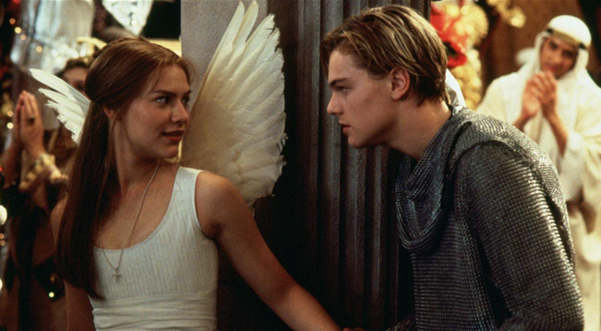
When Juliet speaks these words, she’s arguing that a name doesn’t change the essence of a person. But her line also points to something deeper: the way we attach meaning to words, images, and symbols. A rose isn’t just a flower, it is a symbol that often represents ‘beauty’; however that meaning can be subverted, layered, or expanded. Here are just a few examples of how roses have been used as symbols in films in a variety of ways;


So we can see that symbols are much more than simply inserting an image or icon to stand in for an idea; symbols can be complex. They can change in meaning, they can be used sincerely, ironically, or comically. They can mean one thing at the beginning of a story and another thing at the end. They can guide the audiences' expectations, or they can subvert them.
To really get to know how symbols are used in flim, we should first examine some of the important ways that theorists have approached this study.
Semiotic Approaches:
Icon, Index, Symbol
Sign, Signifier, Signified
Denotation & Connotation
Icon, Index, Symbol
Charles Sanders Peirce devised a framework for semiotics that that included three distinct kinds of signs, depending on how they relate to what they represent: icons, indexes, and symbols.
These categories help us understand how meaning is created in different ways; both through resemblance or words, as well as physical traces, emotional cues, and cultural codes.
| Type | Relationship to Meaning | Example |
| Icon | An Icon resembles the thing or idea it is referring to. | Restroom signs 🚻 (man/woman silhouettes) |
| Index | An Index has a real world connection to the thing it is referring to. | A footprint suggests that someone has been here. |
| Symbol | A symbol has an arbitrary cultural meaning that has no connection to the thing it is referring to. | A peace sign or dove to represent peace. |
Let's look at an example to help us understand the difference:
Example
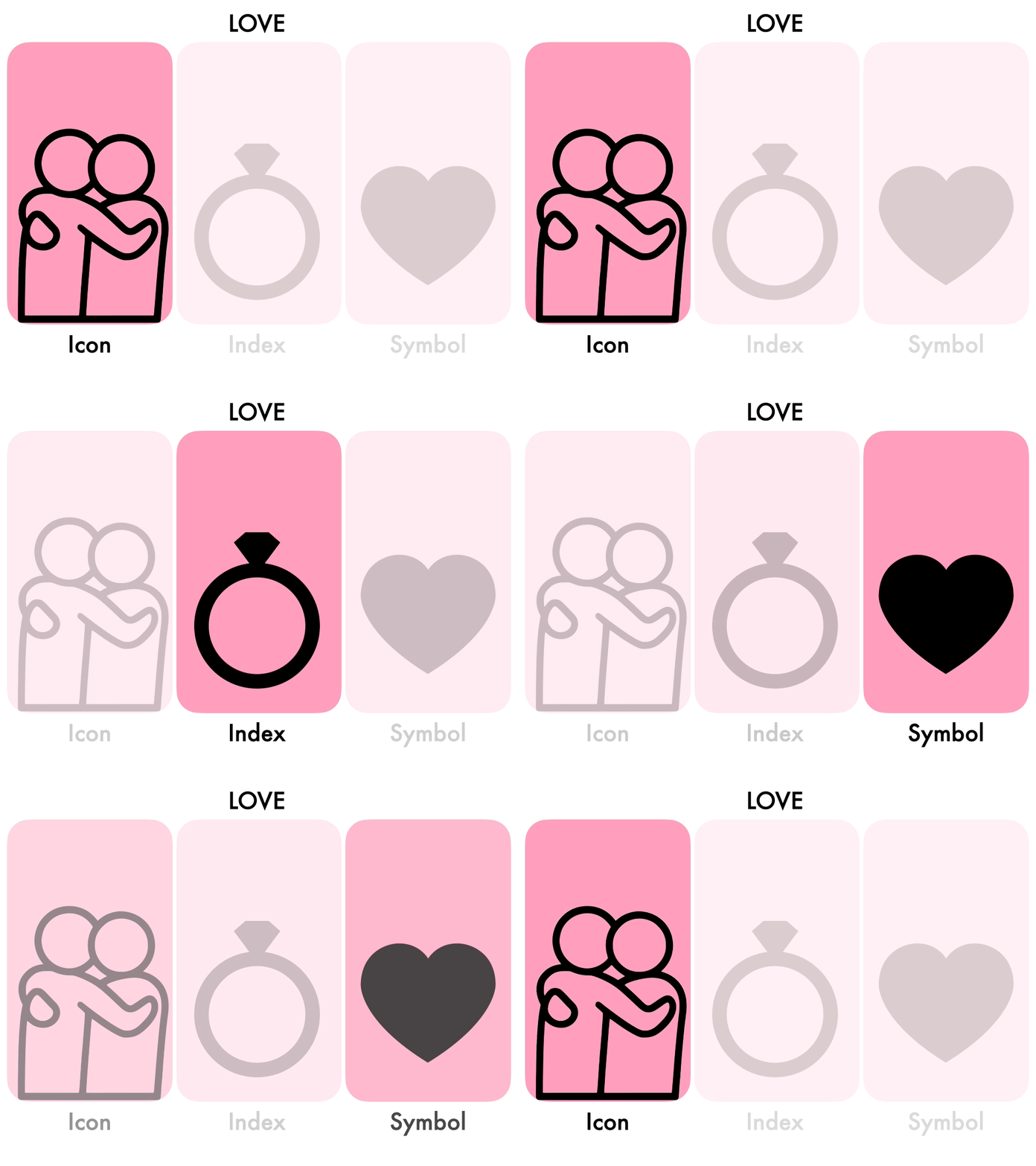
Let's look at the idea of ‘love’ through Peirce's semiotic lens. Each of the images at left can be a representation of love, but each represents love in a different way.
Icon: The icon of two people embracing can be recognized to show a sense of intimacy, and thus refers directly to the idea of ‘love’.
Index: The wedding ring has a real life connection to love.
Symbol: The symbol of a heart has no real connection to love (or even to a real heart) in any way besides the cultural understanding of its meaning.
Sign = Signifier + Signified
Ferdinand de Saussure was a Swiss linguist who is known as the ‘father’ of Semiotics. He proposed that a symbol, or a “sign” is made up of Signifier and a Signified.
| Type | Relationship to Meaning |
| Sign | The sign is the combination of the signifier and signified. It’s the complete unit of meaning. |
| Signifier | The form or physical representation of the sign. |
| Signified | The concept or mental image that is established by the sign and signifier. |

Example
The concept or ‘sign’ of dog is made up by the signifier and the signified.
Signifier
The signifier is the form or physical representation of the sign (for example, a word, an image, or a sound). In the diagram, there are two examples of signifiers:
- The word “DOG” – a linguistic signifier
- A silhouette of a dog – a visual signifier
Both of these are forms that point to a shared meaning in our minds. The word ‘dog’ has no real world connection to the actual animal anymore than the word ‘pero’ (spanish) or 狗 (Chinese). It becomes the signifier because that's the common name we've ascribed to this animal.
Signified
This is the concept or mental image that comes to mind when we encounter the signifier. It is not the thing itself.
In the diagram, the signified is shown with a photo of a real dog, representing the idea or concept of a “dog” that we all understand; even though the specific image may vary from person to person.
It’s important to note: the signified is not the actual animal, but our understanding of what a “dog” is; a furry, four-legged companion, usually friendly, often a pet. In this case, it is my dog. You may tape a photo of your dog over mine on the screen so that this image reflects your understanding of ‘dog’ (note that when you scroll you will have to remove the photo).
Sign
The sign is the combination of the signifier and signified. It’s the complete unit of meaning. So, the sign isn’t the actual dog itself, it’s the way we connect a word or image to the idea of a dog in our minds.
Saussure's key idea is that the real-world dog doesn’t matter to the sign; what matters is the mental concept and the sign system that makes communication possible.
Connotated & Denotated
Roland Barthes was a French theorist, philosopher, and literary critic who believed that signs don’t just have one fixed meaning. In his modle, signs carry layers of meaning shaped by culture, context, and emotion. He introduced the idea of denotation (the literal meaning) and connotation (the suggested or symbolic meaning).
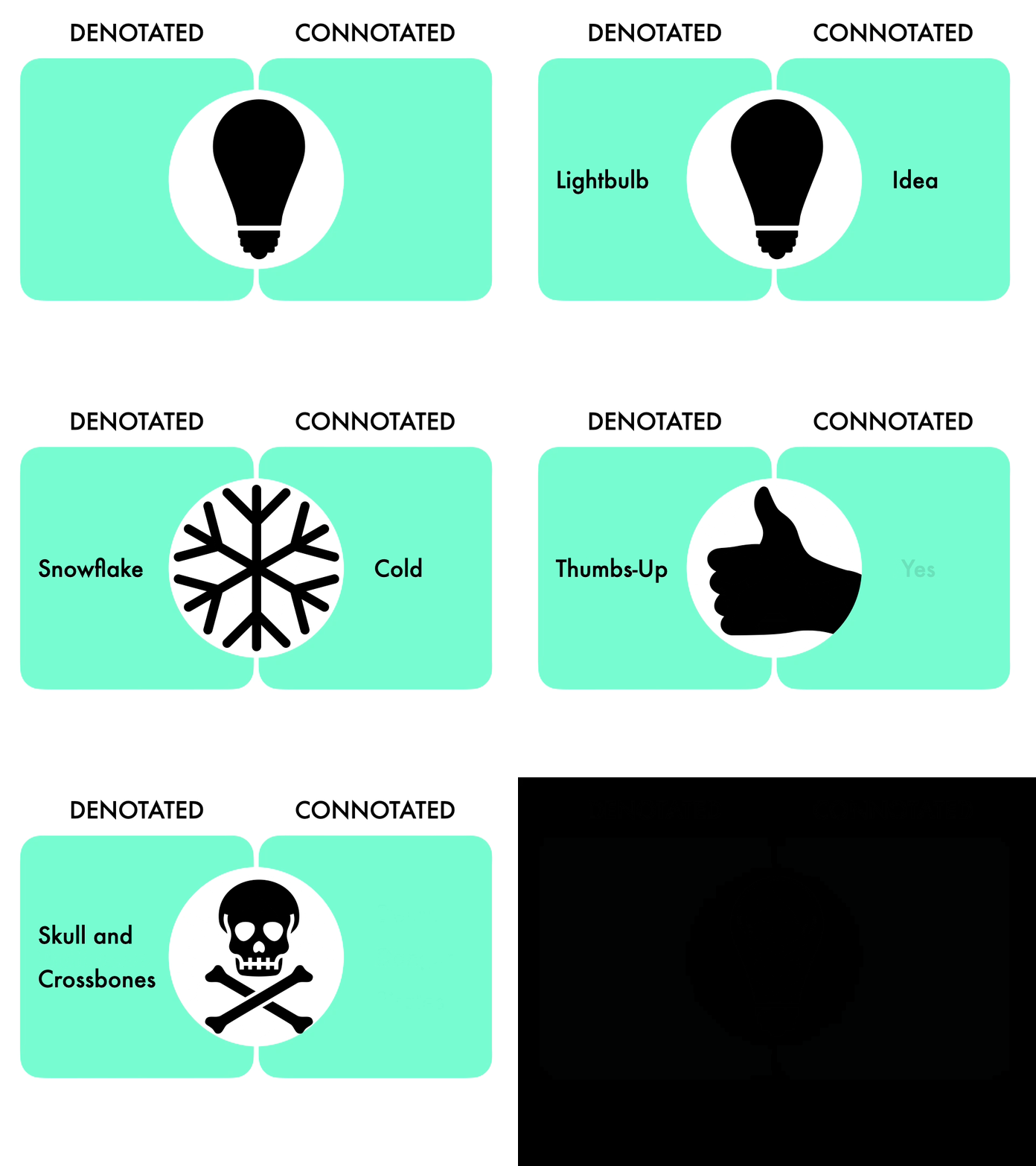
| Denotation | The literal meaning of a symbol. |
| Connotation | The culturally understood meaning of the symbol |
Applying Understanding
For the following activity, you might use this as an opportunity for a class discussion using the video below, or have the students independently respond using the written task.
Students may notice some of the following in their responses, although there will be other applicable ideas as well:
| Type | Example | Signifier / Denotated (What we see) | Signified / Connated (What it means) |
|---|---|---|---|
| Icon | Dictator’s face | A stern, oversized man’s face on a giant screen | Authoritarian power, surveillance, control |
| Marching workers | Rows of expressionless people in grey uniforms | Dehumanized masses, loss of individuality | |
| The woman running | Athletic, real person with hammer | Human energy, urgency, defiance | |
| Industrial setting | Concrete walls, tunnels, metal | Coldness, oppression, dystopia | |
| Index | Explosion of the screen | Screen shattering as hammer hits | Evidence of rebellion, collapse of control |
| Sledgehammer in motion | Heavy object being hurled toward the screen | Imminent disruption, resistance | |
| Sweat, breath of the runner | Visible physical exertion | Urgency, emotional intensity, being alive (vs. robotic workers) | |
| Audiences’ reaction to explosion | Blank faces shocked by the screen’s destruction | Index of a power shift or awakening | |
| Symbol | Apple logo at the end | Stylized bitten apple | Innovation, creativity, freedom |
| The date “1984” and Orwell reference | Text onscreen: “1984 won’t be like 1984” | Cultural allusion to dystopia and the promise of change | |
| Hammer | A Tool | Resistance, rebellion, breaking systems | |
| Red shorts and white tank (on woman) | Distinct color vs. grey environment | Individuality, hope, boldness |
Select a symbol in this film, it may be an aspect of mise-en-scéne, an action, a sound... anything. Explain its denotated meaning and conotated meaning, or as signifier vs. signified.
If we look at this through Pierce's framework, would we identify that as an Icon,Index, or Symbol? Why?
Discuss how this commercial uses multiple symbols in ways that create meaning togehter?
Here students might, for example, discuss the hammer and screen with the authoritarian figure as two distinct symbols; the explosion when the screen is hit by the hammer creates a third symbol. They might also address the runner and the hammer, the drab colors and the mindless people, etc.