Dialogue

"Dialogue is the easiest thing to write and the hardest thing to get right."
Elmore Leonard
Writing good dialogue is often considered one of the most challenging tasks for IB Film students to conquer; and for good reason. Good dialogue doesn't just communicate information; it captures nuances of the characters' personality or leaves room for the actor to discover nonverbal cues that compliment their words. It can convey deeper meanings or even articulate the opposite of what is meant.
Awkward or inauthentic sounding dialogue can pull the audience out of the story. It can be hard to find the right notes; dialogue can be too direct, or not direct enough. In some cases, the rhythm and cadence of dialogue must be carefully calibrated to match the tone and pace of the scene, in other cases rhythmic dialogue will sound too planned. It's no wonder that even the most seasoned writers struggle to craft dialogue that feels both authentic and effective.
However, with purpose and an understanding of the different types and layers of dialogue, you can find a great deal of success in both analyzing and crafting your own dialogue.
Writing Advice from David Mamet
All “Quicker Flickers” contain AI generated video & images. All scripts are human generated.
Layers: Text, Subtext, Context
Whether you are writing or analyzing dialogue, it is important to be aware of the differences between the text, the subtext, and the context.
Text:
The text refers to the literal words spoken by characters in a dialogue. It's the surface-level meaning of what's being said, without any underlying implications or hidden meanings. The text is often the most obvious aspect of dialogue, but it's only one part of the equation.
Subtext:
The subtext is the underlying emotional or psychological meaning behind the words spoken. It's the unspoken motivation, desire, or intention that drives a character's dialogue. Subtext can reveal a character's true feelings, desires, or conflicts, even if they're not explicitly stated. Subtext can be conveyed through tone, body language, facial expressions, and even the words themselves.
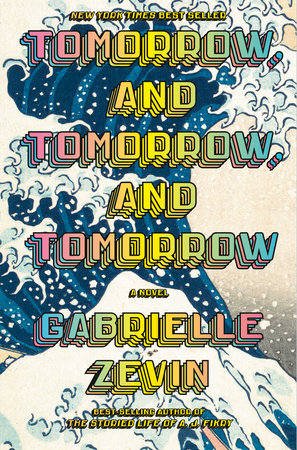 | In the book Tomorrow and Tomorrow and Tomorrow (2022) by Gabrielle Zevin, there is an excellent passage that describes how someone might think about subtext in their own life; That is to say, Sam Masur at age twenty-one did not have a build for pushing and shoving and so, as much as possible, he weaved through the crowd, feeling somewhat like the doomed amphibian from the video game Frogger. He found himself uttering a series of “excuse me”s that he did not mean. A truly magnificent thing about the way the brain was coded, Sam thought, was that it could say “Excuse me” while meaning “Screw you.” Unless they were unreliable or clearly established as lunatics or scoundrels, characters in novels, movies, and games were meant to be taken at face value—the totality of what they did or what they said. But people—the ordinary, the decent and basically honest—couldn’t get through the day without that one indispensable bit of programming that allowed you to say one thing and mean, feel, even do, another. |
Context:
The context refers to the surrounding circumstances, environment, and relationships that influence the dialogue. It's the external framework that shapes the meaning and interpretation of the text and subtext.
Dialogue
The video above is a snippet that comes from this longer, but very worthwhile video about dialogue. It is worth looking at as we move forward:
Examples
Example: No Country for Old Men (2007)
In this classic scene, the villain Anton Chigurh presents the owner of a gas station with a life-or-death choice in the form of a simple coin flip.
From what we can see in this example, we can clearly identify the text, the subtext, and the context:
Text: Chigurh asks the attendant about his life and asks him to flip a coin.
Subtext: There are two clear examples of subtext in Chigurh's end of the conversation. First, he is clearly passing judgment on this man's simple life, and second, he is threatening that life with a coin flip. Through these two aspects of subtext we can read a third; that this coin toss will also give this man's 'humble' existence greater meaning.
Context: We know at this point in the film that Chigurh is a cold blooded killer and a nihilist. This conversation happens in the middle of the desert where he can clearly kill this man without anyone noticing. The location and the prior knowledge create the context that adds tension to the scene.
Dialogue Types: Formalism vs. Realism
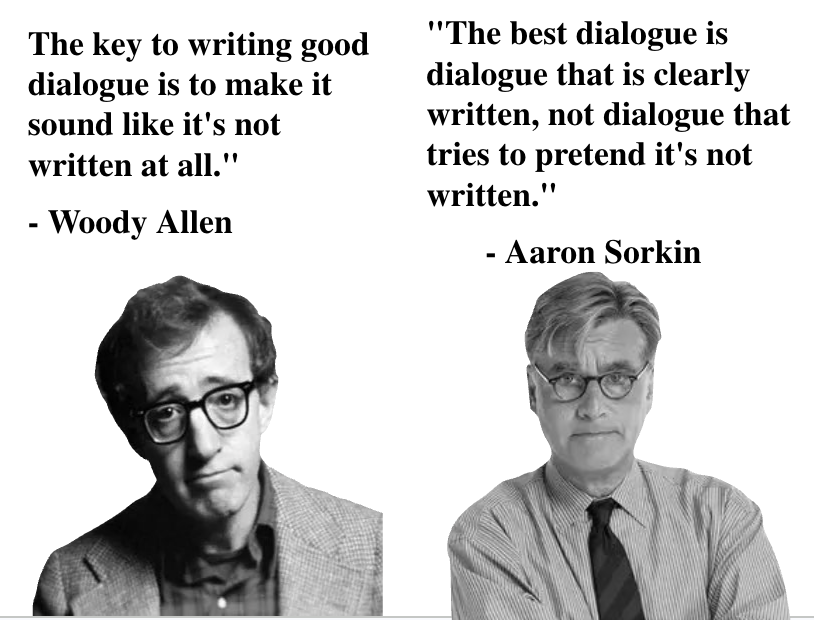
Is there one right way of writing dialogue? According to Woody Allen, good dialogue sounds like it is completely natural. According to Aaron Sorkin, dialogue shouldn't pretend that it's natural. So who is right? These two disparate approaches mirror the tension between formalism and realism that is faced in many aspects of filmmaking (and discussed in more detail on the page about verisimilitude).
What do you notice about the dialogue in Caleb Slain's Free Pie?
One thing you will notice about more formalist dialogue is the characters seem to have an almost lyrical banter, and that replies are almost always clever to the point where they seem planned. Contrast this with Noah Baumbach's more realist approach- sometimes it seems as if the characters aren't even aware of what others are saying. Notice how both characters in Marriage Story both lose the thread of the conversation and the subtext of the dialogue devolves into nothing but rage (language warning):
Baumbach is known for his very realist dialogue; his characters are often inarticulate, they cut each other off, they respond to the wrong things, they often don't even listen to each other. Each character has their own nuance of speaking that often compliments or conflicts with how they communicate with the people around them. Evan Puschak explores these interactions with great detail in the following Nerdwriter video essay:
Some important takeaways from this video that you might want to discuss with the class;
- There is a big difference in most cases between how characters talk on TV & movies and the way people talk in real life.
- Baumbach's writing is often considered much more 'realistic' because of the way his characters respond and interact with each other.
- Non-verbal cues are critical to supporting, or undercutting, what is actually said.
- Baumbach uses dialogue to illustrate our imperfect attempts to communicate with each other. This, according to Puschak is part of the beauty of the human condition.
Classicism: The Middle Path
Most of the time, writing doesn't feel real to the extent that characters do in a Noah Baumbach film, nor do they feel so constructed as they might in Free Pie, an Aaron Sorkin film or a Wes Anderson film. In the middle of those extremes is 'classicism'; dialogue that is clearly constructed but also natural. Dialogue written in this style sounds as if people, sometimes, know the right thing to say at the right time. I think Ted Lasso often does this well;
What aspects of the dialogue (as well as ted's monologue) feel more genuine? Which feel more constructed?
As you can see in the above examples, dialogue is an essential part of communicating meaning...
...Except When More is Said with Silence
There is a tendency to underestimate the power of what we can do without words. Sometimes you can make a scene even more powerful and precise without dialogue.
Mads Mikkelsen
Consider the opening montage of Pixar's Up (2009), this sequence tells you everything you need to know about the evolving relationship between Carl and Ellie as they navigate married life.
These heartwarming, heartbreaking, and bittersweet moments across the decades of their marriage exist without a single word of dialogue spoken. Indeed, we can imagine that any dialogue here might lesson the emotional impact of the screen.
Often, when we forsake dialogue, we can challenge ourselves to rely on alternative storytelling techniques such as using a variety of other film elements as symbolism. This forces us to think creatively and express ideas through visual and aural cues - fostering a deeper understanding of the art of filmmaking.
Of course, this is not only an all or nothing proposition. Consider how many TV shows and films you've watched in which a scene of multiple characters involved in a conversation, but it cuts away when a character is asked a probing question or having just received new information. In these moments we have to imagine what the character might say in response. This is often more effective than having them say what we already expect to hear.
Often a character's silence says more than a spoken response. Thoughtful silences or pauses; the absence of dialogue, these are also important choices for a screenwriter.
"I think people remember pictures, not dialogue. That's why I like pictures".
David Lean
Sound can magnify emotions, build tension, or suggest intimacy; but so can silence. In those moments in which you intentionally avoid dialogue you allow the audience to focus on the characters' facial expressions, body language, even a subtle blink or tick of the eye; all of which can evoke a more profound emotional response. Silence can be ambiguous, leaving room for personal interpretation and enhancing the audience engagement with the film.
Here's some advice along these lines from film teacher Mike Oomens:
As a former screenwriter I tell my students to leave the dialogue out of the first draft of their screenplay. This focuses them on show don’t tell. “How will you show us the protagonist is scared?” We then might workshop the script and add a line or two where we feel something MUST be said for the scene to work. Often this is a line that goes to the theme of the film. Often students prefer the version without dialogue as they are in the groove with thinking of ways to show the drama in other ways. This improves the strength of other roles, including sound which is often neglected as too hard.
Check for Understanding
Why does Noah Baumbach’s dialogue feels realistic?
Which of the following best describes formalist writing?
What is meant by “classicism” in dialogue writing?