FT Blog: A $1trillion pay deal for Elon Musk
Financial Times article

Elon Musk celebrates $1tn Tesla pay vote victory
This blog is based on the article published by the Financial Times on 7 November 2025:
The link for the article is: https://www.ft.com/content/42dc4aef-f1e2-4381-ab81-fcd3d2f18e6e
This article is part of the Financial Times free schools access programme. Details/registration here.
The theme of this Financial Times article is income inequality. It focuses on the $1 trillion pay package that Tesla shareholders have agreed to pay the company's CEO, Elon Musk.
Some current wealth and income statistics:
- In 2025, the world's 3,028 billionaires have a combined wealth of $16.1 trillion. This is a similar value to the world's second-largest economy, China.
- The richest 1% of the world's population accounts for 43% of the value of all global financial assets.
- The bottom 50% of the world's population owns just 2% of the value of all global financial assets.
- If Elon Musk achieved an asset value of $1 trillion, it would make his wealth the equivalent of the 20th largest economy in the world (above Belgium, Taiwan and Argentina).
- The US Gini coefficient has increased from 0.43 in 1990 to 0.49 in 2024
a. Outline the difference between Elon Musk's income and wealth. [2]
b. Outline what Elon Musk has to achieve in terms of the value of Tesla to receive his $1trillion income payment. [2]
c. Using a diagram, explain how the Lorenz curve shows income inequality in a country. [4]
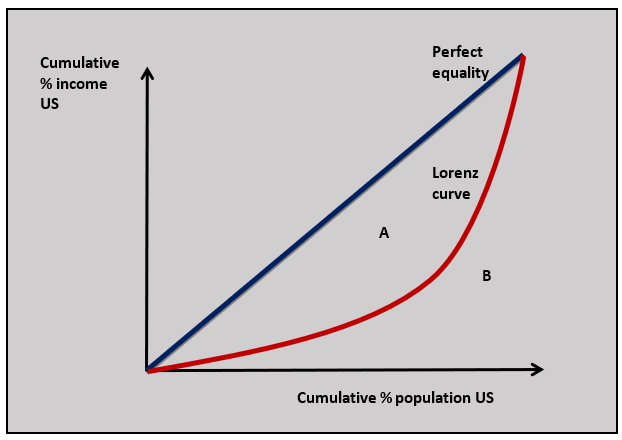
d. Explain how the Gini coefficient can be used to measure income inequality. [4]
e. Explain two factors that lead to income inequality in the US. [4]
- Low-income households in the US own very little or no capital at all. This means their only source of income is from low-paid work. High-income households in the US, on the other hand, often own assets and are holders of wealth.
- High-income individuals in the US often work in high-skilled jobs, which earn them a high income. Low-income individuals often work in low-skilled jobs, which earn them a low income.
f. Explain two negative consequences of income inequality in the US. [4]
- Wide income inequality creates a sense of unfairness in US society, and this can lead to an increase in crime and social unrest.
- A high level of income can adversely affect US economic growth because low-income households do not have the income to fund effective education and healthcare, which reduces the US's growth in potential output.
g. Explain two benefits of paying someone like Elon Musk, such as a large potential income. [4]
- Paying Elon Musk a high income means a high incentive for him to grow his businesses, which will create jobs in the US.
- The high potential income offered to Elon Musk gives him the incentive to innovate in his businesses and develop new products.