The subject report and errors in the exam papers
This blog stresses the importance of the chemistry subject reports. It focuses particularly on the recommendations and guidance for teaching future students and why this is also important to those setting, marking, checking and proof reading the examination papers.
Subject reports are also relevant to those writing the exam papers
Why the subject reports are important to both teachers and examiners
The chemistry subject reports for the May 2025 examination session have been available on My IB for the past few weeks. I encourage all teachers to read them as they offer useful advice for teaching your future students. They also give feedback on some of the comments teachers made and the performance of students on individual questions. The subject report covers all of the papers taken in the three different time zones, TZ1, TZ2 and TZ3 and also covers the IA which is common to all three zones. Many of you will use these questions for your mock exams. It is worth noting that the papers you can purchase are not exactly the same as the papers actually sat by your students last May as some (but not all) of the mistakes in the papers have been rectified resulting in some changes, so be careful as to which papers you use.
In recent years there have been a number of errors in the examination papers. Teachers and examiners need to make sure they adhere to the standards they are asking of the students. At the end of each paper there is a section titled 'Recommendations and guidance for the teaching of future students'. With my tongue somewhat in my cheek I suggest that this should actually be titled 'Recommendations and guidance for the teaching of future students and for the setting, checking and proof reading of exams'.
Below are some examples to illustrate the point I am making.
May 2025 Examination Papers and report
1. The first point in the recommendations and guidance list in the chemistry subject report for May TZ2 HLP2 is:
"Ions must be written as Xn+/- and oxidation states as X+/- n"
Question 6 on the May 2025 TZ2 HLP1 (section A) exam asked students to identify the charge on the monatomic ion formed by the element with the electron configuration [Ar]4s23d104p3. The four responses (A to D) were 3–, 2+, 3+ and 5+.
The subject report states
"58% of the students chose a charge of -3 applying the rationale for N and P. However, 29% favored +3 probably in due consideration the element is a metalloid. The data booklet accepts both values, as a teacher well observed, and hence, the decision was made to remove this question."
This question should not have been asked in the first place as the data booklet wrongly shows only a 5+ ion for P and both a 3+ and 5+ ion for As. P has an oxidation state of +5 in PF5 but 5+ ions can never exist in phosphorus or arsenic compounds as the high charge density results in covalent bonding (see my earlier blog on this). The two values given in the IB data booklet for arsenic are actually 3+ and 5+, not –3 and +3 as stated in the report which has not only confused the numbers but also written them as oxidation states not charges. Be careful if you use this question in your mock exams as the purchased paper has the question changed. It now asks students to identify the charge on the monatomic ion formed by the element with the electron configuration [He]2s22p3.
The same question also appeared as Question 6 on the SL paper and the subject report comment for the SL paper is clearer (although it still ignores the fact that the data booklet also gives 5+ for arsenic). It states:
“Question 6 was removed because it contained alternative answers and could have caused confusion. Students could have selected A, based on the electron configuration, or C, based on the charge of the arsenic ion given in the data booklet.”
2. The second point in the recommendations and guidance list for May TZ2 HLP2 is:
"Rate always includes the mention of time"
Question 27 on May 2025 TZ2 HLP1 (section A) asked students what the overall order is for the reaction 2NO(g) + Cl2(g) ⟶ 2NOCl(g) and gave the following table:
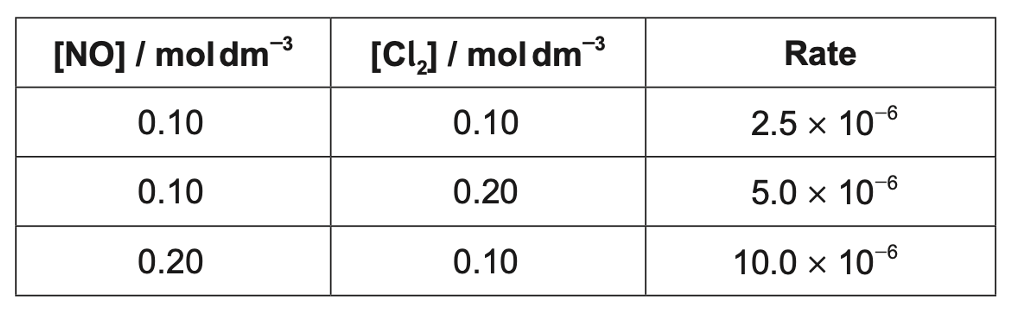
There are two serious errors in this table. Rate has no mention of time (nor of concentration), i.e. the units mol dm-3 s-1 have been omitted, and it should state "Initial rate" not just "Rate".
The report states:
"66 % of students efficiently solved this problem on Reactivity 2.2.10. 21% of students incorrectly chose the second order."
These errors do not appear to have been picked up or acknowledged as there is no mention of them in the subject report and the question has not been altered in the purchased exam paper.
3. The third point in the recommendations and guidance list for May TZ2 HLP2 is:
"Check units: this is the most common mistake in calculations involving entropy, enthalpy and ∆G."
Question 3a(v) on the May 2025 TZ2 HL P2 exam sat by students asks them to calculate the standard entropy change, ΔS⦵, of the reaction between carbon monoxide and chlorine to form phosgene. Students were told to use section 13 of the data booklet and the following data:
Standard entropy change, ΔS⦵, of chlorine = 223 J mol-1 K-1
Standard entropy change, ΔS⦵, of phosgene = 284 J mol-1 K-1
This is an error as entropy change has been used instead of just entropy. Unlike enthalpy, where only a change in enthalpy can be measured, pure substances like chlorine and phosgene have their own measurable entropy values. It should read:
Standard entropy, S⦵, of chlorine = 223 J mol-1 K-1
Standard entropy, S⦵, of phosgene = 284 J mol-1 K-1
The question continues on to question (vi) which asks whether the reaction would go to completion or reach equilibrium at 298 K and then states: “If you did not get an answer to a(v) use - 150 mol-1 K-1”. This statement omits the J in the units for the entropy change.
Both questions 3a(v) and 3a(vi) have been corrected in the purchased version.
The report again makes no mention of the errors or that the question has been corrected.
"3a(v): this question was one of the best answered in the exam.
3a(vi): calculation of ∆G and K were found to be a challenge due to not using consistent units. Moreover, most students stopped at calculation of ∆G and not K, and thus were unable to predict the extent of reaction, explaining why most students only got 1/3 marks in this question."
There are other errors too on the 2025 May papers. Most of them are relatively trivial, i.e. mixing up italics and non-italics for the same constant in a question. For example, M2025 TZ1 HL Paper 1 (section A) Qu. 31 where T and k on the axes of the graph are not in italics but they are in italics in the expression given below the graph. However some of the errors are more serious. Two questions had to be removed from the May 2025 TZ3 HL Paper 1 (section A) and one from each of the TZ2 and TZ3 HL Papers 1 (section A) all due to errors in the questions.
Another serious error occurred in Question 9(b) (ii) on the May 2025 TZ3 HL P2 paper. It asked students to calculate the enthalpy change for the combustion of ethanol using section 12 of the data booklet and giving the equation C2H5OH(l) + 3O2(g) ⟶ 2CO2(g) + 3H2O(g).
This question is impossible to answer as the enthalpy change of state for changing liquid ethanol into gaseous ethanol is not given in the data booklet.
The markscheme breaks down the calculation assuming all the bonds are in the gaseous state and arrives at the correct (sic) answer which is of course not correct. The question remains unaltered in the purchased exam paper. The subject report still talks about obtaining full marks for the “correct” answer for the combustion with ethanol in the liquid state:
"(b)(ii) Students approached the question correctly, with about 40% obtaining full marks. Unfortunately, the rest of the students made many errors in counting all bonds for reactants and products, and identifying double bonds. Some also subtracted the values the wrong way around. Unfortunately, the state symbol of ethanol was liquid in the equation but it was not noticed by the students."
Examples which warn students about this common error are given on this website (e.g. see the video on the page on Learning to think critically) and I'm sure many teachers hammer home the point about all reactants and products must be in the gaseous state if the only data to be used is average bond enthalpies. What would have happened if a student had simply written "this question is impossible to answer as the enthalpy change for the vaporization of ethanol is not given"? - the markscheme should have taken this into account and awarded them full marks for this question straight away.
November 2025 Examination Papers
It would be nice to think that the November 2025 chemistry exams did not contain any similar errors. I haven't seen all the papers or gone through them carefully but there are still mistakes. The report has not yet been published. Here are just two of several errors that I (and others) have already spotted:
1. In Question 1 (c) on the N2025 TZ1 Paper 1 (section B) for both the SL and HL exams the burette scale is wrongly shown as there are only nine (not ten) divisions between the 10 and 11 cm3 and between the 22 and 23 cm3 graduations so students cannot easily determine the initial and final readings and the volume used accurately.
.png)
It is also worth noting that there are no units given for the volumes and the two sections of the burette shown should be open at the bottom so they can function as a burette.
2. Question 1(c) SL TZ1 Paper 2 starts with the statement:
"The Mr of the oxide formed in (b)(ii) was known to be 219.88 g mol-1".
Examiners should know that relative formula masses do not have units (see Structure 1.2.4).
Reflections
Two important points come out of this.
1. The IB is recognized as being academically rigorous and an acceptable qualification for entrance to universities worldwide. The standard of the examination papers needs to reflect this.
2. On a positive note, these errors in the examination papers provide an excellent resource to train your students in critical thinking. Give the suspect questions to your students and ask them to evaluate them critically - they can learn a lot from identifying the mistakes.