FT Blog: US adds 119,000 jobs in September but unemployment hits four-year peak
US adds 119,000 jobs in September but unemployment hits four-year peak
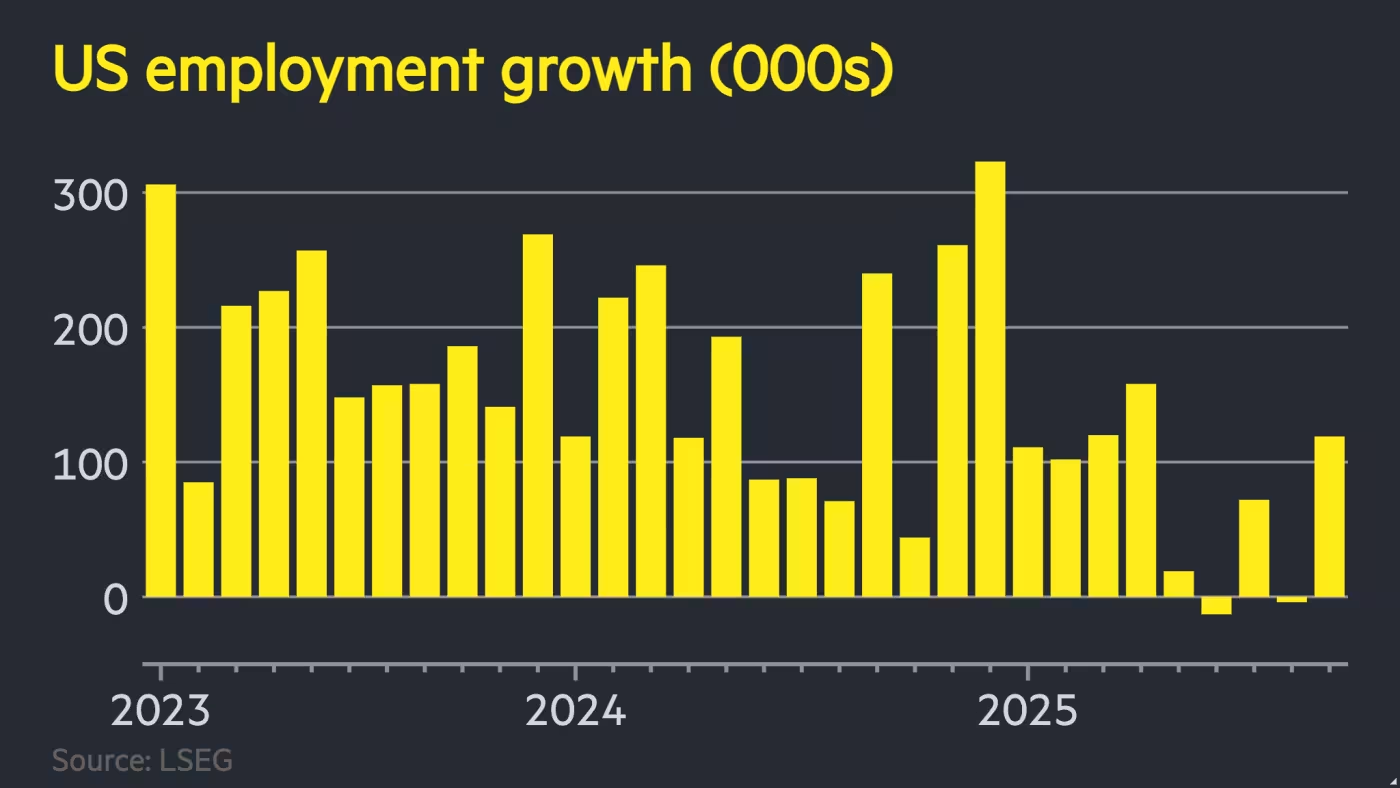
Figures complicate Fed decision on rates next month
This blog is based on the article published by the Financial Times on 20 November 2025:
The link for the article is: US adds 119,000 jobs in September but unemployment hits four-year peak
This article is part of the Financial Times free schools access programme. Details/registration here.
The theme of the Financial Times article is unemployment and monetary policy.
Some current statistics about monetary policy and unemployment:
USA's current rate of unemployment is 4.4%, the third lowest in the G7 behind Japan (2.56%) and Germany (3.41%)
The Federal reserve already has the highest central bank base rate at 4%, joint level with the UK
USA inflation rate of 3% is close to its target rate but the second highest in the G7, behind UK's 3.6%
Unemployment is measured by the Bureau of Labor Statistics
US President Donald Trump has long campaigned for the Fed to cut rates arguing that high interest rates act as a barrier to jobs and investment but the Federal Reserve is run independently and must consider a range of variables when making any decision to cut rates.
Questions:
a. Define the word unemployment identified in the article (line 1). [2]
b. Define the word inflation identified in the article (line 36). [2]
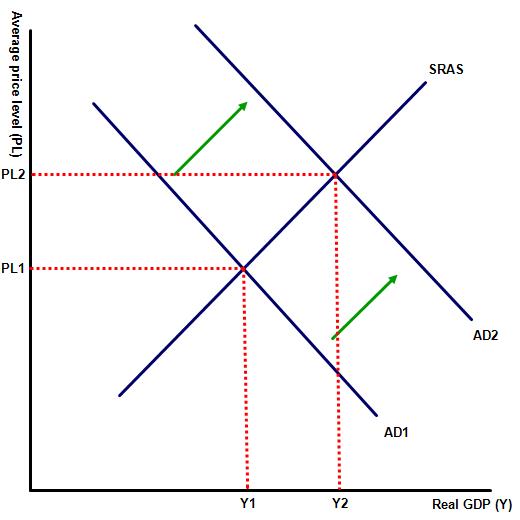
c. Sketch on an AD/AS diagram the effect of inflation resulting from low central bank interest rates. [1]
d. Explain two different macroeconomic factors that the Fed must consider when deciding whether to change the central bank interest rate. [4]
- the level of inflation, measured against target
- the level of unemployment
- current level of economic growth in the economy
- expectations for the above over the coming 6-12 months.
e. Using the information contained in the passage and your knowledge of economics, discuss the effectiveness of reducing interest rates in reducing unemployment. [15 marks]
In this example the command term discuss means offer a considered and balanced review of the various arguments both against and in favour of the statement that lower interest rates will be effective in lowering the unemployment rate, before reaching a conclusion as to which of these is the most convincing perspective.
Responses should include the following:
A definition of unemployment as well as central bank interest rate.
An explanation that expansionary monetary policy (lower interest rates) can be effective in raising the level of national income / economic growth by increasing both private consumption and investment. This in turn reduces cyclical
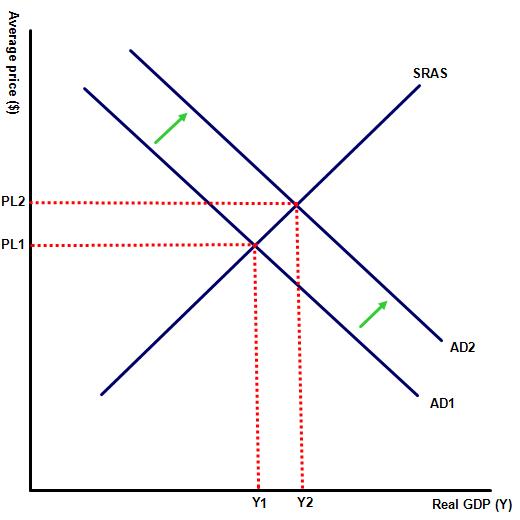
unemployment by increasing the demand for labour. Illustrated by diagram one, to the right, where the rise in real GDP is represented by Y1 − Y2.
An explanation of the relationship between lower interest rates and higher levels of AD/GDP. This might include an explanation that lower interest rates are likely to encourage private consumption and investment because the opportunity cost of saving is lowered. With many US households paying a mortgage and / or student loans and car finance, lower interest rates increase the disposable incomes of households, with the interest rate often impacted by the central bank interest rate. Lower interest rates for businesses is also likely to increase the rate of private investment, while saving is discouraged.
A discussion of the weaknesses of demand-side policies in reducing unemployment. For example, time-lags, inflationary pressure, higher levels of government debt, increased import levels or crowding out.
A recognition that another significant weakness of demand side policies is that they are only effective in reducing cyclical unemployment levels. Demand side measures are not effective, for example, in reducing levels of equilibrium unemployment.
A discussion of alternative policies that may be used to reduce unemployment, i.e. supply-side policies.
Examples of supply-side policies can may be used to reduce long term unemployment include measures to improve the nation's infrastructure, investments in human capital as well as increased spending on research and development.
A recognition that supply side measures, unlike demand side policies, are also effective in reducing structural unemployment rates.
.jpg)
An AD/AS diagram illustrating a right shift in the LRAS curve or an outward shift in the PPF curve, following an improvement to either the quantity and / or quality of the factors of production in the economy. Diagram 2 illustrates that following a rise in LRAS, real GDP rises to Y2 and unlike the use of demand side policies there is no rise in inflation.
A discussion of some of the disadvantages of governments using supply-side policies, e.g. time-lags and the costs associated with large scale investment and government training projects.
A recognition that supply-side policies aimed at increased labour market flexibility or a reduction in access to unemployment benefits may also come at a social cost in terms of a reduction in labour protection or employment security.
Responses should conclude with an evaluation of the above arguments in terms of short-term versus long-term consequences and the impact on other macroeconomic objectives.