FT blog: Legislation and regulation in monopoly
Financial Times article

Elliott’s litigation fund behind UK lawsuit against Rightmove
This blog is based on the article published by the Financial Times on : 17 November 2025
The link for the article is: https://www.ft.com/content/1d2c63f8-58ee-4777-b718-dac2b39e1a83
This article is part of the Financial Times free schools access programme. Details/registration here.
The theme of this Financial Times article is Rightmove's monopoly power in the online property sales market and how it might be controlled through legislation and regulation.
Background to Rightmove PLC:
- It is a UK-based company with an 80% market share of the UK real estate/property portal market.
- Users of the Rightmove website can view around 1 million UK residential properties advertised every month
- Its main customers are estate agents, letting agents, and developers, who pay a subscription fee to list their properties on the Rightmove website.
- Also earns revenue by selling property market data and reports to mortgage lenders, surveyors, and local government.
- Revenue 2024 £389.9 million (2024)
- Profit £192.7 million (2024)
Questions
a. Explain how barriers to entry might lead to abnormal profits in the online property viewing market in the long run and the short run [10]
A barrier to entry is a restriction and/or cost of setting up in a market that is over and above the normal cost and or restrictions of entering a market.
Abnormal profits occur when total revenue exceeds total costs, and a business is making more profit than the minimum needed to remain in the market.
Rightmove has an 80% market share in online property viewing, giving it significant monopoly power. To maintain its monopoly position, Rightmove’s market position is protected by barriers to entry. For example, it will have economies of scale, enabling it to operate at a lower average cost than any new entrant to the market. It also has a strong brand image, which keeps its existing users loyal to the Rightmove brand.
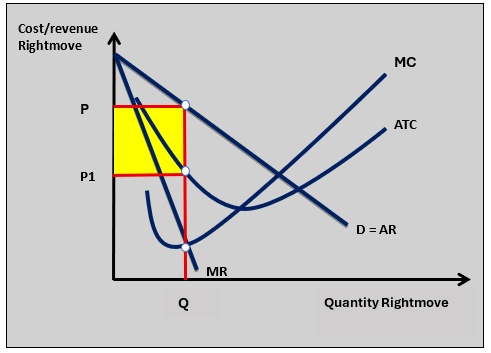
In the short run, when one factor of production is fixed, Rightmove will earn abnormal profit if the price it charges estate and letting agents exceeds its average costs. This is shown in the diagram, with the yellow-shaded area representing abnormal profit.
Rightmove can sustain this abnormal profit in the long run due to barriers to entry in the online property viewing market.
b. Using a real-world example, evaluate the use of legislation and regulation to regulate the online property viewing market to prevent Rightmove from exploiting its monopoly position in the market. [15]
A monopoly is where supply in a market comes from one producer. It is is also possible to describe a market as a monopoly when one firm accounts from a high market share. In this case, Rightmove has an 80% market share of the UK real estate/property portal market.
When a monopoly exists in a market, theory suggests the market will not achieve allocative efficiency and consumers will pay a price above marginal cost. This is shown in the diagram, where the price is at P above the allocatively efficient price, P*. The welfare loss from consumer surplus is the yellow area, and the welfare loss from producer surplus is the green area.
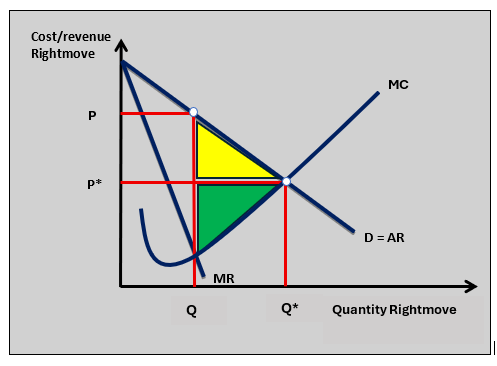
The loss of allocative efficiency in the UK real estate/property portal market has led the UK government to intervene through legislation and regulation. In the Rightmove example, the business's customers can take legal action against Rightmove for charging an excessive price for its services.
Legislation and regulation have the following advantages:
- Laws force monopoly businesses to behave in a way that does not exploit the consumer by charging a price higher than marginal cost. This is the case with Rightmove, for which specific customers are suing for charging an overly high price.
- The law is a relatively low-cost approach to controlling monopoly power. In the Rightmove case, the government incurs the cost of setting up a legal framework, which is lower than, for example, the cost of nationalising a monopoly.
- The law is a more flexible method of controlling monopoly power compared to other methods, such as taxes and nationalisation. In the Rightmove case, regulations targeting monopoly pricing can be explicitly aimed at anti-competitive behaviour, unlike a broader policy such as tax.
Evaluation: Legislation and regulation have the following disadvantages:
- The laws imposed on a business like Rightmove might reduce its efficiency and add to its costs, which could lead to higher prices for consumers.
- Laws take time and resources to formulate, and this could be an opportunity cost to the government. For example, the legal costs of the Rightmove court case for the UK government.
- Laws that affect decision-making and operations in a country's businesses could make them less competitive in international markets. This might not be as important in the Rightmove case, since most customers are in the UK.
- Overregulation in a country might make it less attractive to foreign investment. This could be the case for foreign investors in the property platform. A monopoly is a market in which the supply comes from a single producer. It is also possible to describe a market as a monopoly when one firm accounts for a high market share. In this case, Rightmove has an 80% market share of the UK real estate/property portal market.
Total [25]