FT Blog: The consequences of a tariff
School IB economics: Tariffs are a weaker weapon than Trump thinks
This blog is based on the article published by the Financial Times on 23 October 2025:
The link for the article is:
https://www.ft.com/content/d4489435-dea0-44c2-9dbf-c3a23dd5800a
This article is part of the Financial Times free schools access programme. Details/registration here.
The article is an opinion piece written by a senior research scholar at Columbia University’s Centre on Global Energy Policy. The article considers the impact of US government import tariffs imposed this year and examines their effects on stakeholders in the US economy and in countries trading with America.
These questions are based on the Financial Times article on tariffs and are IB-style questions.
a. Define the term import tariff. [2]
An import tariff is a tax levied on a good imported into a country from another country.
b. Explain two reasons why the US government might have imposed tariffs on imported goods into the US. [4]
Two reasons might include:
- To raise tariff revenue from goods imported into the US economy, which can be used to fund public services such as health and education.
- Tariffs on manufactured goods imposed by the US government could restrict imports into the US, which could protect domestic manufacturing businesses in the US and stop the deindustrialisation of the country.
c. One of India’s biggest exports to the US is packaged medicines. Using a tariff diagram, explain the impact of a 50% tariff imposed by the US government on India’s exports to the US would have on:
(i) The price and quantity of packaged medicines imported into the US. [4]
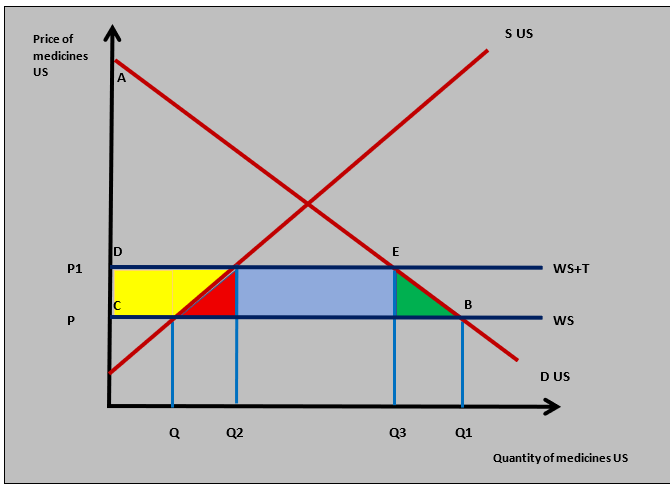
A 50% tariff imposed by the US government on packaged medicines would increase their price in the US economy from P to P1 in the diagram as the world supply from India shifts from WS to WS1. As the price increases, the US supply increases from Q to Q2, and the US quantity demanded decreases from Q1 to Q3. This leads to a decrease in the quantity imported of packaged medicaments from Q - Q1 to Q2 - Q3.
(ii) The US consumer and US producer surpluses in the packaged medicines market in the US. [4]
(iii) The tariff revenue the US government might receive as a result of the tariff on imported packaged medicine from India. [2]
(iv) Economic efficiency in the packaged medicine market in the US. [4]
The increase in the world price of packaged medicines in the US due to the US tariff will lead to a loss of efficiency in the US economy, as inefficient US packaged medicines producers are drawn into the market by the tariff. This is shown by the red shaded area in the diagram. There is also a welfare loss of consumer surplus as the price of packaged medicines increases, and no one gains the lost surplus, as US consumers no longer have this quantity of the goods. This is shown by the green shaded area in the diagram.
d. Using an aggregate demand and supply diagram, explain the impact of the tariff on goods imported into the US on the production costs of US producers. [4]
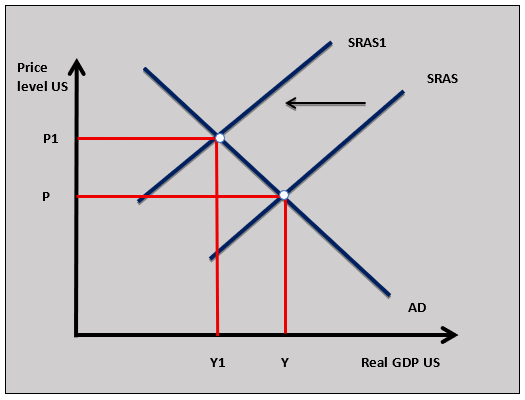
The tariffs on imported goods into the US economy could increase the production costs of US producers that use imported inputs. This will shift the SRAS curve in the US economy from SRAS to SRAS1, leading to an increase in the price level from P to P1 and a decrease in the real GDP from Y to Y1.
e. Explain the impact US tariffs on imported goods might have on the revenues of US exporters. [4]