DP Core
- What is the 'DP Core' and why is it important?
- Contains comprehensive information about ALL aspects of Chemistry Extended Essays.
- Detailed advice given to help you fulfil the role of an Extended Essay supervisor.
- Step by step help for you to give to your students from choosing and formulating the research question to writing and completing the Extended Essay.
- Many genuine examples given to show students how to achieve the maximum marks for each of the Extended Essay assessment criteria.
- Loads of resources to help schools, supervisors and students through every step of the Extended Essay process
- What is Theory of Knowledge and what does it have to do with Chemistry?
- Many examples of how language, sense perception, emotion, reason, imagination, faith, intuition and memory provide ways of knowing in Chemistry.
- Full details of a modern paradigm in Chemistry.
- Unpacking the Learner Profile
What is the IB Core?
Some time ago the IB replaced the old hexagon approach with the 'dart board' approach. However for chemists the delocalised benzene ring actually provides a better model to explain the holistic nature of the IB.
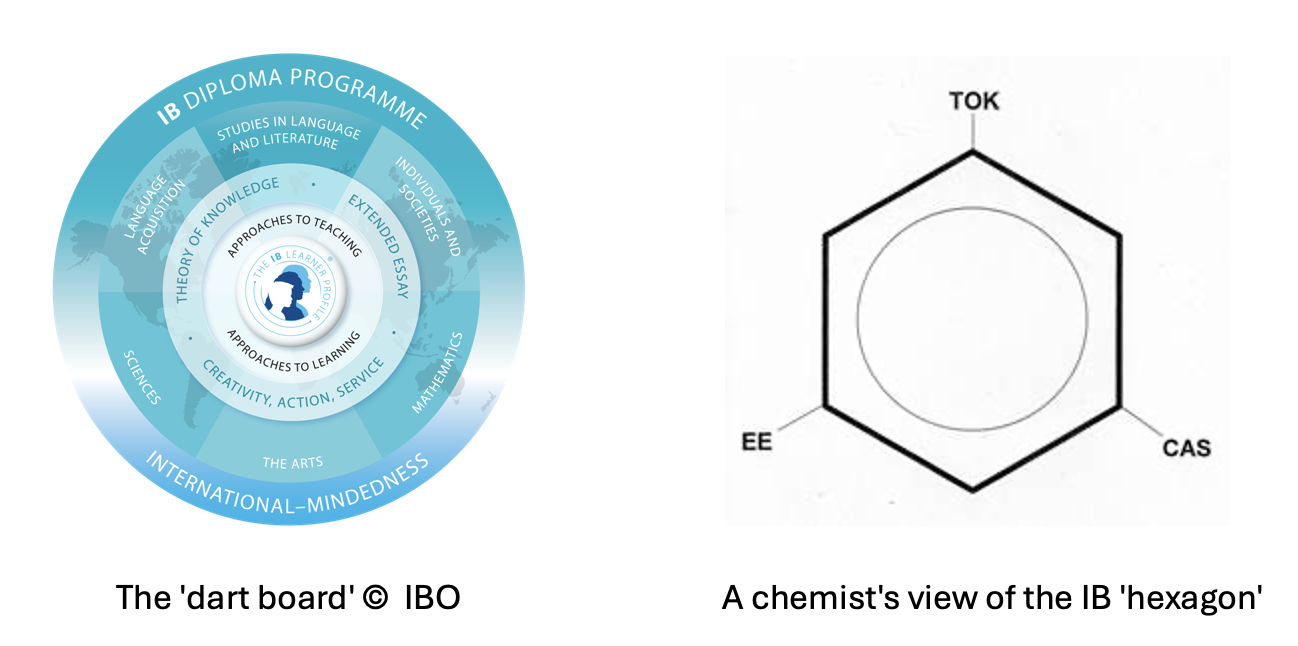
The IB core consists of Theory of Knowledge (TOK), the Extended Essay (EE) and Creativity, Activity, Service (CAS). In addition I've also included the Learner Profile in this section as it enshrines the basic aims of the overall IB programme.
It is a requirement of the IB Diploma that all three of the IB core components are included in the programme and the requisite number of hours spent on them. Students (and perhaps some teachers) may be tempted (wrongly in my view) to put slightly more emphasis on TOK and EE than on CAS (or the Learner Profile) as together TOK and EE are worth a maximum of three bonus points whereas no points are awarded for CAS.
This section looks separately at the Learner Profile, TOK and the EE. It takes a broad view then focuses on how TOK and the EE both relate specifically to Chemistry with many practical examples to help your students gain the maximum bonus points possible.

Training to be a lifeguard is just one of many ways in which IB students can fulfil their CAS requirement
Creativity, Activity, Service (CAS)
I believe very strongly that CAS is an important component of the IB. Part of the IB Mission Statement is that it aims to develop caring young people and it also aims to encourage students to become active and compassionate. What is the point of an IB education if it is not to produce students with these qualities? However, unlike TOK and the EE I do not see that CAS can generally be linked in any meaningful way specifically to IB chemistry. For this reason I have not included a separate section on CAS. This is despite the fact that the whole rationale of the United World College movement where I worked and was actively involved for nearly twenty seven years is to provide service to the community.
Learner Profile
This page gives the background to the IB Learner Profile. It lists the ten key attributes and explains that it sets the scene for lifelong learning. It also points out that rather similar ‘Learner profiles’...
Extended Essays (Last assessment 2026)
Note: This section on Extended Essays only applies to Extended Essays that will be submitted for assessment before the end of 2026. A separate new section - Extended Essays (first assessment 2027) - is...
Extended Essays (First assessment 2027)
This whole section looks at Extended Essays in general and then specifically on EEs that are either focused solely on chemistry or interdisciplinary EEs involving chemistry and one other subject. It covers...
Theory of Knowledge (TOK)
This section explains exactly what Theory of Knowledge is, how the course is structured and how it is assessed. It focuses on the 12 TOK concepts and then looks in particular at how TOK relates to chemistry...